



In high‑speed electronics, multi‑layer PCBs deliver greater density, better signal integrity, and stronger performance for complex applications. Yet their compact routing, tightly stacked layers, and high‑frequency signals also raise serious electromagnetic interference (EMI) risks. Uncontrolled EMI degrades signal quality, creates crosstalk, triggers system instability, and leads to failure in EMC compliance tests such as FCC, CE, or CISPR. Reducing EMI is not an optional extra—it is a core requirement for reliable, certifiable, and market‑ready designs.
This article presents practical, engineering‑proven methods to minimize EMI in multi‑layer PCB layouts, covering layer stacking, grounding, routing, filtering, shielding, and validation. By following these guidelines, you can build layouts that control radiation, contain noise, and maintain stable performance in real‑world electromagnetic environments.
Understand EMI Basics in Multi-Layer PCBs
Electromagnetic interference (EMI) describes unwanted electromagnetic energy that disrupts circuit operation. Electromagnetic compatibility (EMC) means a device functions properly in its environment without producing unacceptable interference to other equipment. In multi‑layer boards, EMI often arises from:
High‑speed signals with fast edge rates that generate strong high‑frequency harmonics
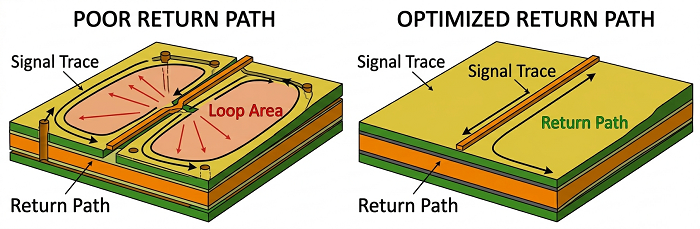
Large current loops formed by poor signal return paths
Crosstalk between closely spaced parallel traces
Unstable power distribution and noise on power rails
Improper grounding that creates radiating loops
Floating conductors, unused pins, or long cables that act as antennas
EMI propagates in two main ways: through radiation (air‑borne coupling) and conduction (along wires or cables). Effective EMI reduction targets both paths at the layout stage.
Optimize Layer Stack‑Up for Low EMI
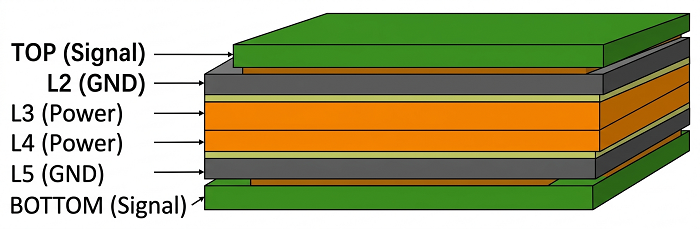
Layer stack‑up is the foundation of EMI control in multi‑layer PCBs. A well‑designed stack‑up shortens return paths, contains electric and magnetic fields, and reduces noise coupling between layers.
Use Continuous Reference Planes
Every signal layer should have an adjacent ground or power plane to provide a low‑inductance return path. This structure confines electromagnetic fields and drastically reduces radiation.
For a 4‑layer board, recommended stack‑up: Signal → GND → Power → Signal
For a 6‑layer board, recommended stack‑up: Signal → GND → Power → Power → GND → Signal
Solid, unbroken planes are far better than split or fragmented planes. Avoid gaps, slots, or excessive voids in ground and power layers, as these force return currents to detour and increase loop area.
Pair Power and Ground Planes Closely
Place power planes directly adjacent to ground planes with thin dielectric spacing—ideally less than 0.254 mm (10 mil). This forms a natural, high‑frequency decoupling capacitor that stabilizes voltage, lowers impedance, and suppresses noise across a broad frequency range.
Avoid Isolated Signal Layers
Never place a signal layer between two other signal layers without an intervening ground plane. Such “isolated” signal layers suffer severe crosstalk and poor field containment, raising EMI significantly.
Master Grounding Strategies
Grounding is the single most effective way to control EMI. Poor grounding creates loops, common‑impedance noise, and radiating structures.
Use Multi‑Point Grounding for High Frequencies
For circuits above 1 MHz, multi‑point grounding to a continuous ground plane is superior. It lowers impedance at high frequencies and prevents large ground loops. Low‑frequency circuits may use single‑point grounding to avoid circulating currents.
Add Ground Stitching Vias
Use multiple ground vias near signal vias that switch layers. These “stitching vias” maintain a continuous return path, prevent field leakage at layer transitions, and stabilize impedance. For high‑speed designs, keep ground via spacing below 12.7 mm (0.5 inch).
Eliminate Ground Loops
Design return paths to be short, direct, and overlap with signal paths. Large ground loops act as loop antennas that radiate strongly. Keep high‑speed traces and their return paths tightly coupled.
Control Routing to Minimize Crosstalk and Radiation
Trace routing directly affects EMI. Careful routing reduces coupling, shortens antennas, and preserves signal integrity.
Follow the 3W Rule
Maintain trace spacing of at least three times the trace width. This reduces capacitive and inductive crosstalk between adjacent traces. For noise‑sensitive or high‑speed signals, use wider spacing.
Route Critical Signals on Inner Layers
Route clocks, high‑speed data lanes, and noisy signals on inner layers sandwiched between ground planes. This stripline structure provides excellent shielding and contains EM fields.
Avoid Routing Near Board Edges
Traces near board edges radiate more strongly and are more vulnerable to external interference. Keep high‑speed traces at least one dielectric thickness away from the edge.
Use Differential Pairs
For critical high‑speed interfaces, use tightly coupled, length‑matched differential pairs. They cancel common‑mode noise, reduce radiation, and improve immunity.
Reduce Trace Length
Shorter traces mean smaller antennas and lower radiation. Minimize the length of clock lines, oscillator traces, and fast‑edge signals.
Use Decoupling and Filtering Effectively
Decoupling capacitors and EMI filters suppress noise at its source before it spreads across the board or radiates outward.
Place Decoupling Capacitors Close to ICs
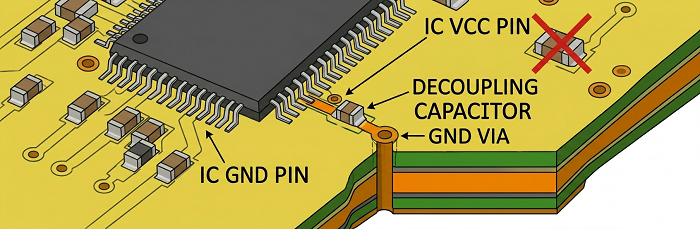
Mount high‑frequency capacitors (such as 0.1 μF) within 2.54 mm (100 mil) of IC power pins. Use short, wide traces or direct via connections to minimize parasitic inductance. Combine small capacitors for high frequencies and larger bulk capacitors for low‑frequency stabilization.
Apply Ferrite Beads and Filters
Place ferrite beads at power inputs to attenuate high‑frequency noise while passing DC. For I/O ports and power lines, add π‑filters or LC filters to block conducted EMI and prevent cables from becoming radiating antennas.
Shielding and Component Placement
Strategic shielding and component placement separate noise sources from sensitive circuits.
Separate Noisy and Sensitive Circuits
Place switching regulators, clocks, and RF circuits away from analog circuits, sensors, and low‑level receivers. Use ground planes or guard traces to create isolation barriers.
Use Component‑Level Shielding
Cover oscillators, RF modules, and switching circuits with metal shielding cans. Ensure shields connect securely to the ground plane with multiple vias to form a continuous Faraday cage.
Guard Rings and Ground Fills
Surround sensitive or noisy traces with grounded guard rings. Use ground copper pours on outer layers and stitch them to internal ground planes to enhance containment. Avoid floating copper fills—they can worsen EMI.
PCB Material Selection
Material properties influence high‑frequency performance and EMI.
Choose laminates with stable dielectric constant (Dk) to preserve impedance control.
Use thinner dielectrics between power and ground to increase capacitance and reduce noise.
For very high‑speed designs, consider low‑loss materials to reduce signal attenuation and radiation.
Validate EMI Performance
Even the best layout requires verification.
Perform pre‑compliance testing with near‑field probes to detect hotspots during prototyping.
Conduct formal EMC tests in accredited labs for radiated emissions, conducted emissions, and immunity.
Iterate the layout based on test results to fix resonance, radiation, or coupling issues.
Common Mistakes to Avoid
Ignoring signal return paths and allowing large loops
Splitting ground planes unnecessarily
Placing decoupling capacitors too far from ICs
Routing high‑speed signals parallel for long distances
Leaving unused pins, test points, or traces floating
Delaying EMI testing until the final design stage
Conclusion
Reducing EMI in multi‑layer PCB layouts requires systematic planning across stack‑up, grounding, routing, filtering, and shielding. When implemented early in the design cycle, these methods significantly improve EMC, reduce rework, and speed up certification.
For professional, high‑reliability multi‑layer PCBs built with EMI‑optimized design and manufacturing standards, choose a partner with deep experience in electromagnetic compatibility and high‑performance fabrication.
PCBCart specializes in advanced multi‑layer PCB manufacturing with full support for low‑EMI layout practices, high‑quality materials, and strict process control. Whether you are developing consumer electronics, industrial equipment, or high‑speed digital systems, PCBCart delivers boards that combine performance, reliability, and compliance. With PCBCart, you can turn your EMI‑optimized layout into a production‑ready PCB that performs consistently in real‑world environments.
Helpful Resources
• Ensuring First-Time Success in PCB EMC Design
• High-Speed Layout Tips
• Strategies to the Design of Crosstalk between Two Parallel Micro-strip Lines on PCB
• High-Speed PCB Design Challenges on Signal Integrity and Their Solutions


