



In electronic manufacturing, the "Rule of Ten" is unforgiving: a design flaw corrected at the schematic stage costs $1; at the prototype stage, $10; but if it hits the production line, it can escalate to $100 or more in rework and wasted materials.
For High-Mix, Low-Volume (HMLV) EMS projects, these risks are amplified. With complex BOMs and frequent setups, any minor oversight leads to costly downtime. At PCBCart, we bridge the gap between "working prototype" and "manufacturable product" through a rigorous 200-point Design for Manufacturing (DFM) inspection.
What is DFM in HMLV Manufacturing?
Design for Manufacturing (DFM) is the practice of designing PCB layouts to ease the manufacturing process, reduce costs, and ensure long-term reliability. In HMLV environments, DFM is critical because it prevents line-stoppages caused by component mismatches or soldering defects.
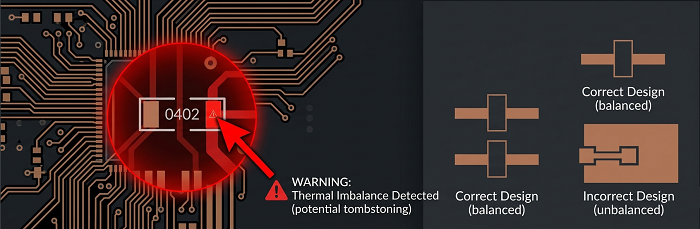
1. Pad Design: Preventing the "Tombstone" Effect
In HMLV production, aggressive miniaturization often leads to thermal imbalances.
The Issue: When one pad is connected to a large copper plane and the other to a thin trace, uneven heat distribution during reflow causes the component to stand upright—known as tombstoning.
PCBCart’s Solution: We analyze the thermal symmetry of every SMT pad. Our engineers recommend thermal relief or teardrop additions to ensure balanced solder tension, maintaining a high first-pass yield (FPY).
2. Optimized Panelization: Balancing Yield and Stress
Small-batch runs often struggle with material utilization. However, poor panel design can damage fragile components during de-paneling.
V-Score vs. Tab-Routing: While V-scoring saves space, it introduces mechanical stress. For boards with overhanging components or thin substrates, we suggest tab-routing.
PCBCart’s Edge: We customize panel layouts based on board thickness and assembly method. This ensures ±0.05mm placement accuracy and prevents substrate warping during high-temp reflow.
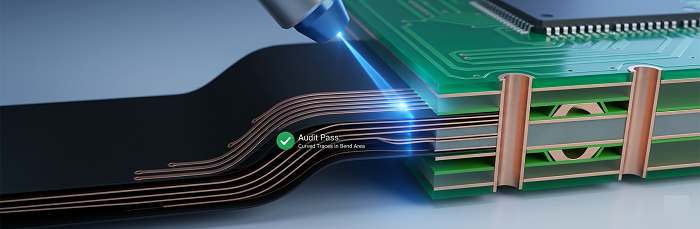
3. Specialized Checks for Complex HMLV Projects
As an IATF 16949-certified partner, PCBCart applies automotive-grade scrutiny to diverse industry projects:
HDI & Multilayer Precision: We audit aspect ratios for blind and buried vias to ensure reliable copper plating and prevent micro-cracks.
Rigid-Flex Integrity: For wearable and aerospace tech, we inspect the "bend area" for vias or 90-degree traces that could lead to fatigue failure. We advocate for curved traces to distribute mechanical stress.
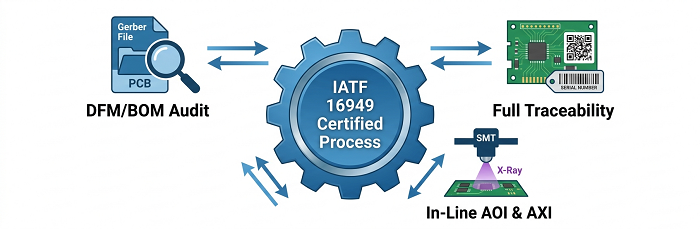
4. The Value of 200+ Inspection Points
Why is such an extensive checklist necessary for small batches?
Eliminate EQ Cycles: By identifying issues upfront, we reduce the back-and-forth "Engineering Queries," keeping your project on schedule.
BOM-to-Footprint Validation: We verify that your physical components perfectly match the PCB footprints—crucial in HMLV where parts substitutions are common.
Proactive Risk Mitigation: We use FMEA (Failure Mode and Effects Analysis) to predict and prevent 90% of potential production errors before the first solder paste is applied.
Summary: Designing with a Manufacturing Mindset
In the HMLV race, speed is vital, but "Right First Time" is the ultimate cost-saver. PCBCart’s DFM process isn't just a hurdle—it’s your engineering insurance. Whether you are ordering 5 units or 500, we ensure your innovation is built on a foundation of manufacturability.
Helpful Resources
• Design for Manufacture and Assembly of PCBs and General Rules it Conforms to
• PCB Design Tips to Better Take Advantage of PCBCart's Assembly Capabilities And Save Cost
• 6 Effective Ways to Cut PCB Assembly Cost Without Sacrificing Quality
• Pre-order File Checklist
• Comprehensive Components Sourcing Service


