



The electronics manufacturing industry has faced a significant challenge with Head-on-Pillow (HoP) defects, also referred to as Head-in-Pillow (HIP) or ball-and-socket defects, since the widespread adoption of lead-free soldering technologies. This defect manifests as the incomplete coalescence of solder joints between Ball Grid Array (BGA), Chip-Scale Package (CSP), or Package-on-Package (PoP) components and the printed solder paste on Printed Wiring Boards (PWBs). Unlike obvious soldering failures, HoP defects often pass initial electrical tests but cause intermittent failures in the field, posing severe risks to product reliability and brand reputation. This article systematically explores the root causes of HoP defects from supply, process, and material dimensions, analyzes their formation mechanisms, and proposes comprehensive prevention strategies. Finally, it introduces how PCBCart provides professional solutions to mitigate HoP risks for high-reliability electronics assembly.
1. Introduction to HoP Defects
1.1 Definition and Morphology
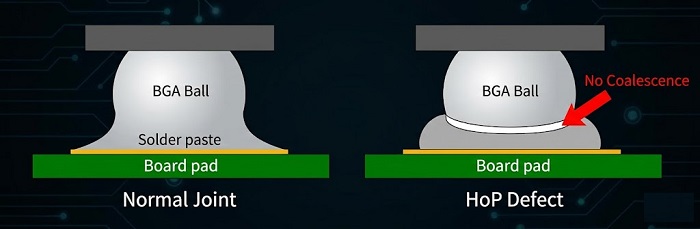
A Head-on-Pillow (HoP) defect is a soldering anomaly where the BGA solder ball and the PCB solder paste fail to form a continuous metallurgical bond during reflow. When cross-sectioned, the solder joint resembles a “head resting on a pillow”—the molten solder ball and paste do not merge, leaving a distinct boundary between them.
HoP defects are categorized into two main types based on their causes and distribution:
Type A (Poor Wetting): Randomly distributed across the BGA array, caused by insufficient flux activity, solder ball oxidation, or contamination.
Type B (Warpage-Induced): Concentrated at the edges or corners of large BGAs, resulting from thermal warpage of the component or PCB during reflow.
1.2 Detection Challenges and Reliability Risks
HoP defects are notoriously difficult to detect with standard inspection methods:
Visual Inspection: Limited to the outer rows of BGA balls, blocked by surrounding components in high-density designs.
2D X-Ray: Fails to identify subtle necking or partial separation between the ball and paste.
Electrical Testing (ICT/FVT): May pass if intermittent contact exists during testing, only to fail under thermal cycling or vibration in the field.
Destructive Tests: Red dye penetration and cross-sectional analysis confirm defects but are unsuitable for mass production.
3D X-Ray CT is currently the most reliable non-destructive method, but its high cost limits widespread adoption. The hidden nature of HoP defects leads to unexpected field failures, increased warranty costs, and damaged customer trust—making prevention critical for modern electronics manufacturing.
2. Root Causes of HoP Defects
HoP defects arise from a complex interplay of supply, process, and material factors, all of which disrupt the synchronized melting and coalescence of solder balls and paste during reflow.
2.1 Supply-Side Factors
Supply issues occur before components enter the assembly line and are often beyond direct manufacturer control:
Solder Ball Oxidation: BGA solder balls oxidize during manufacturing, packaging, or storage due to inadequate humidity control or exposure to air. Oxide layers prevent wetting between the ball and paste, even with sufficient flux.
Silver Segregation: In lead-free solder alloys (e.g., SAC305), silver migrates to the solder ball surface during cooling, forming high-silver intermetallic layers (up to 35% silver content). These layers alter melting behavior and inhibit coalescence.
Component Contamination: Residues from probe testing during IC packaging adhere to solder balls, contaminating surfaces and impairing wetting.
Inherent Warpage Risk: Some BGA packages have substrate materials with poor high-temperature resistance, prone to warpage at lead-free reflow temperatures (230–250°C).
2.2 Process-Side Factors
Process issues during solder printing, component placement, and reflow are the most common triggers of HoP defects:
2.2.1 Solder Paste Printing
Insufficient Paste Volume: Poor stencil design (e.g., low area ratio <0.66), misalignment, or inadequate board support leads to insufficient paste deposition. Inadequate paste fails to bridge gaps caused by warpage or provide enough flux to dissolve oxides.
Low Transfer Efficiency: Inconsistent paste transfer (due to stencil wear, temperature/humidity fluctuations, or squeegee pressure issues) results in uneven paste deposits. Variations in paste height increase the risk of non-contact between balls and paste.
Misregistration: Printing offset from pads (common in panelized designs) reduces effective contact area, exacerbating wetting issues.
2.2.2 Component Placement
XY Misalignment: Inaccurate pick-and-place positioning causes solder balls to shift from paste deposits, reducing coalescence chances.
Insufficient Z-Axis Pressure: Inadequate downward force during placement fails to ensure firm contact between balls and paste, leading to separation during reflow.
Coplanarity Issues: Warped components or uneven placement cause some balls to lose contact with paste entirely.
2.2.3 Reflow Profile (Critical Factor)
Most HoP defects stem from suboptimal reflow parameters that exacerbate warpage or deplete flux activity:
Excessive Ramp Rate: A rapid temperature rise causes premature flux volatilization, reducing its ability to dissolve oxides and protect molten solder.
Inadequate Soak Time: Insufficient preheating leads to uneven temperature distribution, causing differential expansion and warpage.
Too High Peak Temperature/Extended TAL: Excessive peak temperature (>250°C) or long Time Above Liquidus (TAL >90s) intensifies component/PCB warpage and depletes flux, promoting re-oxidation of solder surfaces.
Uncontrolled Cooling Rate: Rapid cooling forms coarse crystalline structures in solder joints, reducing mechanical strength and making joints prone to separation under stress.
2.3 Material-Side Factors
Solder paste and flux performance directly impact wetting and coalescence, making material selection critical for HoP prevention:
Low Flux Activity: Pastes with low-activity fluxes fail to fully dissolve oxides on solder balls or PCB pads.
Poor Oxidation Barrier: Fluxes with inadequate oxidation protection allow re-oxidation of molten solder during reflow, creating barriers to coalescence.
Inconsistent Rheology: Pastes with poor tackiness or stringiness lose contact during component warpage, preventing reconnection upon cooling.
Incompatible Alloys: Mismatched solder paste and BGA ball alloys (e.g., SAC305 paste with high-indium balls) cause uneven melting and wetting issues.
3. Formation Mechanism of HoP Defects
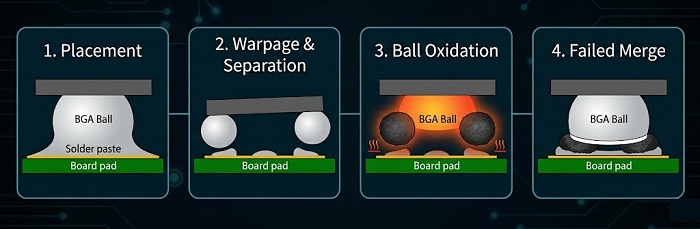
HoP defects form in four sequential stages during reflow, driven by thermal-mechanical stress and chemical reactions:
Initial Contact: BGA placement ensures solder balls contact printed paste deposits.
Warpage-Induced Separation: As temperature rises, CTE mismatches between BGA substrate and PCB cause warpage, lifting edge/corner balls from paste.
Oxidation of Exposed Surfaces: Lifted solder balls oxidize rapidly at high temperatures, forming a dense oxide layer.
Failed Coalescence: When warpage subsides during cooling, the oxidized ball and paste recontact but cannot merge—residual flux activity is insufficient to break the new oxide layer, resulting in a HoP defect.
This mechanism highlights that sustained contact between solder balls and paste during the molten phase is essential for defect-free joints. Even minor separations (micron-level) can trigger HoP defects if accompanied by oxidation.
4. Comprehensive Prevention Strategies for HoP Defects
Preventing HoP defects requires a holistic approach addressing supply, process, and material factors, with a focus on minimizing warpage and preserving flux activity.
4.1 Supply Chain Control
Component Qualification: Source BGAs from reputable suppliers with strict process controls for solder ball oxidation and silver segregation. Reject components with inconsistent ball sizes or surface contamination.
Moisture-Sensitive Device (MSD) Management: Store BGAs in nitrogen-purged dry boxes at <5% humidity and bake per J-STD-020 before use to reduce oxidation risk.
Incoming Inspection: Implement 100% visual and X-ray inspection for BGA solder ball quality, checking for oxidation, discoloration, or damage.
4.2 Process Optimization
4.2.1 Solder Printing Enhancement
Stencil Design Optimization: Use electro-polished or electro-formed stencils with area ratios ≥0.7 to ensure high transfer efficiency. Enlarge apertures at BGA edges/corners by 10–15% to compensate for warpage-induced separation.
Printing Process Control: Calibrate printers regularly for registration accuracy (±25 μm) and use vacuum board support to eliminate stencil-PCB gaps. Maintain room temperature at 23±2°C and humidity at 40–60% to stabilize paste rheology.
Solder Paste Inspection (SPI): Deploy 3D SPI systems for 100% inspection of paste volume, height, and alignment, rejecting boards with inconsistent deposits.
4.2.2 Placement Accuracy Improvement
High-Precision Placement: Use pick-and-place machines with ±15 μm XY accuracy and closed-loop Z-axis control to ensure consistent contact pressure.
Local Fiducials: Add fiducial marks near BGA components to enhance alignment accuracy, especially in panelized designs.
Coplanarity Check: Verify component coplanarity before placement, rejecting warped BGAs.
4.2.3 Reflow Profile Tuning (Key Optimization)
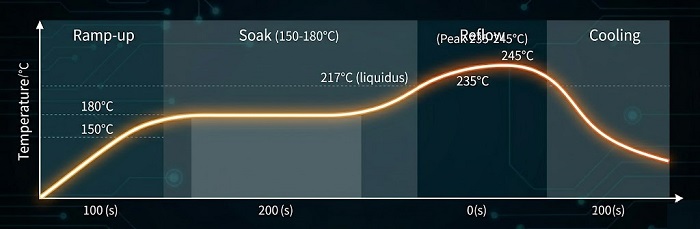
Optimize reflow parameters to minimize warpage and preserve flux activity:
Ramp Rate: 1–2°C/second from room temperature to 150°C to prevent premature flux volatilization.
Soak Zone: 60–90 minutes at 150–180°C to ensure uniform temperature distribution (ΔT <5°C across the board).
Peak Temperature: 235–245°C (avoid >250°C) with TAL of 60–90 seconds to balance melting and warpage control.
Cooling Rate: 2–3°C/second to form fine, dense solder grain structures, enhancing joint strength.
Nitrogen Reflow: Use nitrogen atmosphere (O₂ <500 ppm) to reduce re-oxidation risk, especially for high-density or fine-pitch BGAs.
4.3 Material Selection and Optimization
High-Performance Solder Paste: Select lead-free pastes with high-activity, long-life fluxes that offer superior oxidation barriers and tackiness. Prioritize pastes with good stringiness (≥5mm stretch before breaking) to maintain contact during warpage.
Flux Dipping: For high-risk components, dip BGA solder balls in high-activity flux before placement to supplement flux and enhance oxidation protection.
Alloy Compatibility: Match solder paste alloys to BGA ball alloys (e.g., SAC305 paste with SAC305 balls) to ensure consistent melting and wetting.
4.4 PCB and Package Design for Manufacturability (DFM)
High-Tg PCB Materials: Use PCB substrates with Tg ≥170°C to reduce warpage at lead-free reflow temperatures.
Stiffeners and Reinforcements: Add metal stiffeners to large BGAs or high-density boards to minimize thermal deformation.
Pad Design: Follow IPC-7351 standards for BGA pad dimensions (pad diameter ≥80% of solder ball diameter) and avoid vias-in-pad or ensure they are fully filled.
5. How PCBCart Mitigates HoP Defect Risks
At PCBCart, we understand that HoP defects threaten product reliability and manufacturing yield. Our comprehensive solutions combine advanced process controls, material expertise, and DFM optimization to minimize HoP risks for high-reliability electronics assembly:
Expert DFM Review: Our engineering team conducts rigorous pre-production DFM checks, optimizing PCB pad design, stencil apertures, and component placement to reduce warpage and ensure consistent solder contact.
Premium Material Sourcing: We partner with trusted suppliers for high-Tg PCB substrates, high-activity solder pastes, and low-oxidation BGA components, ensuring material compatibility and reliability.
Precision Process Control: Our state-of-the-art SMT lines feature high-precision printers, pick-and-place machines, and reflow ovens with closed-loop temperature control. We implement 3D SPI and AOI for 100% process inspection, ensuring solder paste quality and placement accuracy.
Custom Reflow Profiling: Our engineers develop application-specific reflow profiles tailored to your BGA components and PCB designs, balancing melting efficiency with warpage control.
Comprehensive Quality Assurance: We offer 3D X-Ray CT inspection and cross-sectional analysis for critical assemblies, enabling early detection of potential HoP defects and ensuring zero-defect delivery.
Whether you are manufacturing consumer electronics, industrial controls, or automotive components, PCBCart’s expertise in HoP defect prevention ensures your products meet the highest reliability standards.
6. Conclusion
Head-on-Pillow (HoP) defects remain a critical challenge in lead-free electronics assembly, driven by the interplay of supply, process, and material factors that disrupt solder joint coalescence. Their hidden nature and severe reliability risks demand proactive prevention rather than reactive detection. By implementing strict supply chain controls, optimizing printing/placement/reflow processes, selecting high-performance materials, and adopting DFM principles, manufacturers can significantly reduce HoP defect rates.
As a trusted partner in electronics manufacturing, PCBCart combines technical expertise, advanced equipment, and rigorous quality control to deliver HoP-free assemblies for global clients. Contact us today to learn how our tailored solutions can enhance your manufacturing yield and product reliability.
Helpful Resources
• Factors Affecting the Quality of BGA Assembly
• Comparison between Wave Soldering and Reflow Soldering
• PCB Design Elements Influencing SMT Manufacturing
• Solder Paste Inspection (SPI)


