



Resistors are the foundation of electrical circuits, since they act as imperative controls of the electric current. They are essential in achieving safe and efficient operation of the circuits, as well as limiting the level of voltages and protecting vulnerable elements against voltage spikes. Knowing how to read resistor values is an essential skill required of any person working with electronics, be it in the design, prototyping or repair of circuits.
The Fundamental Role of Resistors in Circuits
For every resistor, its ability to obstruct the flow of electrical current, and this also works on Ohms Law. The Law of Ohm stipulates the relationship that exists between voltage (V), current (I), and resistance (R) and thus resistors are required to control these factors within a circuit. Resistors come in many forms including fixed, variable, carbon film, metal film and wirewound and are tailored to suit individual application needs within consumer electronics and industrial systems alike.
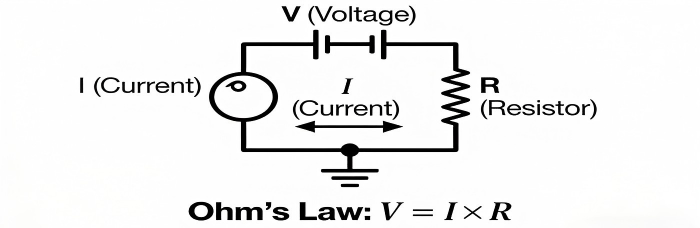
The non-polar character of resistors makes their application easier because these resistors do not need an orientation depending on their polarity. This feature renders them very flexible elements of electronic design. Their use is also extensive, such as the regulation of current flow to the control of voltage, such as adjusting the performance of an analog or digital circuit.
Color Codes of Through-Hole Resistor
A typical type of resistor is called through-hole resistors and uses the standard International Electrotechnical Commission (IEC) 60062. They show the values of their resistance, tolerances, and in some cases temperature coefficients in a combination of colored bands. Such bands may be three to six with each band carrying certain information:
Orientation: Initially, resistor with tolerance band (tend to be gold or silver) should be held on the far right. This is to make sure there is the right reading left to right.
Significant Digits: The initial two or three bands are important digits. They are required to decide the base value of the resistor. An example would be that in case of brown and black bands, the number would be 1 and 0.
Multiplier: The second band is the multiplier which magnifies the significant figures to the true resistance value. The band in the third position is red, and the third band multiplicon is 100 giving a total of 1,000 ohms (1kΩ).
Tolerance: The last band shows tolerance which shows the extent to which resistance may be varied. A band of gold indicates a tolerance of ±5% of the actual resistor indicating that its value may vary within this range.
An example is that a resistor that has the color bands of brown, black, red, and gold give a resistance of 1kΩ with a tolerance of ±5%.
Advanced Configurations: Five and Six Band Resistors
Some resistors have more bands in an attempt to be more precise. Five and six-band resistors are more accurate than other types, and the extra band is used to capture additional significant numbers and data on temperature coefficient needed in precision applications.
Five-band resistors usually have the first three bands representing significant figures, the fourth band representing the multiplier and the fifth band representing tolerance.
Six-band resistors are similar to the five-band design except that the fifth band is replaced with a sixth band indicating the degree to which resistance varies with change of temperature.
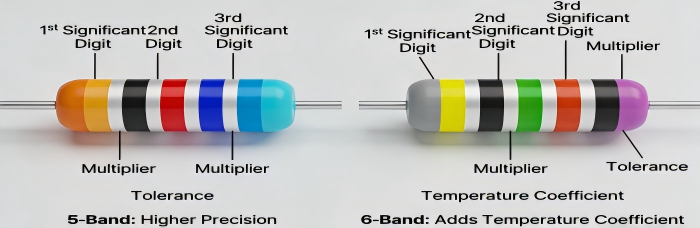
The knowledge of these other bands is very important in cases where a high degree of precision is needed because it will mean that circuits will be reliable even in different environmental factors.
Decoding Surface Mount Device (SMD) Resistors
Surface Mount Device (SMD) resistors have numeric values rather than color bands to describe their values, unlike through-hole resistors:
Three-digit system: The first two represent important numbers and the third is the multiplier.
Four-digit system: The first three are of significance, and the fourth is the multiplier.
In cases of high precision, the EIA-96 scheme is used, in which a two-digit code is associated with a particular value in an E96 series table, and the letter is a multiplier.
Tools to Aid Reading Resistor
Although reading it manually is a basic requirement, such tools as multimeters can provide a fast and accurate way of estimating the resistor values. Multimeters are especially helpful in resistors whose bands are worn out or unreadable, as that leads to errors caused by visual misinterpretation.
Alternatively, you can find online resistor calculators, as well as mobile apps, that can give you immediate help and allow finding the resistance of resistors fast. Such tools are especially useful in the large projects where the efficiency and accuracy of the work are significant.
Avoiding Common Mistakes in Resistor Reading
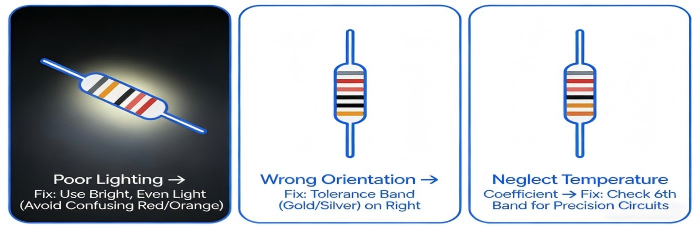
Even experienced professionals may make an error when reading resistors and the reason is most of the time the poor lighting or in a hurry. The following are some pitfalls that are likely to be encountered and how to avoid them:
Lighting and Differentiation: Make sure that there is sufficient illumination to well differentiate similar colors such as those of red and orange or green and blue. Where there is any uncertainty, multimeter cross-checking is always a good thing.
Reading Orientation: It is always important to begin to read with the big numbers at the end. The tolerance band side is to be on the right as one reads.
Negligence of Temperature Coefficients: In the case of high-precision resistors, an extra band may mean temperature sensitivity. This is a major consideration in an application that requires relative stability in performance with changes in temperature.
The ability to read resistors accurately is an important electronic skill required in the design, prototyping and repair of circuits. On understanding how to interpret color codes and use helpful tools to check the correctness, one will be able to identify the resistor values efficiently. Such expertise will make sure you achieve maximum performance of the circuit, and by doing that, you will be able to achieve more accurate, reliable, and efficient electronic designs. With these methods, once you are conversant with them, it will be easy to decode resistor values that will promote innovation and accuracy in all projects.
At PCBCart, we realize how important resistors are in your electronic project. Our quality and precision involve us in being one of your first choices in all your PCB manufacturing. You need custom boards or we can offer you standard boards, either way, we are able to offer you strong solutions depending on what exactly you need. Our quotation and ordering system are smooth, and the prices are competitive, with support team. Contact PCBCart now and see our unrivaled services that help in the innovation and make your project a success.
Get an Instant Quote for Cost-Effective & Advanced PCB Assembly
Helpful Resources
• PCB Quality Inspection and Testing Methods
• High-Density Interconnect (HDI) PCB Design
• PCB Prototyping for Electronic Projects


