



Even fully assembled and tested PCBAs can fail in the field due to latent issues. The cause is not mechanical, not thermal, and not visible under white light. It is ionic residue — left behind by the soldering process itself — that remains dormant until humidity and DC voltage activate it into a conductive filament capable of bridging adjacent conductors and shorting your product months after deployment. For clinical laboratory instruments operating in humid, reagent-exposed environments, this is not a theoretical scenario. It is a documented failure mode with a well-understood mechanism, a measurable root cause, and a preventable outcome.
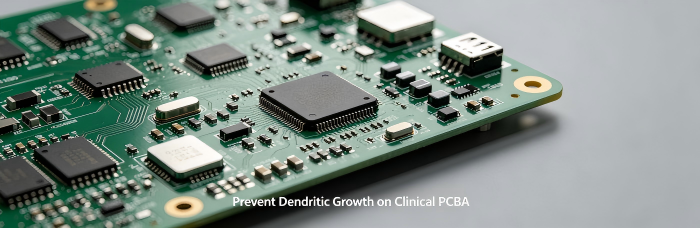
The Hidden Threat in Clinical Environments
Hematology analyzers, PCR thermal cyclers, immunoassay platforms, and point-of-care diagnostic devices share a common operating reality: they live on the clinical bench, surrounded by aerosolized reagents, humidity cycling, and periodic electrolytic cleaning. Standard accelerated life testing rarely replicates these conditions with sufficient fidelity, which means latent ionic contamination on the PCBA surface can pass through qualification undetected — and surface only after the instrument has been placed in service.
The failure mode is electrochemical migration (ECM), and its most destructive expression is dendritic growth: the spontaneous formation of crystalline metal filaments that grow across adjacent conductors under electrical bias. In a diagnostic device, a leakage path induced by dendritic growth can compromise measurement integrity and, depending on system architecture, may contribute to patient safety or regulatory compliance risks.
Where Ionic Contamination Originates
Every soldering process — whether lead-free SAC305 reflow peaking at 240°C–250°C or selective wave soldering under nitrogen atmosphere — relies on flux chemistry to reduce copper oxide on pad surfaces and enable proper intermetallic bonding. Flux is chemically necessary. But it is not inert post-reflow.
Depending on flux classification per IPC J-STD-004D and whether a post-reflow cleaning step is employed, residual ionic species remain distributed across the board surface after assembly. The primary contaminants of concern include halide activators such as chloride and bromide ions from aggressive flux chemistries, organic acid residues including adipic, succinic, and glutaric acids from no-clean flux systems, ionic surfactants from incompletely rinsed aqueous wash solutions, and process water ions — sodium, potassium, sulfate — introduced through poorly maintained deionized water systems.
Beyond soldering, ionic contamination can also enter through improper board handling, where salts from skin contact deposit on pad surfaces, or through incoming bare boards that already carry fabrication residues. On a modern medical-grade PCBA carrying differential signal pairs or low-leakage analog front-end circuitry, conductor spacing often as tight as 100 μm. At these geometries, ionic residue is not a cosmetic issue. It is a latent electrochemical threat.
The Electrochemical Migration Pathway
The mechanism follows a well-characterized sequence. When a contaminated board is exposed to elevated relative humidity — often above 60% RH and especially under condensation-prone conditions — while a DC bias exists across adjacent conductors, moisture adsorbs onto the ionic residue, forming a thin electrolytic film that establishes a functioning galvanic cell.
At the anode, metal undergoes oxidative dissolution — tin from SAC solder is among the most common species involved, while copper, silver (from immersion silver finishes), and other conductive metals may also participate depending on the surface finish and assembly materials. The dissolved metal cations migrate through the electrolytic film toward the cathode, where reduction occurs and the metal re-deposits as a branched, filamentary crystalline structure: the dendrite.
What makes ECM particularly difficult to detect is its behavioral profile. Dendritic growth can progress over timescales ranging from hours to months, depending on humidity, voltage bias, conductor spacing, and contaminant chemistry. The structure is mechanically fragile — it can bridge a gap, generate a transient fault, fracture under vibration or thermal cycling, and re-grow. In field diagnostics, this pattern presents as an intermittent leakage fault with no visible physical cause. Standard AOI cannot detect the condition, and conventional ICT may not reveal it until a conductive path has already formed. For the clinical engineer reviewing field return data, the failure signature of ECM often remains invisible until cross-sectional or electron microscopy analysis is applied — by which point the instrument may have already generated unreliable diagnostic results in service.
Measuring Ionic Cleanliness: IPC-TM-650 and the ROSE Test
The Standard and Its Physical Basis
The primary quantitative methodology for ionic contamination measurement is IPC-TM-650, Method 2.3.25 — the Resistivity of Solvent Extract (ROSE) test. It is widely used to support cleanliness verification programs and process control strategies referenced throughout IPC J-STD-001 and related industry standards.
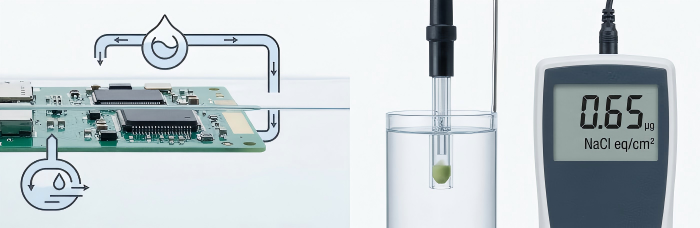
The ROSE test operates on a direct physical principle: ionic contaminants dissolved into a 75% isopropyl alcohol / 25% deionized water extraction solution reduce the solution's electrical resistivity in proportion to ion concentration. The test instrument flows this solution over the PCBA surface, captures the eluent, and monitors resistivity until equilibrium is reached. The result is expressed as micrograms of NaCl equivalent per square centimeter (μg NaCl eq/cm²).
Cleanliness Thresholds and Why the Classical Limit Is Insufficient
The historical cleanliness threshold of ≤1.56 μg NaCl eq/cm² originates from MIL-P-28809 and remains widely referenced across the industry. Many manufacturers serving high-reliability, medical, aerospace, or mission-critical markets adopt tighter internal process control limits — often ≤1.00 μg NaCl eq/cm² or lower — based on product-specific reliability requirements rather than an explicit IPC Class 3 mandate. For clinical instrumentation PCBA with fine-pitch components below 0.5 mm or low-standoff BGA and QFN packages, many engineering teams define internal process control limits as tight as ≤0.50 μg NaCl eq/cm², based on customer-defined requirements for their specific end-use conditions.
The critical point for procurement directors and quality audit managers: a binary pass/fail ROSE result is insufficient. Request actual measured values and their statistical distribution across production lots. A process consistently measuring at 0.85 μg and one varying between 0.40 and 1.45 μg may both generate passing reports — but their risk profiles are fundamentally different. Trend data is where process drift becomes visible before it becomes a field return.
Surface Insulation Resistance Testing as a Complementary Method
Where root cause investigation is needed, ion chromatography (IC) per IPC-TM-650 Method 2.3.28 provides a complementary high-resolution analysis — separating individual anion and cation species to identify not just the quantity of contamination but its precise chemical origin, tracing elevated halide readings back to a specific flux lot or process chemistry change.
Process Control: Preventing Contamination at the Source
Upstream Architecture Determines Downstream Cleanliness
Ionic contamination is not an inspection problem solved at the end of the line. It is a process architecture problem. Inspection measures the outcome. Only disciplined process control prevents it.
Flux classification must be matched to board surface condition rather than defaulted to the most aggressive activator available. ROL0 chemistries — halide-free, low-activity rosin — minimize ionic residue load but demand tight control over incoming board oxidation and component solderability. Reflow profile design has a direct impact on residue chemistry: a properly characterized soak zone between 150°C and 180°C for lead-free assemblies ensures complete flux activation and volatile outgassing before peak temperature. Compressed profiles leave partially activated residue with elevated ionic potential — a common root cause of elevated ROSE readings that is traceable only if lot-level process records exist.
For mixed-technology assemblies, automated selective wave soldering under nitrogen blanketing — maintaining low oxygen levels (often below 500–1000 ppm, depending on process requirements) at the wave — minimizes oxidation-driven flux overconsumption while enabling the controlled heat transfer required to achieve the the 70–80% barrel fill criterion mandated by IPC Class 3 for through-hole joints.
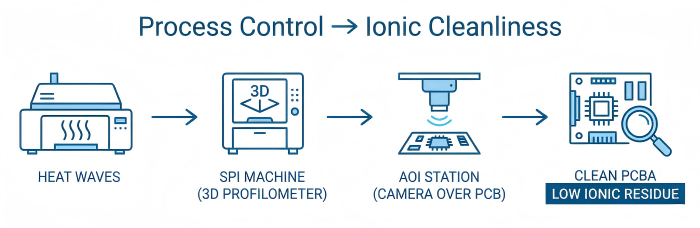
Closed-Loop Inspection as a Process Feedback Mechanism
3D SPI prior to component placement verifies solder paste deposition volume and, consequently, the amount of flux chemistry introduced into each solder joint. Deviations trigger immediate closed-loop correction to the stencil printer before placement begins. Post-reflow 3D AOI flags bridging and solder pooling conditions that correlate with localized flux concentration in confined inter-component spaces.
For BGA and QFN packages, offline X-ray inspection measures void area per joint against the IPC-A-610 Class 3 limit of ≤25% void area. Excessive voiding may indicate process conditions that also hinder complete flux volatilization or residue evacuation beneath low-standoff packages, making such locations worthy of additional contamination-risk evaluation. X-ray inspection functions not only as a solder joint quality check but as an indirect ionic risk screen for the most geometrically vulnerable locations on the assembly.
Full Traceability as the Foundation of Corrective Action
When a ROSE reading approaches a process limit, root cause investigation requires knowing exactly which flux lot, solder paste lot, reflow recipe, and production shift are associated with the affected boards. A Smart MES with full component lot and date code tracking — tied to laser-marked unique serial numbers on each PCBA — transforms a contamination exceedance from a broad hold into a surgically scoped corrective action with defined material boundaries.
At PCBCart, ionic contamination testing, closed-loop SPI and AOI inspection, X-ray voiding analysis, and full MES-driven traceability are standard elements of every IPC Class 3 PCBA build — not optional add-ons. We work with engineering and quality teams in life sciences, industrial, and mission-critical sectors who need a manufacturing partner capable of discussing process data, not just certifications.
Helpful Resources
• Process Control Measures to Stop Defects in SMT Assembly
• What is Solder Flux in PCB Manufacturing?
• How to Clean PCBs after Surface Mount Soldering
• PCB Assembly Inspection Methods AOI, ICT and More
• Advanced PCB Assembly Service


