



In the design and manufacturing of printed circuit boards (PCBs), one of the most critical decisions that can have an impact on the look, manufacturing process, inspection, and in some cases, the performance of the PCB is the selection of the solder mask finish. In the industry, there are mainly two solder mask finishes that are commonly used: matte finish solder mask and glossy finish solder mask. Although both of these finishes have the same industry standards for functionality and performance, their physical properties and performance make them more appropriate for different use cases. In most cases, the selection of the solder mask finish is left to the manufacturer, who usually selects the glossy finish solder mask. However, with the information provided in this article, you will be better equipped to make the right selection for your next PCB project.
What Are Matte and Glossy PCB Finishes?
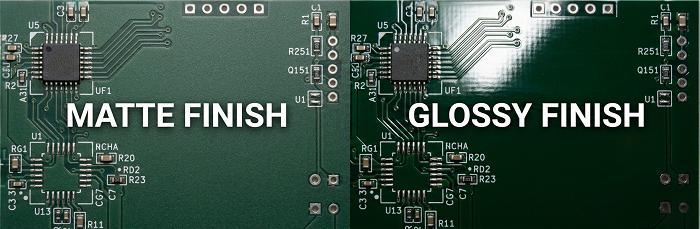
At their core, both the matte and glossy solder mask finishes of the solder mask material are the same, as the differences come down to the texture of the finish, the curing process, and the reflective properties of the light. As such, both of the solder mask materials adhere to the same standard set by the IPC-SM-840 specification for the qualification of the solder mask material in terms of performance, including the prevention of oxidation, solder bridges, and electrical insulation. The difference lies in the actual texture of the finish.
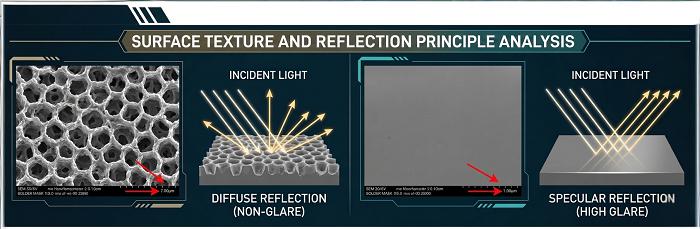
The glossy PCB finish has a smooth, poreless surface that has high light reflectivity, and it is also lighter in color than the matte finish. The hard, shell-like texture of the glossy finish is the determining factor in the durability and scratch resistance of the finish, and it is the industry standard because of the long-standing popularity of the finish as well as the look it has.
The matte PCB finish has a soft, slightly porous, textured surface that has low light reflectivity, giving it a non-shiny look that is darker in color than the glossy finish. The roughness of the surface of the matte finish is the primary factor that differentiates it from the glossy finish, which is the driving factor behind the many advantages of the matte finish in the manufacturing process, despite the fact that it is slightly softer and has a tendency to scratch the surface lightly.
Key Advantages of a Glossy PCB Finish
Glossy finishes are still the first choice in many PCB projects, and this is because of a number of factors, all of which contribute to a product that is pleasing to the eye and tough enough to withstand the test of time. The advantages of a glossy finish are not limited to its appearance, making it a great choice for a number of different projects where appearance and durability are key factors.
Superior Aesthetic and Market Appeal
The most important advantage of a glossy finish is its sleek and professional appearance. The glossy finish provides a polished appearance for a product, especially in consumer electronics, display boards, or in any product where the PCB is exposed to consumers or stakeholders, for instance, through a transparent casing or in trade show settings. For products where aesthetics is an important consideration in terms of branding and marketing, a glossy finish provides a substantial advantage in terms of enhancing the overall look of the electronic device.
Enhanced Scratch Resistance and Durability
Additionally, the glossy finish is harder than the matte finish, making it less likely to be damaged by scratches during handling, assembly, and even after extended periods of use. This is one of the key advantages of the glossy finish, especially for PCBs that are subjected to constant physical contact, such as those used in portable electronics or machines that require regular maintenance.
While the finish is not completely immune to scratches, it can withstand minor scratches, allowing the PCB to retain its pristine condition for longer periods of operation.
Easier Cleaning and Surface Maintenance
The smooth, non-porous finish of a glossy finish is resistant to the accumulation of dust, flux residue, and handling oils, and in the event that contaminants do accumulate, they can be easily wiped off the surface. This is advantageous in situations where the cleanliness of the finish is of utmost importance, such as in medical applications, food service, conformal coating of PCBs, among others. In contrast to the matte finish, which may require rigorous cleaning procedures to remove contaminants trapped in the finish, the glossy PCB can be cleaned using less rigorous procedures, thus shortening the time required in the manufacturing process without damaging the components.
Industry Standard Familiarity
The glossy finish is the default option for almost all PCB manufacturers, owing to the long history of established manufacturing processes and quality control standards. Selecting the glossy finish ensures that the manufacturing process will yield consistent results, as manufacturers are highly experienced in the application and curing of this finish. The glossy finish is the best option for designers or buyers who have no specific finish requirement.
Minor Thermal Resistance Edge
Some producers claim a small advantage in high-temperature resistance for glossy finishes. Though insignificant in most standard applications, this is a small plus for PCBs that undergo repeated thermal cycling or long-term exposure to high temperatures, such as in automotive applications or industrial heating systems. This small advantage in thermal reliability is an added strength for glossy finishes in harsh environments.
Key Advantages of a Matte PCB Finish
While matte finishes may not be as aesthetically pleasing as glossy finishes, the specific physical properties that matte finishes provide are incredibly valuable, and their practical advantages make them a must-have for high precision, high reliability, and high frequency PCBs, among other applications. The surface roughness and non-reflective qualities that matte finishes provide solve a number of significant problems in manufacturing, inspection, and soldering, among other things.
Unmatched Inspection Visibility and Defect Detection
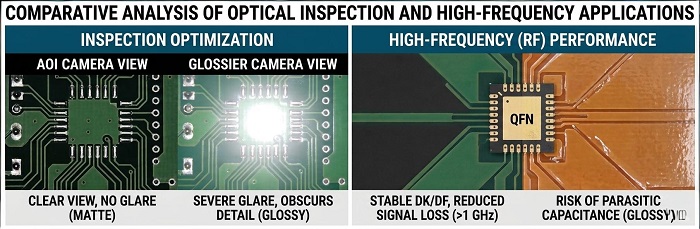
The absence of reflection on a matte finish surface means that there is no glare from inspection lighting, making it much simpler to inspect details on the PCB surface. Details include copper tracework, solder points, and small components. Such a feature is a game-changer for both manual and automated inspection systems. For manual inspectors, a matte finish means less eye strain is required to inspect a PCB. Additionally, small defects such as hairline cracks in PCBs or even contamination are much simpler to spot when using a matte finish. For projects that have specific quality assurance standards, a matte finish can increase defect detection rates.
Reduced Solder Ball Formation
Solder balls are one of the major manufacturing defects in PCBs that may lead to short circuits in PCBs and may also lower the reliability of PCBs, but it has been proven that matte finish minimizes solder balls in PCBs. It has been researched that when solder is melted and allowed to come into contact with other surfaces, it forms a convex meniscus over the rough and textured surface of a matte finish, thereby reducing the points of contact for solder balls to form. On the other hand, it forms a concave meniscus over the smooth surface of a glossy finish, thereby increasing the points of contact for solder balls to form. It has been found in numerous research papers that there is a direct correlation between gloss levels and soldering defects in PCBs; it has been found that lower gloss levels lead to a significant reduction in solder balls in PCBs, which is more prominent than other soldering defects like solder shorts or solder bridges.
Optimal Performance for High-Frequency (RF) Applications
Matte finishes are the obvious choice for Radio Frequency and High Frequency PCB designs, operating above 1 GHz, such as 5G, Radar, and Satellite systems. This is because a matte finish has a flat surface that does not reflect electromagnetic and light waves, reducing unwanted interference and crosstalk that can impact signal integrity. Glossy finishes, on the other hand, have high reflectivity and can induce unwanted parasitic capacitance and change impedance, which are critical issues for RF PCB designs that require a precise impedance of 50 ohms to transmit signals effectively. Moreover, matte finishes can be used with RF-specific solder mask materials that have a constant dielectric constant (Dk) of 3.5 to 4.0, reducing signal loss and providing a high level of performance for high-frequency applications. Matte finishes can also provide better adhesion properties for components and markings, which is critical for high-frequency applications.
Better Fingerprint and Glare Resistance
The matte finish does not show finger prints, smudges, or glare as much as the glossy finish. This is a real-world benefit for PCBs that may be handled frequently in the design, prototyping, or servicing of the PCB—designers and technicians can work on the PCB without worrying about cleaning it, and the PCB looks clean throughout the entire design and testing phases. The non-glare finish of the matte PCB also makes it easier to photograph, which is a big plus for product development records.
Streamlined Production and Quality Assurance
For projects where the importance of production accuracy and quality control is of utmost importance, the improved visibility of the matte finish can offer greater peace of mind when fabricating the PCBs. Furthermore, when it comes to the feedback loop that can exist between PCB fabricators and PCB designers, the improved visibility of the matte finish can also offer advantages in that it can be easier to determine when there is an issue in the PCB fabrication process.
Critical Trade-Offs to Consider
Although both options have considerable benefits, each has disadvantages that need to be considered in relation to your project’s requirements:
- The presence of scratches: Although glossy finishes are resistant to scratches, if any damage does occur, it will be easily visible due to the reflective finish. Matte finishes are prone to minor scratches but have the advantage of hiding them well due to the textured finish.
- Aesthetic or functionality issues: Although glossy finishes have excellent aesthetic appeal, they have disadvantages in terms of functionality and manufacturing process issues. Matte finishes have better functionality but lack the aesthetic appeal that glossy or other similar finishes have.
- Accumulation of dust: The textured finish of the Matte finish may lead to the accumulation of dust in the long term, which may be problematic in harsh or unfiltered environments.
- Vision system compatibility: Although glossy finishes may be problematic in terms of AOI and pick-and-place vision systems due to reflective issues, Matte finishes do not have this problem at all.
It is important to note that cost and manufacturing processes are identical for both matte and glossy finishes. There is no inherent price difference between the two, and any indirect cost variations stem from project-specific factors like rework rates or inspection requirements—not the finish itself.
How to Choose the Right Finish for Your PCB Project
Finally, it is a matter of matching up the finish properties with your project’s fundamental priorities. With that said, here is a simple guide on how to pick the finish that suits your project’s needs.
Choose a Glossy Finish If:
1. Aesthetics are a top priority: Your PCB is visible in the final product (e.g., consumer electronics, transparent enclosures) or used for marketing/display (e.g., trade show samples, sales demonstrations).
2. Cleanliness and low maintenance are critical: Your application demands strict surface cleanliness (e.g., medical devices, food service equipment) or the PCB is exposed to minimal handling after assembly.
3. Scratch resistance is essential: The PCB undergoes frequent physical contact or is used in a harsh environment where scratches are a risk (e.g., portable electronics, industrial machinery).
4. You have no particular finish preference: You wish to utilize the industry standard process and results that everyone is accustomed to.
Choose a Matte Finish If:
1. Inspection and quality control: The project requires high reliability and depends on manual or automated inspection (AOI).
2. Need to reduce solder balls: The project involves high-volume PCB manufacturing or requires high reliability, where soldering defects need to be minimized.
3. High-frequency/RF PCB: The project involves PCB designs for high-frequency applications, i.e., above 1 GHz.
4. Frequent PCB handling: The PCB requires frequent handling, and you are in the development phase.
5. Optical compatibility: The PCB requires optical compatibility, i.e., it will be used in an environment where cameras and optical components will be present.
Conclusion
Matte and glossy PCB solder mask finishes are not one of those situations where one of them is considerably better than the other; rather, they are two finishes, each of which has been optimized for different project objectives. While glossy PCB finishes shine in terms of their aesthetic appeal, scratch resistance, and ease of cleaning, the Matte PCB finishes excel in terms of inspection visibility, solder ball prevention, and high-frequency RF designs, making them suitable for high-precision and high-reliability engineering and industrial projects.
Both finishes have been tested and certified to comply with the same industry standards for electrical functionality and protection, and neither of them has a cost advantage over the other, so the final choice should be yours, depending on your project’s specific requirements.
When it comes to bringing your PCB design to life with the perfect finish, look no further than PCBCart for all your PCB fab and assembly needs! With our expertise in providing matte and glossy solder mask finishes that meet the strictest industry requirements, we are dedicated to providing you with top-notch quality and consistency in every project, from consumer electronic devices and prototyping to high-frequency RF design and high-reliability industrial applications. Our advanced manufacturing capabilities and quality control procedures are geared towards providing you with a perfect PCB finish that meets your design requirements, whether you are looking for the premium look and feel that a glossy solder mask has to offer or the functional benefits that a matte solder mask offers.
Helpful Resources
• Full-Service PCB Fabrication
• Low-Volume PCB Assembly (HMLV)
• Printed Circuit Boards Assembly Process
• Requirements on PCB Design Files
• Effective Ways to Cut PCB Assembly Cost


