



Motor drive PCBAs are some of the most unforgiving boards in industrial automation. A single assembly typically carries high-current THT connectors, gate driver SMD ICs, current-sense shunt resistors, and aluminum electrolytic capacitors — often within 10mm of each other. Running this board through a conventional flood wave soldering process doesn't just risk defects. It actively damages components that were never meant to see molten solder in the first place.
This article quantifies that damage, walks through the selective soldering parameters that prevent it, and shows the inspection data that proves the process is in control.
The Problem: What Flood Wave Soldering Actually Does to a Mixed-Tech Board
When a motor drive board with mixed THT/SMD content goes through a full flood wave, two failure mechanisms show up repeatedly in failure analysis:
Flux spray contamination on current sensors. Wave soldering generates flux aerosol and spray-back as the board exits the wave. Current-sense shunt resistors and Hall-effect sensors within roughly 8mm of THT connector pins routinely show flux residue on their sensing surfaces — a direct path to long-term drift and intermittent measurement error in the field.
Thermal overstress on adjacent aluminum electrolytic capacitors. Most SMD aluminum electrolytics in motor drive applications are rated to 85°C case temperature. A flood wave's bottom-side exposure, even with masking, routinely drives local board temperature near the wave contact zone to ~110°C for several seconds — enough to accelerate electrolyte vaporization and shorten capacitor life, with no visible defect at time-zero AOI.
| Failure Mode | Root Cause | Typical Exposure |
|---|---|---|
| Flux contamination on current sensors | Spray-back from flood wave | Sensors within <8mm of THT pins |
| Capacitor electrolyte degradation | Bottom-side thermal overstress | ~110°C vs. 85°C rated case temp |
The fix isn't better masking tape on a flood wave. It's not exposing those components to molten solder or thermal load in the first place.
Selective Soldering Process Parameters
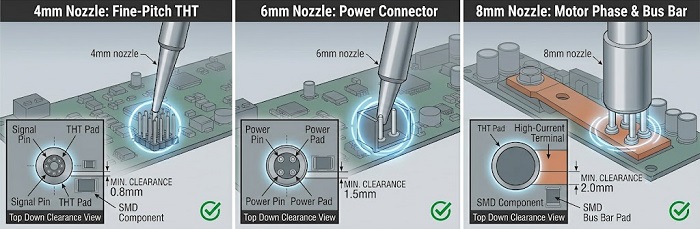
Selective wave soldering applies solder only to the THT joints that need it, via a programmable nozzle, while everything else on the board stays outside the thermal and chemical exposure zone. On our ZSWHPS-11-2 selective soldering platform, three parameters drive joint quality on mixed-technology boards:
Nozzle Diameter Selection
Nozzle bore is matched to pin pitch and barrel diameter, not standardized across the whole board:
| Nozzle Diameter | Typical Application |
|---|---|
| 4mm | Fine-pitch headers, signal connectors, tight THT clusters |
| 6mm | Standard power connectors, gate driver THT leads |
| 8mm | High-current bus bars, motor phase terminals |
Undersized nozzles starve solder volume on large-barrel power pins; oversized nozzles flood adjacent pads and reintroduce the spray-back problem the process is meant to eliminate.
Dwell Time
Dwell time per joint typically runs 1.8–2.5 seconds, set by pad thermal mass and copper thickness rather than a single global setting. Power connector pins on heavy copper (2–3 oz) need dwell time toward the upper end of that range to reach full wetting; signal-level THT pins on standard 1 oz copper sit at the lower end to avoid overheating nearby SMD.
Preheat Profile
A controlled preheat curve — top-side ~145°C, bottom-side ~110°C — activates flux and reduces thermal shock at the point of solder contact, without ever bringing the board into the 110°C+ exposure window that damages adjacent SMD electrolytics. Because preheat is localized and ramped, not a flood exposure, the capacitor case temperature stays within its 85°C rating throughout the cycle.
Nitrogen Atmosphere: Quantifying the Benefit
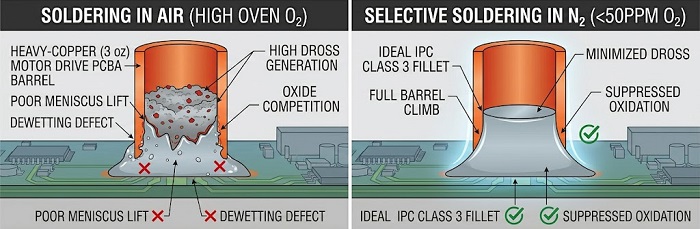
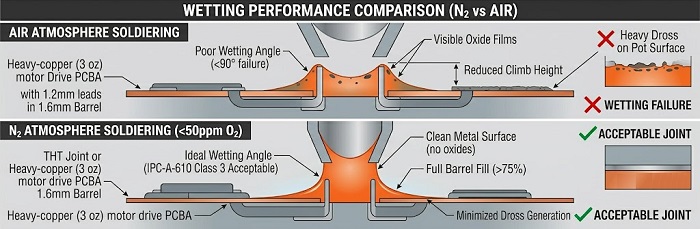
For motor drive boards with heavy copper THT pads (common on power stages), oxidation at the solder joint is a real yield driver, not a theoretical concern. Running the JTR-class thermal process and selective solder pot under nitrogen atmosphere (<50ppm O₂) produces measurable differences versus air:
| Condition | Wetting/Climb Height | Dross Generation |
|---|---|---|
| Air atmosphere | Reduced wetting, visible meniscus lag on heavy-Cu pads | Baseline |
| N₂ atmosphere (<50ppm O₂) | Full climb to top of barrel, clean fillet | ~60% reduction |
Lower dross means less solder consumption variability and fewer process interruptions for pot skimming — but the reliability impact is metallurgical: on heavy-copper-thickness pads, oxide formation during the solder dwell window directly competes with wetting. Suppressing it with N₂ is what gets full barrel fill consistently, not just as a best-case outcome.
Post-Solder Inspection: 3D AOI Data
Every selectively soldered joint on a motor drive board is verified against IPC-A-610 Class 3 criteria using full-board 3D AOI:
Fill height: ≥75% of barrel height (vertical fill)
Wetting angle: <90° (acceptable wetting, no dewetting/icicling)
Bridging: zero tolerance between adjacent THT pads under 2.5mm pitch
The process control difference between flood wave and selective soldering shows up directly in first-pass AOI yield on mixed-technology boards:
| Process | First-Pass AOI Yield |
|---|---|
| Flood wave soldering | ~82% |
| Selective soldering (ZSWHPS-11-2) | ~97% |
The gap is almost entirely attributable to wetting angle failures and incidental solder/flux contact on SMD pads adjacent to THT — defect modes that selective soldering structurally avoids by never exposing those areas to the solder wave.
MES Recipe Lock: Traceability for Functional Safety Boards
Motor drive boards used in functional safety contexts (e-stop circuits, overcurrent protection, drive interlocks) carry an audit burden beyond "did it pass AOI." Our Smart MES enforces recipe-level traceability:
Each board's laser-marked serial number is bound at scan to the specific selective soldering program version used on it — nozzle selection, dwell time, preheat profile, and N₂ setpoint as one locked record.
Any recipe change requires engineering change approval before a new version can be called by a serial number; operators cannot select an unauthorized parameter set on the line.
This gives functional safety auditors a direct, unbroken chain from a fielded board's serial number back to the exact parameters applied — stronger evidence than a generic lot traveler.
This level of process discipline runs under our IATF 16949-certified quality system, which governs change control and process validation across every program — not only automotive-adjacent ones. For non-implantable medical and life-sciences customers, this automotive-grade process control framework typically exceeds the reliability rigor called out in standard medical device manufacturing requirements.
When Selective Soldering Isn't the Right Answer
Selective soldering is not universally applicable. Three THT design situations are better routed to manual or hybrid hand-soldering instead:
Extremely tall or shrouded connectors where nozzle access geometry can't reach the joint without contacting adjacent plastic housings.
Mixed-height THT components on the same local area where a single nozzle program can't hit varying standoff heights without under- or over-dwelling on one of them.
Very low THT joint count per board (under ~10 joints) where programming and nozzle changeover time exceeds the cycle-time benefit versus a trained operator hand-soldering to IPC-A-610 criteria.
For everything else — and that's the majority of mixed-technology motor drive designs — selective soldering with closed-loop thermal and N₂ control is the process that keeps THT joints in spec without putting adjacent SMD at risk.
Next Step: Get Your Design Reviewed Before It Hits the Line
If your motor drive board mixes THT power connectors with SMD sensing components in tight proximity, the layout decisions made now determine whether selective soldering is straightforward or constrained later.
Request a free DFM Review — our process engineering team will assess THT/SMD spacing, flag selective soldering access conflicts, and identify thermal exposure risks before your first build.
Helpful Resources
• Hybrid Assembly Strategies for THT and SMT Components
• Wave Soldering vs. Selective Soldering for PCB Assembly
• Relationship between Copper Weight, Trace Width and Current Carrying Capacity
• Common Defects in PCB Assembly and How to Prevent Them


