



Industry: Industrial / Telecommunications
Key Capabilities: Dam & Fill Technology · Material Engineering · 3D Printing Fixtures · Environmental Hardening · NPI Analysis
Overview
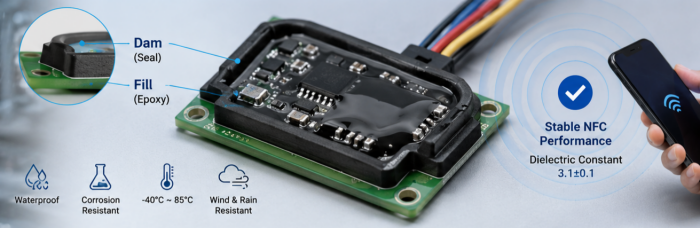
Electronic systems deployed in outdoor environments face constant threats from moisture, chemical corrosion, and extreme temperature fluctuations. For an NFC Auxiliary Board Wire Harness Assembly, PCBCart was tasked with providing a robust protection layer that would ensure years of operation without degrading signal performance. We deployed a specialized "Dam & Fill" encapsulation method, providing a localized yet high-strength protective barrier tailored to the specific needs of NFC technology.
Background
The NFC (Near Field Communication) device is a critical component of an outdoor communication infrastructure. The client required a solution that could withstand wind, rain, and high humidity while maintaining a compact form factor. A major technical constraint was ensuring that the encapsulation material did not interfere with the core card-reading distance, which is highly sensitive to the dielectric properties of surrounding materials.
The Challenges
Environmental Survivability: Ensuring the PCB and wire harness joints are 100% isolated from corrosive elements.
Signal Integrity Maintenance: Selecting potting materials that minimize interference with high-frequency NFC signals.
Aesthetic & Volumetric Control: Managing glue overflow and height within tight spatial tolerances to ensure the device fits within its final housing.
Engineering Insight
Traditional full-board potting often adds unnecessary weight and can negatively impact signal transmission. The "Dam & Fill" approach allows for localized protection of sensitive solder joints and ICs while maintaining a thinner profile over the antenna areas, optimizing both protection and performance.
Optimization Strategy
Material Science Engineering: After rigorous testing, we selected a high-strength epoxy resin for the core "Fill" and a specialized rubber-based sealant for the perimeter "Dam." Materials were validated for a Shore D hardness of 80-90 and high dielectric strength (≥25 KV/mm).
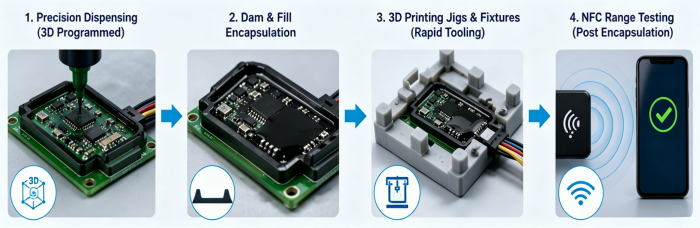
Precision Dispensing Control: We utilized automated 3D programming to define the dispensing path, ensuring the "Dam" height was uniform and the "Fill" volume was strictly controlled to avoid overflow.
Rapid Tooling via 3D Printing: To accelerate the New Product Introduction (NPI) phase, we used 3D-printed jigs and fixtures for immediate production setup, allowing for rapid iteration of the dispensing process.
Performance Validation: Conducted post-encapsulation NFC range testing to verify that the dielectric constant (3.1±0.1) remained within acceptable limits for stable communication.
Results
Zero-Defect Delivery: Successfully scaled to 10,000+ units with no reported abnormalities in signal performance or mechanical durability.
Enhanced Reliability: The units passed all internal and client-specified environmental stress tests, ensuring a multi-year service life in outdoor conditions.
Process Efficiency: Automated dispensing reduced manual labor and improved cosmetic consistency, resulting in a cleaner, more professional final product.
Protecting Your Critical Hardware in Harsh Environments?
Discover how PCBCart’s advanced encapsulation and material engineering can safeguard your outdoor electronics.


