



Your PCB assembly quote lists more parts than your BOM because the BOM only describes one finished board. The quote also has to cover the parts consumed while getting components onto every board (attrition), plus whatever extra the purchase itself forces through minimum order quantities, full reels and order multiples. Only the first group is actually used up; the second is inventory you paid for and still own.
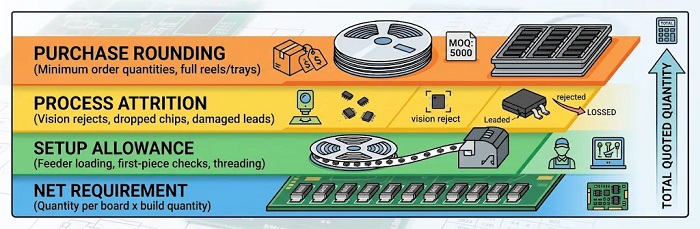
Why is the quoted quantity higher than your BOM?
A quote is built in layers, and only one of those layers is your BOM. We start from the net requirement for each line: quantity per board times build quantity, minus any DNP positions. Everything above that number falls into one of four buckets, and they behave very differently once the build is finished.
| Quantity layer | What it covers | Consumed in the build? | After the build |
|---|---|---|---|
| Net requirement | Parts fitted to the boards you ordered | Yes, they are on the boards | Delivered on your PCBAs |
| Setup allowance | Feeder loading, threading tape, first-piece checks | Mostly | Unused part comes back to you |
| Process attrition | Vision rejects, dropped chips, damaged leads | Only what is actually lost | Unused part comes back to you |
| Rework spares | A replacement when a part has to come off a board | Only if rework happens | Yours if not used |
| Purchase rounding | MOQ, full reel, full tray or tube, order multiples | No | Yours: ship back or hold for the next build |
Two things often get read as attrition and shouldn't be. Extra boards built for first article inspection or functional testing are part of the build quantity, so their full component sets belong in the net requirement. And when a purchased quantity is far larger than any loss could explain, you are almost always looking at a reel or an MOQ, not a factory planning to lose half the parts.
If a line looks wrong, ask us which bucket the extra sits in. We would rather walk you through it than have you approve a number you don't trust.
What drives attrition by package type?
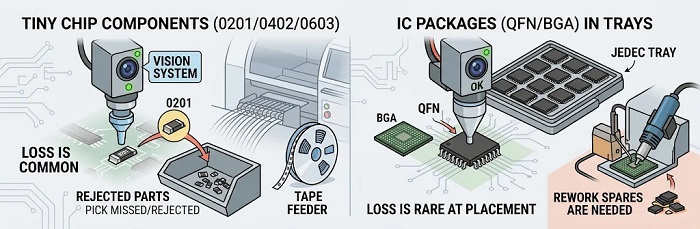
Package size and the way a part is fed decide most of the loss. Unit price decides almost none of it.
A chip component in 0201 or 0402 is picked by a vacuum nozzle and checked by the placement machine's vision system before it lands. If the pick is off-center, or the part sits flipped in its pocket, the machine rejects it, and a rejected chip that small is not recovered and hand-placed. Every line behaves this way, which is why tiny passives carry a small overage on almost every quote. Larger chips and SOT packages pick more reliably and lose fewer parts.
ICs in trays are a different story. A QFN or BGA rejected by vision is usually still a good part and goes back into the tray, so placement alone rarely calls for spares. Where we do ask about a spare is rework. If a BGA has to come off the board after X-ray inspection, the removed part is generally not reused, so a replacement has to come from somewhere. Whether that spare is worth buying up front depends on the device price and how mature the design is.
Through-hole parts and connectors are inserted by hand, often after lead forming. Losses here come from bent pins, forming mistakes and the odd dropped part, and they climb with lead count and fragility.
Two cases deserve their own conversation. Moisture-sensitive devices can be scrapped if their floor life runs out and they can't be baked again within the manufacturer's limits. Parts that are programmed before placement can fail programming. Neither looks like attrition on a datasheet, but both consume parts.
| Package or part type | Typical feed | What causes loss | What we usually ask for |
|---|---|---|---|
| 0201 / 0402 / 0603 chips | Tape on feeder | Pick misses and vision rejects; parts too small to recover | A small overage on every line |
| SOT, SOD, small SOIC | Tape on feeder | Feeder loading, fewer pick issues than chips | A modest overage |
| QFN, LGA, fine-pitch QFP | Tape or tray | Bent leads on QFP, coplanarity rejects | A few spares if the price allows |
| BGA, large ICs | Tray | Rarely lost at placement; replacement during rework | Exact count is often fine; spare if rework is likely |
| Through-hole parts, connectors | Tube, tray or bulk | Hand insertion, lead forming, damaged pins | A small overage for forming and handling |
| Programmed or moisture-sensitive parts | Any | Programming failures, exceeded floor life | Agreed per part number |
Build quantity changes the picture more than most buyers expect. Feeder loading and first-piece checks use about the same number of parts whether we build 10 boards or 1,000, so on a small run the overage looks large next to the net requirement. We assemble orders down to a single board, and that setup cost in parts still applies to the one board. Splitting an order into several deliveries repeats setup each time, because in a high-mix factory the reels rarely stay on the feeders between your runs.
MOQ, full reels and cut tape
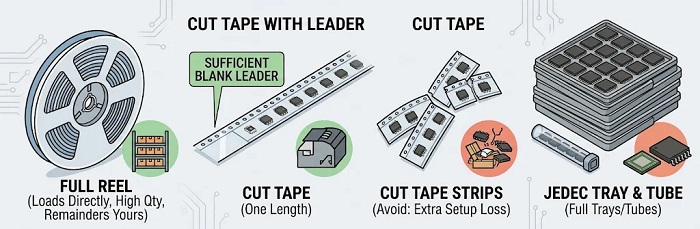
On a turnkey quote, purchase rounding usually adds more parts than attrition does, and it is also the part you have the most control over.
When we source parts for you, we buy from authorized distributors by default, and those distributors sell in fixed units. Some parts carry a minimum order quantity, some ship only in multiples of a tray or tube, and some low-cost passives are priced so that a full reel costs little more than a strip of cut tape. In that last case we generally buy the reel, because the total cost is lower even though the quantity on the quote looks odd. A reel of 0402 resistors holds thousands of pieces. If your build needs a couple of hundred, most of that reel is stock you own, not expected loss.
Packaging also decides whether a part can go on a machine at all, and that feeds straight back into quantity.
| Supply format | Feeder-ready? | Effect on quantity | When it makes sense |
|---|---|---|---|
| Full reel | Yes, loads directly | Buys well above need on small builds; remainder is yours | Cheap passives, repeat builds, parts shared across projects |
| One continuous length of cut tape | Yes, with enough leader to thread the feeder | Needs extra length at the start; little rounding | Small builds of mid-priced parts |
| Several short cut-tape strips | Only with splicing or extra loading | Each strip adds setup loss | Avoid where possible; combine into one length |
| Tray or tube | Yes, on tray or tube feeding | Purchase rounds up to a full tray or tube | Fine-pitch ICs, BGAs, SOICs |
| Loose or bagged parts | Generally no for small chips | Hand placement or unusable; confirm with our engineering team | Last resort, larger parts only |
Cut tape needs blank leader at the front so it can be threaded into the feeder. If the tape is cut right at the first component, some of those parts end up serving as leader. The length a given feeder needs varies with tape width, so confirm with our engineering team before you cut tape for a consigned kit.
What happens to leftover parts?
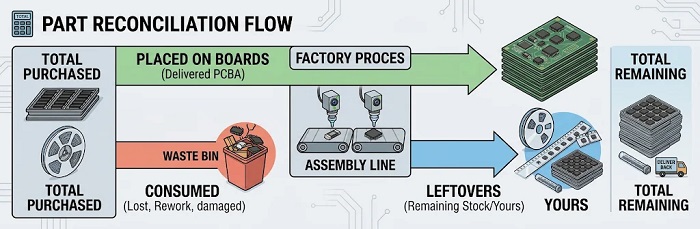
Leftover parts you paid for remain yours. What needs deciding is whether they ship back with the boards or wait for your next build.
On a turnkey order, leftovers are the purchase rounding plus any planned allowance that wasn't consumed. Parts actually lost on the line, such as rejected chips, damaged leads or a replaced BGA, are gone and won't appear in what comes back. The clearest way to see this is a line-by-line reconciliation: purchased, placed, consumed, remaining. Ask for it when you place the order rather than after delivery.
On a consigned build, the parts started as yours, and whatever isn't placed or consumed is returned to you. Counting before shipment and again on receipt is what keeps that reconciliation clean, so send a packing list by line.
If you want leftovers held for a repeat order instead of shipped, tell us at order time. Partial reels of moisture-sensitive devices need dry storage or resealing, and date codes keep aging while parts wait, so storage method and duration are worth confirming with our team case by case rather than assuming.
How can you reduce the overage?
Start with the rounding, because that's where the volume is. Squeezing attrition on a resistor that costs a fraction of a cent rarely pays for the conversation.
• Mark DNP positions in the BOM and take them out of the quantity column. Parts listed against unpopulated positions get bought.
• Consolidate values. Three BOM lines for the same 10 kΩ 0402 from three manufacturers means three reels; one approved part number means one.
• List approved alternates. We don't substitute without your approval, so an in-stock equivalent in a smaller package quantity only helps if you name it up front.
• For consigned kits, send one continuous length of tape per line with the leader intact, not a bundle of short strips.
• Keep expensive ICs at exact count and decide spares part by part, based on rework risk rather than a blanket rule.
• Plan repeat builds together. If a second build is coming, buying one reel for both and having us hold the remainder usually beats buying twice.
• Ask for the quote broken out into net requirement, allowance and purchase rounding before you approve it.
One trade-off to keep in mind: cutting overage to zero on a small run doesn't remove the risk, it moves it. If a line runs short halfway through placement, that line stops until parts arrive, and an idle build almost always costs more than a few extra chips.
FAQ
Are spare boards and test boards counted as attrition?
No. Boards built for first article inspection, functional testing or as field spares are part of the build quantity, so each one needs a full component set. If your quote seems to double-count, check whether the build quantity already includes those boards before you push back on the overage.
Can I send exactly the BOM quantity on a consigned job?
You can, and for high-value parts it is often reasonable. The risk sits with small passives. If a line runs out mid-build, placement for that line stops and we contact you. We won't swap in a different part number without your approval, so a shortage means waiting for parts rather than a quiet substitution.
Why might the purchased quantity differ from the quoted one?
Distributor stock, packaging options and price breaks can move between quote and purchase. A part quoted on cut tape may only be available on a full reel by the time the order is placed. If specific lines matter to you, ask us to re-confirm the purchase plan for them when you order.
Can leftovers from a previous order offset my next quote?
Yes, if they are the same manufacturer part number and still usable. Tell us before purchasing starts and list which lines should come from stock. Moisture-sensitive parts and parts with date code requirements need checking first, since time on a shelf doesn't keep them build-ready.
Why do two quotes for the same BOM show different overage?
Usually because something other than the BOM changed: the build quantity, the number of runs, the packaging assumed for a line, or which approved alternate was in stock. Compare those four before comparing the overage itself.
Helpful Resources
• Full Turnkey PCB Assembly
• Low-Volume PCB Assembly (HMLV)
• How to Create a BOM (Bill of Materials)


