



Bottom line up front: PCBA can't be quoted instantly because BOM pricing changes daily; your quote is built from three components — NRE, assembly fee, and component cost.
If you've requested a PCB assembly (PCBA) quote and wondered why the number looks the way it does, this guide breaks down exactly what you're paying for — and why most reputable assemblers can't give you an instant online price the way they can for bare PCBs.
Why PCBA Can't Be Instantly Quoted Like Bare Boards
Why is bare board cost fixed and calculable?
A bare PCB has a fixed, calculable cost: layer count, dimensions, and copper weight go into a formula. As a general baseline, bare-board fabrication typically runs in the $0.02–$0.05 per square inch range — see our bare PCB pricing guide for the full breakdown of how that figure is built, or get an instant number from our online PCB price calculator.
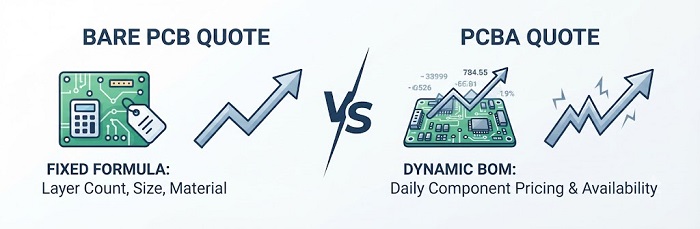
Why isn't PCBA cost calculable the same way?
PCBA pricing depends on your Bill of Materials (BOM) — real-time component pricing, availability, and packaging types that change daily. That per-square-inch baseline above only covers the bare board; it says nothing about what gets added on top once components and labor enter the picture.
How different can two PCBA quotes actually be?
The gap comes from two factors stacking on top of each other, not from board size or the bare-board rate. First, component count itself: a 200-component board simply has ten times more placements to pay for than a 20-component board. Second, assembly technology adds a further multiplier on top of that — THT running 30–80% higher per component than SMT, mixed assembly adding 15–30% over pure SMT, and fine-pitch/BGA/QFN carrying their own surcharge. A 20-component SMT-only prototype and a 200-component mixed-assembly board with BGAs land in different cost categories mainly because both factors compound at once — not because either one alone explains the full difference. That's why PCBA needs a separate, BOM-based quote rather than an extension of the bare-board formula.
Why do reputable assemblers require manual review?
That's why most legitimate assemblers require a manual quote (typically 24–48 hours) rather than an instant calculator.
How do you spot a quote that isn't trustworthy?
Be cautious of any vendor promising an instant PCBA price without reviewing your BOM first — it usually means they're guessing.
The Three Cost Components of Every PCBA Quote
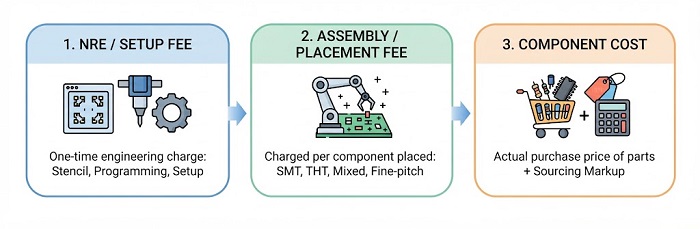
1. NRE / Setup Fee
What does the NRE fee cover?
A one-time engineering charge covering stencil creation, pick-and-place programming, and first-article setup.
Why do low-volume unit prices look so high?
This cost doesn't scale down much with volume — it's why unit prices drop sharply once you move from 10 pieces to 100+.
2. Assembly / Placement Fee
What is this fee actually charged on?
Charged per component placed, not per board.
How does component count affect cost?
A board with 200 components will always cost more to assemble than one with 20, regardless of board size.
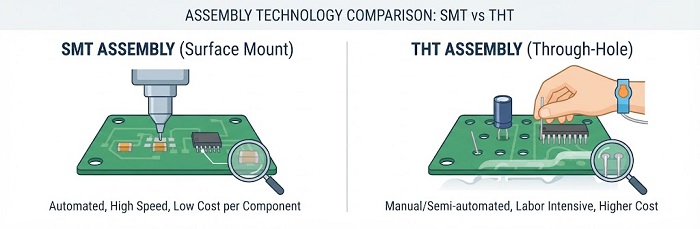
SMT (Surface Mount): Fully automated placement — the lowest per-component cost, and the default choice for most modern designs.
THT / DIP (Through-Hole): Often requires manual insertion or wave/selective soldering. Expect 30–80% higher per-component cost than SMT, since labor is a bigger share of the process.See our SMT vs THT assembly Q&A for a deeper technical comparison.
Mixed Assembly: Combines both on one board. Budget for SMT base pricing plus a separate THT surcharge — typically adding 15–30% to the total assembly cost versus a pure-SMT board.
Fine-pitch / BGA / QFN: Add a further surcharge due to stencil precision requirements and mandatory X-ray inspection after reflow.Check our BGA and fine-pitch assembly capabilities for package types we support.
3. Component Cost
How is component cost calculated?
The actual purchase price of parts, plus a sourcing markup (commonly 5–15%) if the assembler is procuring components on your behalf rather than you supplying them.
Does Layer Count Affect Assembly Price?
Does layer count affect placement cost?
Indirectly. Layer count mainly affects the bare board cost, not the placement cost — a 4-layer and 2-layer board with identical components cost roughly the same to assemble.
As a rough industry reference (always confirm with an actual quote):
| Layer Transition | Typical Bare-Board Cost Increase |
|---|---|
| 2 → 4 layers | ~40–70% |
| 4 → 6 layers | ~30–50% |
What else does adding layers affect?
Higher layer counts do add DFM review time and can extend lead time slightly, since via structures (blind/buried vias, impedance control) require more engineering verification.This is one reason every order includes a free DFM check before production starts.
What to Send to Get an Accurate Quote Fast
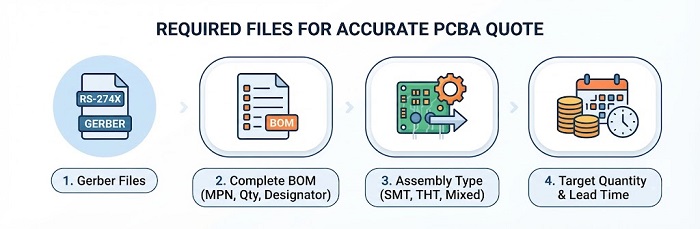
Gerber files (RS-274X preferred) — see how to generate Gerber files from your CAD software
A complete BOM with Manufacturer Part Number, Designator, Quantity, and Description
Your preferred assembly type (SMT-only, mixed, or THT) if you already know
Target quantity and desired lead time
The Bottom Line
Is there one standard price for PCBA?
There's no single "PCBA costs $X" answer.
Why do costs vary so much between boards?
A 20-component SMT-only board and a 200-component mixed-assembly board with BGAs are entirely different cost categories — the difference comes from component count and assembly technology compounding together, not board size.For a general sense of price ranges by board size, see our PCBA cost breakdown by board size.
What's the fastest way to get an accurate number?
The fastest way to get a real number is to submit your Gerber + BOM for a formal quote rather than relying on generic per-square-inch estimates, which only capture bare-board cost, not assembly.Explore our full PCB assembly services to see how SMT, THT, and mixed assembly are handled end to end.
FAQs
1. Why can't PCBA be quoted instantly online like a bare board?
— Because pricing depends on real-time BOM component pricing, availability, and packaging, not a fixed formula. A bare-board baseline (e.g., $0.02–$0.05/sq inch) doesn't extend to assembly.
2. What are the components of a PCBA quote?
— NRE/setup fee, assembly/placement fee (charged per component), and component cost (with a 5–15% sourcing markup if applicable).
3. How much do SMT, THT, mixed assembly, and fine-pitch/BGA differ in cost?
— THT runs 30–80% higher than SMT per component; mixed assembly adds 15–30% versus pure SMT; fine-pitch/BGA/QFN carry an additional surcharge.
4. How does layer count affect assembly pricing?
— It mainly affects bare-board cost (2→4 layers ~40–70%, 4→6 layers ~30–50%), with only an indirect effect on assembly cost, though it can add DFM review time.
5. What do you need to submit for a fast, accurate quote?
— Gerber files (RS-274X), a complete BOM, preferred assembly type, and target quantity/lead time.


