



A PCBA quote is a stack of seven charges in a fairly fixed order: one-time engineering, the bare board, components, assembly labor, test, packaging, and freight. For each line, ask what it covers, whether it comes back on a reorder, and what the vendor assumed about your files. When two quotes sit far apart, the gap is usually in scope, meaning what is included, before it is in anyone's rate.
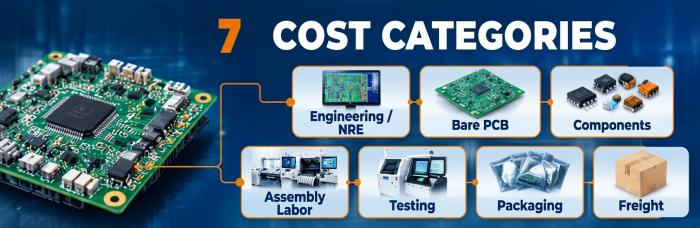
What are the one-time charges at the top of the quote?
One-time charges pay for getting your design running on a line for the first time, and they should be separable from the per-board price. Most quotes carry some mix of NRE, a stencil, and programming, sometimes under different names.
NRE (non-recurring engineering) covers file review and DFM feedback, pick-and-place programs, line setup, and first-article work. It is real work done before any board ships, so we don't read it as padding. What matters is how it is billed. A vendor who lists it on its own lets you see it. A vendor who spreads it across the unit price makes a 50-piece order look cheaper than it is and a 10-piece reorder look worse than it should. Ask which way your quote does it, and ask what recurs when you reorder the same revision.
The stencil is the line buyers most often skip. A laser-cut stencil is cut for one board revision and one side, so a double-sided SMT board needs two, and a Gerber change means a new one. A quote with no stencil line at all deserves a question. The vendor may be jetting solder paste instead of printing it, may have folded the stencil into NRE, or may have missed it. We have a MYCRONIC jet printer, but whether jetting suits your board is a call to confirm with our engineering team, not something to assume from the quote.
Programming is the third one-time item. If your boards need firmware or IC programming, find out who supplies the file, who supplies or builds the programming hardware, and whether the charge is one-time setup or time per board. Both structures exist, and they scale very differently with quantity.
What should the board line match?
The board line should match your fabrication drawing field for field, and it is the quickest line to verify. Check layer count, material, finished thickness, copper weight, surface finish, solder mask and legend, smallest hole, minimum trace and space, and panel format. Finish is the mismatch that slips through most easily. A quote that quietly assumed a different finish than your drawing specifies is cheaper for a reason, and you will hear about it later, usually at order confirmation.
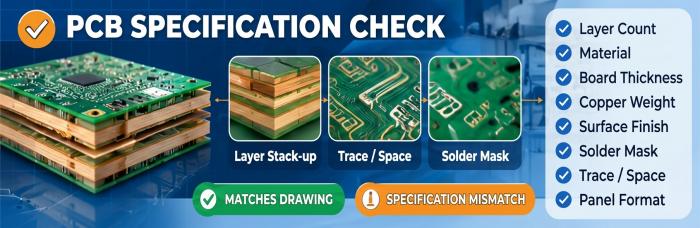
Our standard boards are built to IPC Class 2. If your design needs a tighter acceptance requirement, or something like controlled impedance, put it on the RFQ so the board line prices it, and confirm with our engineering team how it will be handled. Finding out at order time costs you days you did not budget for.
Panel format deserves its own look because it moves two lines at once. It changes how many boards fit on a fabrication panel, and it changes what the assembler needs for rails, fiducials, and break-away. If the fab side assumed no technical rail and the assembly side needs one, someone absorbs the difference, and it is not always the party who quoted it.
Why does the component line move, and what should it show?
The component line is BOM quantity times unit price, plus procurement handling and a purchase overage, rounded up to whatever pack sizes the distributors sell. That makes it the line that differs most between vendors for the same design, and the hardest to compare when it arrives as a single total. We ask for it at part-number level: manufacturer part number, quantity, unit price, source, and a lead-time flag.
How components sourcing is split between you and the assembler, whether turnkey, partial, or consigned, decides which of these lines you carry yourself. A few specifics are worth asking about before you compare totals.
Overage first. Small passives are normally bought with some extra to cover placement attrition, and each vendor sets that differently. Then minimum order quantities and partial reels: if the buy is rounded up to a full reel, find out who owns the leftover parts and whether they are credited, held for your next build, or simply gone. Then substitutions. A quote built on your exact part numbers and a quote built on "equivalents" are not the same quote, and the second one may need your approval later. Last, availability. Parts on long lead time or allocation should be flagged on the quote, not priced as if they were on the shelf. Component prices are a snapshot of one day, so ask for that date and for what changes would trigger a requote.
If you consign parts, this line shrinks, but shortage and overage risk move to you. Ask what extra quantity the assembler needs on supplied parts before you count the saving.
What is inside the assembly and test labor lines?
Assembly labor is priced from how much machine and hand time your board needs, so the drivers are on your drawing, not in the vendor's rate card. Look at placement count, the number of unique part numbers (each needs a feeder setup, which weighs more on high-mix runs than most buyers expect), fine-pitch and bottom-terminated packages, SMT on one side or both, and through-hole count. Through-hole parts that go through selective wave soldering, which we run on a ZSWHPS-11-2, are a different job from parts soldered by hand. Ask which one your quote assumes.
Inspection often hides inside this line. Solder paste is checked by 3D SPI after printing, and boards by 3D AOI after reflow, with offline X-ray for BGAs and other hidden joints. Some vendors roll all of that into the assembly rate and some show it separately. What you want to know is how far each step goes: X-ray on every BGA board, on the first article only, or on a sample? Vendors answer this differently, and the answer changes the price. For your own board, confirm with our engineering team what applies.
Test is where quotes are least comparable. One vendor may price a power-up check while another prices a full functional test with a fixture and a written procedure. If your RFQ says "functional test" and nothing more, each vendor fills the gap with its own assumption. Send the test spec if you have one. Then ask who writes the procedure, who builds and owns the fixture, whether the fixture charge sits in the one-time lines, and how much test time per board is included. Which test fixtures and procedures we can build and run for your product is a question for our engineering team.
What do the packaging and shipping lines cover?
Packaging should state the method (trays, ESD bags, cartons), the labels, and any customer-specific requirements. If you need serial or lot labels, or a particular carton marking, say so in the RFQ, because a quote written without them will not include them.
Shipping is where a cheap quote often turns out to be ex-works. The line should name the Incoterm, the carrier and service level, and who pays duties and taxes. An ex-works quote and a delivered quote are not comparable until you add freight and clearance to the first. Country of origin can also change duty treatment for some destinations. Your customs broker is the right person to ask about that, not the quote.
How do you compare two quotes fairly?
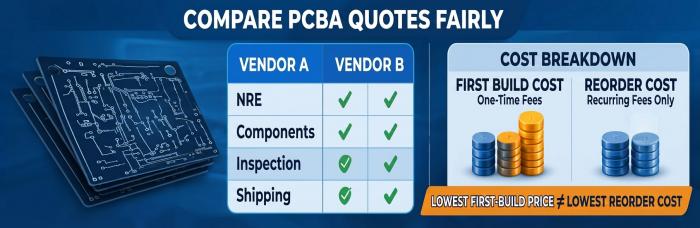
Normalize first, then compare. Send every vendor the same Gerber revision, the same BOM revision, the same assembly scope, and the same quantities, ideally two quantity points so you can see how the one-time charges amortize. Then rebuild each quote in one table and mark every cell where a vendor's number is missing or conditional.
| Quote line | Ask on every quote | Where gaps usually hide |
|---|---|---|
| NRE | Itemized or in the unit price? What repeats on reorder? | Amortized at one quantity only |
| Stencil | One per side? Printed or jetted paste? | No line at all, or counted once on a two-sided board |
| Programming | Who supplies file and hardware? One-time or per board? | Per-board time left out |
| Board | Finish, acceptance class, impedance, panel format | A different finish or class assumed than your drawing calls for |
| Components | Part-number level, overage, MOQ, pricing date, substitutions | "Equivalents" quoted; long-lead parts priced as in stock |
| Assembly | Sides, through-hole method, hand work | Hand soldering or second side not counted |
| Inspection | SPI, AOI, and X-ray: every board or sampled? | X-ray sampled on one quote, full on another |
| Test | Procedure, fixture, ownership, time per board | "Functional test" scoped differently |
| Packaging | Method, labels, special marking | Labels excluded |
| Shipping | Incoterm, carrier, duties and taxes | Incoterm, carrier, duties and taxes |
| Validity | Pricing date, what triggers a requote | Price held only if nothing in the BOM moves |
After the table is filled in, add up two totals per vendor: the first build with everything included, and the reorder with the one-time lines removed. The vendor who wins the first build can lose the second. We usually ask buyers which of the two they will actually place more often, since that is the number that should carry the most weight.
FAQ
Should I ask for NRE to be waived instead of itemized?
Waivers depend on the volume a vendor expects from you, and a waived line is often just a charge moved into the unit price. We would rather see NRE itemized and decide for ourselves. If you expect to reorder, ask for it to be shown separately so you can see exactly what you stop paying after the first build.
One quote has no test line. Is test free there?
Usually it means test is either excluded or limited to in-process inspection. Ask directly what is included, and send your test requirement in writing. A vendor who says "included" without seeing the spec has not priced your test.
Do all vendors need the same BOM revision?
Yes, and the same Gerber revision. If you revise a BOM between quote requests, resend it to everyone and treat any earlier quote as stale. Otherwise you end up comparing two different boards.
Is consigned assembly always cheaper on paper?
The component line shrinks, but you take on shortage risk, overage risk, and the lead time of every part you buy. Compare it on total cost to a finished board, not on the line that disappeared.
What happens to the quote if I change the design after approving it?
A Gerber change usually means a new stencil and a fresh board line. A BOM change moves the component line, and a changed test requirement moves the test line. Ask for a revised quote that shows which lines changed, rather than a new total with no breakdown.
Helpful Resources
• Full Turnkey PCB Assembly
• Low-Volume PCB Assembly (HMLV)
• How to Create a BOM (Bill of Materials)
• PCB Assembly Cost Breakdown: What Actually Drives Your Quote
• PCB Kitting — How Component Verification Works Before Assembly Starts


