



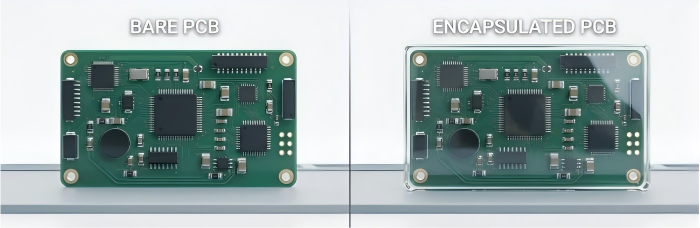
PCB encapsulation is a protective operation applied in electronics production to protect the printed circuit boards (PCBs) against environmental and mechanical stress. Encapsulation involves encircling the PCB and its parts in a solid or gel-like substance, which creates a closed system that isolates the vulnerable circuitry against moisture, dust, chemicals, and vibrations.
The technique is common among industries where electronics should work strongly in severe conditions such as automotive devices, industrial devices and outdoor devices.
Significance of PCB Encapsulation
PCB encapsulation is a technique used to protect circuits by totally enveloping them with a protective substance. This is done to protect the components against moisture, dust, chemicals, vibration and high temperatures and greatly enhance durability and reliability. It is also used to improve electrical insulation and mechanical strength and is used in operating devices in harsh environments like automotive, industrial and outdoor electronics. PCB encapsulation is important in the delivery of long-term electronic performance by increasing the life of the product and decreasing the likelihood of failure.
Common PCB Encapsulation Materials
Epoxy Resins
Epoxy resins are common because they have good adhesion, high mechanical strength and good chemical resistance.
Silicone Compounds
Silicone materials are flexible and have better thermal stability and are appropriate in those applications that are subjected to changes in temperature.
Polyurethane Resins
Polyurethane resins provide flexibility, durability and resistance to moisture in a balanced way.
Other Special Polymer Materials
Advanced polymers more specific in application could be used in some applications, including thermal conductivity, flame resistance, electrical insulation.
PCB Encapsulation Methods
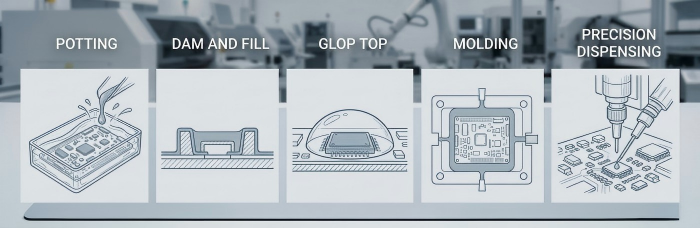
Encapsulation compounds can be applied in a number of ways based on the PCB design and the level of protection required.
Potting
The most popular encapsulation method is potting. A liquid compound is then poured over the PCB which is then placed in a housing or enclosure. Once cured, the compound becomes a solid protection block. This method offers the highest level of protection and is hard to repair.
Dam and Fill
In the dam-and-fill technique, a dam is formed surrounding a set of particular elements and then the encapsulant is poured into the dam. This method enables the engineers to shield important areas of the PCB and leave other sections exposed.
Glop Top
This technique is frequently applied in chip-on-board designs. A little high-viscosity resin is laid directly on a microchip and forms a dome-shaped cover.
Molding
In a mold, the PCB is placed in a mold and encapsulation material is injected into the mold. This method also guarantees a full coverage and regular shapes, which makes it practical in a high volume production.
Precision Dispensing
Automated dispensing systems deposit encapsulation materials accurately on areas that are selected. The technique is applicable in high density or complex circuit boards.
PCB Encapsulation Process
Encapsulation processes are different in various ways, but the general steps are similar.
Cleaning and Preparation
A PCB should also be cleaned properly to eliminate dust, oils and residues of flux. Any impurity can inhibit the adhesion of encapsulation compound. Baking or drying may be necessary to remove moisture.
Masking Sensitive Areas
Some parts have to be left exposed such as connectors, switches and test points. Provisional masking material is used in these areas.
Combining the Encapsulation Compound
A majority of encapsulants are two-part compounds that are required to be blended in a specific ratio. Proper mixing guarantees uniform drying and sound operation. To get rid of the trapped air bubbles, de-gassing can also be done.
Application
Depending on the method of choice, the compound can be poured, injected or dispensed automatically. It is aimed at having full coverage without any air pockets.
Curing
Once applied, the compound of encapsulation should cure and harden. Curing methods include:
Room-temperature curing
Heat curing
UV Cure of special materials
The final curing process will dictate the terminating mechanical and electrical characteristics of the encapsulant.
Inspection and Testing
After curing, the encapsulated PCB is inspected and electrically tested so as to verify that it has not been impaired by the process.
Quality checks usually involve:
Voids or cracks inspection
Functional electrical examinations
Stress testing of the environment
PCB Encapsulation vs. Conformal Coating
Both conformal coating and PCB encapsulation are very popular techniques of covering electronic assemblies, but their usage is different.
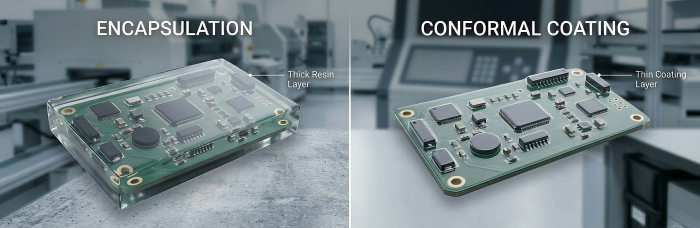
PCB encapsulation is the ultimate enclosure of the circuit board in a mold of resin that is thick enough and creates a solid layer to protect the parts. The approach offers excellent resistance against moisture, chemicals, mechanical shock, and vibration hence suitable to the electronics deployed in harsh environments.
Conformal coating, conversely, is the process that coats the PCB surface and its components with a thin layer of protection. Although it still provides some protection against moisture, dust and minor contaminates, it does not provide as much mechanical protection as full encapsulation. Nevertheless, conformal coating is less cumbersome and easier to check, repair and rework.
Generally, encapsulation is favored with the applications in extreme environmental conditions whereas conformal coating is frequently adopted with the products that can be lightly encased and are easy to maintain.
Typical Applications of PCB Encapsulation
Automotive systems: Covers control modules against vibration, heat, and moisture.
Industrial electronics: Enhances life cycle of control boards at the factory.
LED lighting systems: Coats circuits and drivers with moisture and dust resistance.
Outdoor and marine gadgets: Protects against environmental degradation in the open environment.
PCB encapsulation is a process that is most efficient in enveloping the electronic circuit to shield it against environmental risks, mechanical pressure and electrical breakdowns. Enhancing reliability in harsh conditions and greatly increasing product life by encasing a circuit board in a durable insulating compound, manufacturers can greatly increase the useful life of a product. Nevertheless, effective encapsulation must be done with a close choice of materials and adequate control of the processes and with careful product design.
If you’re developing electronic products, partnering with an experienced manufacturer can make the process much smoother. PCBCart, specializing in PCB fabrication and assembly, provides reliable solutions to help turn your designs into high-quality, durable products. With advanced capabilities and strict quality control, PCBCart ensures your electronic designs perform reliably in real-world conditions, saving time and reducing production risks.
Start Your PCB Fabrication and Assembly with PCBCart
Helpful Resources
• High-Tg PCB Fabrication
• Conformal Coating Application Guide
• LED PCB Fabrication
• Automotive PCB Design Considerations
• Automated X-ray Inspection (AXI)


