



In the current highly competitive electronics manufacturing services (EMS) environment, cutting initial expenses is a priority most of the time- particularly when a prototype is required. PCB prototype services that are low-cost are well-suited to startups and low budgets, as their low cost and fast turnaround make them appealing.
But, behind the scenes, these services are often associated with a host of hidden costs that can greatly contribute to the overall cost of ownership (TCO) and compromise project success. When considered in the entire product lifecycle, such as design validation to mass production, the cheapest option often turns out to be the most expensive.
Low Price vs. True Cost: A False Equation
On the surface, PCB prototyping at low costs seems to provide apparent savings. However, pricing system within this segment may not consider important aspects like:
Engineering support
Design for manufacturability (DFM) checks
Testing and inspection
After-sales technical assistance
Extra charges on setup, stencil production, test and rewrites will add up quickly. What might have started as a cheap quote, may grow to a much higher final cost when all the necessary services are encompassed.
Trade-Offs in Quality and Their Downstream Effect
Limitations of Material and Process
The budget PCB services are often based on lower grade materials, less controlled fabrication areas and simplified processes. This may result in:
Poor solderability
Reduced thermal stability
Inconsistent impedance control
These problems are particularly troublesome in EMS projects where reliability and repeatability are of paramount importance.
Manufacturing Defects
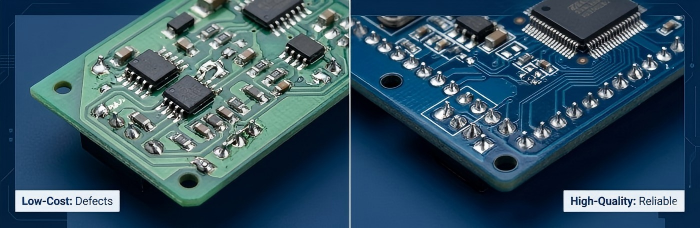
Some of the providers reduce inspection procedures to sustain low prices. This enhances the chances of:
Bridging solder and cold joints
Mismatched or tombstoned elements
Open or short circuits
A slight defect rate at the prototype level can be scaled up to cause serious problems such as loss of yield and field failures.
Rework and Iteration Costs Engineering
Rework is one of the least considered hidden costs.
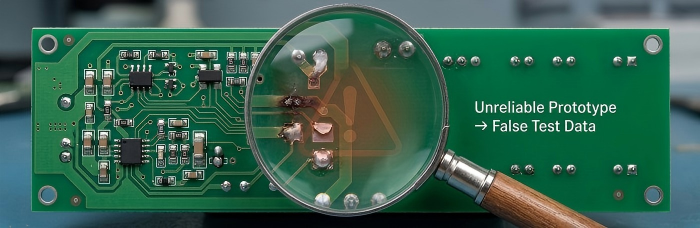
Poor quality prototypes may fail preliminary validation or give unreliable test scores. This leads to:
Multiple redesign cycles
Additional prototype orders
Increased engineering hours
Every re-spin of a PCB does not only entail both direct costs on re-fabrication and re-assembly, but also sets back the development schedule. These delays may have a ripple effect on supply chains and production timelines, particularly in complex EMS projects.
Inaccurate Validation and Design Risk
The prototype should be used to test design intent. But in the case where the very prototype is unsound, it brings about false inferences:
Design flaws can be confused with functional failures due to poor assembly.
Signal integrity problems can be due to inconsistencies during fabrication and not layout.
Real-world conditions may not be reflected in thermal performance.
This puts a risky situation where engineering decisions will be made using faulty data which may result in unnecessary redesigns or incorrectly designed products going into production.
Hidden Costs in PCB Assembly
The cost of PCB assembly (PCBA) is not just the cost of component placement. Some of the most frequently neglected factors are:
Sourcing of components and unstable prices
Minimum order quantities (MOQs)
Stencil and tooling expenses
Setting up and programming costs
Testing (AOI, X-ray, functional testing)
The low-cost providers might only offer basic assembly whereby these components are added as a supplement. Moreover, poor sourcing of components can bring in fake or quality components which can be more risky in the long run.
Inefficiencies in Supply Chain and Procurement
Low cost PCB prototype services do not always have a sound supply chain management. This can result in:
Delays due to component shortages
Replacement with non-equivalent parts
Lack of traceability
In the case of EMS providers, it interferes with production planning and makes it challenging to assure quality. In controlled businesses, lack of traceability may go as far as to certify the product.
Gaps in Compliance, Certification, and Documentation
International standards and certifications have to be followed in many EMS projects. Low-cost providers might not be entirely supportive of:
Material certifications
Process documentation
conformity to industry standards (e.g., IPC guidelines)
This can lead to the situation where prototypes will have to be reassembled with qualified suppliers and then subjected to certification tests, resulting in enormous delays and redundancy of costs.
Barriers of Logistics, Communication and Time Zone
In outsourcing to low cost offshore suppliers, there are operational costs that are hidden and are caused by:
Communication delays
Language barriers
Time zone differences
Customs and shipping costs
Long lead times, and miscommunication may slow down iteration cycles, and introduce errors, which eventually will affect time-to-market.
Intellectual Property and Data Security Risks
Low-cost services can be implemented in the environment with less robust IP protection. Risks include:
Illegal reuse of design files
Data leakage
Reverse engineering
In the case of companies that develop proprietary technologies, it may cause the companies to lose their competitive advantage and cause them long-term financial harm.
Opportunity Cost: Delays That Impact Market Success
One of the most important aspects of EMS projects is time. Delays due to prototypes of poor quality, rework, or supply chain problems may lead to:
Late product launches
Lost revenue opportunities
Reduced market competitiveness
Given that even minor failures during prototyping can have drastic implications on a business.
When Low-Cost Prototyping Might Be Suitable
Nevertheless, low-cost PCB prototype services may still come in handy in cases where they are limited:
Early-stage proof-of-concept designs
Non-critical, low-complexity circuits
Educational or experimental projects
Nevertheless, when the design has neared the production stage or when the design requires a high level of reliability, then investing in the higher-quality services is generally the more cost-effective approach.

Overall, although low-cost PCB prototype options may seem like an effective means of saving upfront costs, they tend to introduce unaccounted expenses, which could significantly affect EMS projects. Problems like quality variances, rework in the engineering process, supply chain inefficiencies, compliance delays, and extended time periods to market quickly offset all initial savings. In firms that seek to deliver dependable products to the market at minimal cost, it is important to consider the total value of a product, instead of the initial price, to reduce the likelihood of risk and cost in the long term.
By selecting a reliable partner such as PCBCart, these uncertainties can be eliminated by effective quality control, clear pricing, good supply chain management and full engineering support. Having established a track record of prototyping and full-scale manufacturing, PCBCart enables seamless transition between projects, or more accurately predictable results. To save on the hidden costs and to shorten your project schedule in the EMS industry, it is the right time to see how PCBCart can help make a tangible difference.
Helpful Resources
• Differences Between PCB Prototyping and Full Spec Production
• When to Use PCB Prototype Service and When to Switch to Standard Production Service
• 6 Effective Ways to Cut PCB Assembly Cost Without Sacrificing Quality
• How to Evaluate A PCB Manufacturer or A PCB Assembler


