



In the electronics manufacturing industry, testing printed circuit board assemblies (PCBAs) is a critical step to ensure product reliability, functional stability, and compliance with quality standards. Among various electrical testing solutions, In-Circuit Testing (ICT) and Flying Probe Testing (FPT) are the two most widely adopted methods. While both are designed to detect common manufacturing defects such as open circuits, short circuits, incorrect component values, reversed polarity, and abnormal resistance or capacitance, they differ significantly in working principles, cost structures, application scenarios, and flexibility. Understanding these differences can help you select the optimal testing strategy that aligns with your production volume, project budget, development cycle, and PCB design complexity.
What is In-Circuit Testing (ICT)?
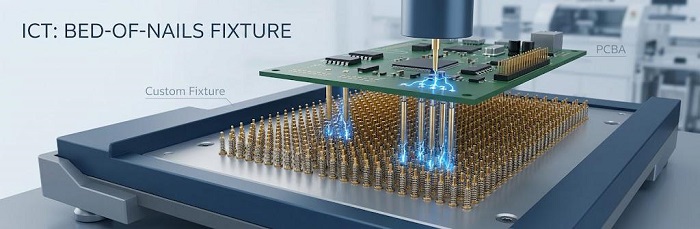
In-Circuit Testing (ICT) is a fixed-fixture electrical testing method that uses a custom-designed bed-of-nails fixture to make simultaneous contact with predefined test points on a PCBA. The fixture contains precision spring-loaded probes that correspond to the circuit nodes of the target board. Once the fixture is installed, the ICT system can quickly apply electrical signals, measure component parameters individually, and verify the integrity of each solder joint and discrete component.
ICT is capable of not only basic electrical tests but also partial digital logic function verification, on-board FPGA configuration checks, and LED color and brightness validation. Due to its parallel contact mechanism, ICT completes a full board test in a very short time—usually around 30–60 seconds per unit—making it highly efficient for mass production scenarios.
Core Advantages of ICT
Ultra-fast test speed: Simultaneous contact with all test points drastically shortens the single-board test cycle.
Low per-unit cost: After the initial fixture investment, the marginal cost of testing each additional board is extremely low.
Comprehensive component verification: Supports independent testing of resistors, capacitors, inductors, integrated circuits, and logic devices.
Stable mass production performance: Suitable for long-term, high-volume continuous manufacturing with consistent test results.
Limitations of ICT
High upfront costs: Custom fixture design and manufacturing involve significant non-recurring engineering (NRE) expenses.
Long development lead time: Fixture production and program debugging typically take days to weeks.
Poor flexibility: Any PCB design modification may require fixture rework or replacement, increasing time and cost.
Limited test scope: Cannot test connectors, non-electrical components, or the collaborative operation of multiple components.
What is Flying Probe Testing (FPT)?
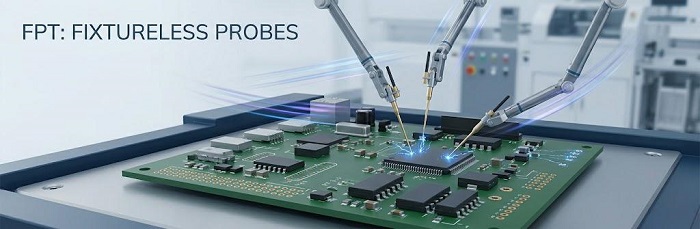
Flying Probe Testing (FPT) is a fixtureless testing technology that uses 4–20 high-precision, electrically controlled movable probes to sequentially "fly" to test points on both sides of a PCBA. Guided by CAD data and dedicated test programs, the probes accurately contact component pins, bond pads, or vias to perform electrical measurements and continuity checks without custom mechanical jigs.
FPT is inherently adaptive and ideal for early-stage prototypes, small-batch production, or frequently revised designs. It eliminates fixture costs and shortens preparation time, as test programs can be quickly generated and modified. Although single-board test time is longer than ICT—usually 5–15 minutes per unit—it offers superior convenience in low-volume scenarios.
Core Advantages of Flying Probe Testing
No custom fixtures required: Eliminates NRE costs and long lead times associated with fixture manufacturing.
Low upfront investment: Significantly reduces initial expenditure for prototypes and small-batch projects.
High flexibility: Test programs can be rapidly updated to adapt to PCB layout changes or design iterations.
Wide applicability: Suitable for high-density, small-pitch, and complex boards where fixture design is difficult.
Limitations of Flying Probe Testing
Long single-board test duration: Serial probe movement results in lower efficiency compared to ICT.
Higher per-unit cost: Less cost-effective in mass production due to extended test cycles.
Restricted test coverage: Cannot test non-active components, connectors, or system-level collaborative functions.
Head-to-Head Comparison: ICT vs. Flying Probe Testing
To help you make a straightforward choice, here is a detailed comparison of key dimensions:
| Comparison Item | In-Circuit Testing (ICT) | Flying Probe Testing (FPT) |
| Fixture Requirement | Custom bed-of-nails fixture required | No dedicated fixture needed |
| Upfront Cost | High (fixture + programming) | Low (only programming cost) |
| Test Development Time | Long (fixture manufacturing + debugging) | Short (rapid program generation) |
| Single-Board Test Time | ~30–60 seconds (fast) | ~5–15 minutes (slow) |
| Per-Unit Test Cost | Very low (mass production) | Relatively high (small batches) |
| Flexibility to Design Changes | Low (fixture may need modification) | High (program updates only) |
| Ideal Production Volume | Medium–high volume (>1,000 units) | Prototypes, low–medium volume (<1,000 units) |
| Test Coverage | Components, logic, basic functions | Components, continuity, polarity, open/short circuits |
| Adaptability to Complex PCBs | Limited by fixture design | Excellent for dense, miniaturized boards |
How to Choose the Right Test Method?
The selection between ICT and Flying Probe Testing should be based on your project’s actual needs, focusing on four core factors: production volume, budget, design stability, and delivery cycle.
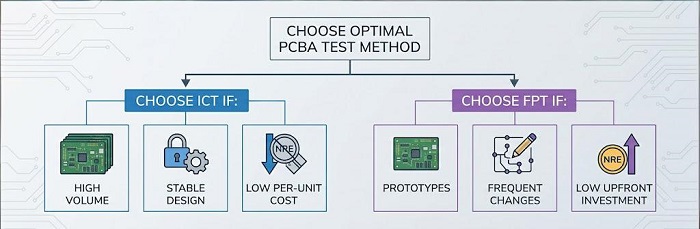
Choose ICT if:
You are preparing for medium-to-high volume mass production.
The PCB design is stable and will not undergo frequent changes.
You prioritize long-term per-unit cost reduction and can bear upfront fixture expenses.
You require fast testing efficiency to match high-speed assembly lines.
Choose Flying Probe Testing if:
You are in the prototype, R&D, or small-batch trial stage.
The PCB design is not finalized and may require multiple iterations.
You want to minimize upfront investment and avoid fixture costs.
You are working with high-density, complex boards that are difficult to fixture.
In many practical projects, a combined testing strategy is often adopted: use Flying Probe Testing for prototype verification and small-batch debugging, then switch to In-Circuit Testing after the design is finalized and mass production begins. This approach balances flexibility, cost, and efficiency to maximize overall benefits.
Partner with PCBCart for Professional Testing Solutions
Selecting the right testing method is only the first step—relying on a professional, experienced manufacturing and testing partner ensures that your PCBAs achieve stable, reliable, and consistent quality.
PCBCart is a leading one-stop PCB & PCBA manufacturing service provider, offering full support for both In-Circuit Testing (ICT) and Flying Probe Testing (FPT) throughout the product lifecycle—from rapid prototyping to mass production. Our advanced testing equipment, standardized operating procedures, and IPC-A-610 Class 2/3 compliant quality system guarantee comprehensive defect detection and accurate test results for every board.
Whether you need fixtureless flying probe testing for prototype flexibility or high-efficiency ICT for mass production, PCBCart provides customized test solutions, professional DFT (Design for Test) guidance, and detailed test reports to support your project’s success. We are committed to helping you choose the most cost-effective and reliable testing strategy, ensuring your electronic products achieve exceptional quality and market competitiveness.
For more information about our PCB assembly and testing services, contact PCBCart today to get a personalized solution tailored to your needs.
Helpful Resources
• Comparison of AOI, ICT and AXI and When to Use Them
• Flying Probe Test for PCB and PCBA
• Printed Circuit Board Assembly Inspection Methods
• Free DFM Check


