



Genuine-parts risk is real but manageable — verification comes down to sourcing hierarchy (authorized distributor first, manufacturer-direct second, broker-sourced only as a last resort with incoming inspection), not luck, and any supplier should be able to name their sourcing tiers in writing.
The Scale of the Counterfeit Problem
Industry counterfeit-reporting organizations have historically tracked tens of thousands of suspect-part incidents per year across the global electronics supply chain, concentrated heavily in allocation-constrained categories: MOSFETs, connectors, analog ICs, and obsolete/end-of-life parts. Risk is not evenly distributed — a common passive resistor bought from any reputable channel carries near-zero counterfeit risk, while a scarce, allocated semiconductor bought through an unverified broker carries meaningfully elevated risk.
The Sourcing Hierarchy That Actually Matters
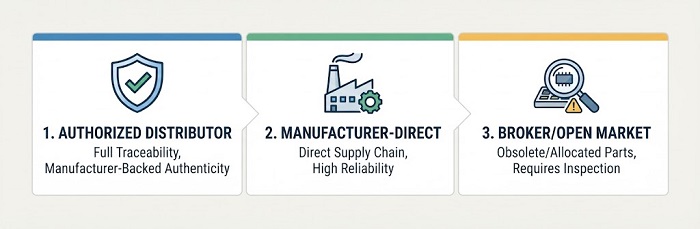
1. Authorized distributor — full traceability to date code and lot, manufacturer-backed authenticity. This should be the default for every part that's available this way.
2. Manufacturer-direct — equally reliable, typically used for high-volume or specialized parts.
3. Broker/open market — reserved for genuinely obsolete or allocated parts with no authorized-channel availability, and should always be paired with incoming inspection.
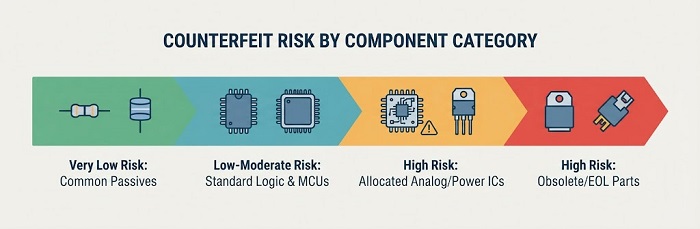
Verification Methods and What They Actually Catch
| Method | What It Catches | Limitation |
|---|---|---|
| Visual/dimensional inspection | Remarking, resurfacing, wrong package | Doesn't catch internal die substitution |
| X-ray inspection | Internal package/die mismatch, wrong bond wires | Requires trained interpretation |
| Solderability testing (J-STD-002) | Poor plating, counterfeit lead finish | Doesn't confirm die authenticity |
| Decapsulation | Confirms actual die matches datasheet | Destructive, used for high-risk/high-value parts only |
| Lot/date-code traceability | Confirms chain of custody | Only as good as the paperwork provided |
A Real-World Scenario
A buyer's BOM includes an analog IC that shows a 26-week lead time at the authorized distributor. A broker offers the same part number "in stock" at half the price. A supplier following proper sourcing discipline would flag this to the buyer, recommend either waiting for authorized stock or accepting broker stock only with incoming X-ray and solderability testing — rather than silently sourcing the cheaper broker part to protect margin or timeline. In this case, the buyer opts for the broker part with full inspection, given a hard product-launch deadline. The X-ray inspection confirms the internal die and bond wires match the expected package, and the parts pass solderability testing — giving the buyer a documented basis for accepting the risk, rather than an unverified gamble on a suspiciously convenient stock position.
How Counterfeit Risk Varies by Component Category
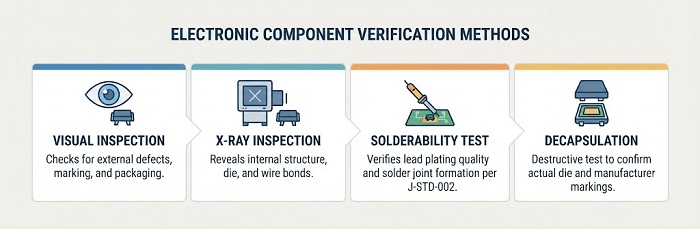
Counterfeit exposure isn't uniform across a BOM — it concentrates heavily in specific categories, and knowing which lines on your BOM carry the most risk helps you allocate scrutiny where it actually matters.
| Component Category | Typical Counterfeit Risk | Why |
|---|---|---|
| Common passives (resistors, capacitors) | Very low | Abundant supply, low value per unit, little incentive to counterfeit |
| Standard logic ICs, common MCUs | Low-Moderate | Generally available through authorized channels at reasonable lead times |
| Analog/power ICs on allocation | High | Scarcity plus high per-unit value makes these the most targeted category |
| Obsolete/EOL parts | High | No authorized-channel supply left, forcing broker sourcing by necessity |
| Connectors and mechanical parts | Low-Moderate | Lower per-unit value, but remarking/resurfacing still occurs |
This is worth mapping against your own BOM before you request a quote: if your design leans heavily on the "very low" and "low-moderate" categories, your overall counterfeit exposure is modest even with a standard sourcing approach. If it includes even one or two allocated analog ICs or EOL parts, that's where your sourcing-verification conversation with the supplier should concentrate, rather than spreading equal scrutiny across every line item.
What to Do When a Critical Part Is Only Available Through a Broker
When an obsolete or heavily allocated part has no authorized-channel path at all, the right response isn't to refuse the part — it's to escalate the verification rigor to match the risk. For a low-value, low-criticality part in this position, visual inspection and lot/date-code documentation may be sufficient. For a part that's expensive, safety-critical, or going into a regulated product, ask specifically for X-ray inspection at minimum, and consider decapsulation testing on a sample from the lot if the financial and safety stakes justify the destructive test cost. The mistake to avoid is treating "no authorized source exists" as a reason to skip verification rather than a reason to increase it.
Common Mistakes Buyers Make on Component Authenticity
• Assuming price alone signals risk. A part priced only slightly below authorized-distributor pricing can still be counterfeit; conversely, a suspiciously large discount is a stronger signal than a modest one, so don't calibrate trust purely on how cheap an offer looks.
• Not asking for sourcing details until after a failure occurs. By the time a counterfeit part causes a field failure, it's too late to change the sourcing decision — ask about sourcing hierarchy at quoting time, not after a problem surfaces.
• Treating "authorized distributor" as a self-certifying claim. Ask which specific distributors the supplier uses by name; a supplier that can rattle off 3-5 named, checkable distributor relationships is giving you a verifiable claim, while a vague "we only use trusted sources" is not.
• Skipping incoming inspection on broker-sourced parts to save time. If a part must be broker-sourced due to obsolescence, skipping the additional inspection step to save a few days is the single highest-leverage mistake a buyer can make on that specific line item.
How to Push for Better Sourcing Transparency
Ask your supplier directly for their top authorized distributor relationships by name, and cross-check that those distributors are genuinely authorized for the specific manufacturers in your BOM — distributor authorization is manufacturer-specific, not blanket. For any part flagged as broker-sourced, request the specific incoming inspection method used (visual, X-ray, solderability, or decapsulation) rather than accepting a generic "we inspect everything" assurance. If your product is safety-critical or regulated, it's reasonable to request that broker-sourced parts be flagged explicitly on your Certificate of Conformance, distinct from authorized-channel parts, so your own quality records reflect the actual sourcing risk profile of each unit.
It's also worth asking how your supplier's incoming inspection process is documented, not just what it covers. A supplier that can produce a sample inspection report — showing what was checked, by whom, and against what acceptance criteria — is demonstrating a real quality process rather than a marketing claim. This matters most for parts you can't personally inspect before they're soldered onto a board: once a component is reflowed, your only remaining verification path is the paperwork trail the supplier generated before assembly, which is exactly why asking for this documentation upfront, rather than after a suspected failure, is the higher-leverage move.
Checklist Before You Trust a Supplier's Sourcing
• Ask for their sourcing hierarchy in writing: which named distributors, and under what conditions broker sourcing is used.
• Request date codes and lot numbers during BOM confirmation, before production.
• For safety-critical or regulated designs, ask whether incoming inspection includes solderability testing per J-STD-002.
• Confirm whether a Certificate of Conformance documenting sourcing will ship with the order.
• For any part sourced through a broker, ask what specific incoming inspection was performed.
• Cross-check that a named distributor is actually authorized for the specific manufacturer in question, not just authorized in general.
FAQs
1. What's the actual risk of counterfeit parts today vs. during 2021-2023 shortages?
Lower than the peak shortage years but still meaningfully concentrated in obsolete or allocated part categories, so risk should be assessed per-component rather than assumed uniformly low across an entire BOM — a passive-heavy design carries very different exposure than one leaning on scarce analog ICs.
2. Can I request date codes before production starts?
Yes — most suppliers can provide this during the BOM confirmation stage, and it's worth building into your standard pre-production checklist rather than requesting it only when something feels off.
3. Does authorized-distributor sourcing cost more?
Sometimes 5-15% more than gray-market pricing, but that premium buys manufacturer-backed traceability and effectively eliminates most counterfeit exposure on that line item, which is a favorable trade for anything but the most price-sensitive, low-risk components.
4. Should I ever allow broker-sourced parts?
Only for genuinely obsolete parts with no authorized-channel availability, and always paired with an explicit incoming inspection step documented on your records.
5. What documentation should I keep for traceability?
Lot numbers, date codes, and the Certificate of Conformance for every production run — retained for at least as long as your product's own warranty period.


