



In today’s fast-paced industrial world, automated systems are being used outside the traditional factory. From outdoor energy solutions to transportation systems and heavy industry, electronics are being used in environments that are far from ideal.
In terms of PCBA reliability, when we talk about these kinds of environments, failure is not just undesirable; it is a threat to the viability of the enterprise itself. And here, we find that the ability of the PCBA to withstand such an environment through conformal coating becomes a critical enablement mechanism, allowing the PCBA to operate reliably in such hostile environments.
What Is PCBA Conformal Coating?
Conformal coating consists of a thin layer of polymer film deposited on the surface of the PCBA. The coating is transparent, dielectric, and covers the surface of the PCBA, including its contours.
Unlike other protection mechanisms, conformal coating offers high-performance protection in a very small size, and this is particularly advantageous in a world that is increasingly compact, such as PCBA-based automation solutions.

Key Benefits of Conformal Coating for Industrial Automation
Protection Against Moisture and Humidity
Industrial automation may be exposed to high levels of humidity, condensation, or even direct exposure to water. The conformal coating layer prevents moisture and humidity from reaching the PCB, hence protecting the circuit components against corrosion and electrical leakage.
Resistance to Dust and Contaminants
Dust, dirt, and other particles may settle on the PCB surface, causing unwanted conductive paths. The conformal coating layer insulates these contaminants, ensuring that the circuit components operate within desired limits.
Chemical and Corrosion Resistance
Industrial automation may be exposed to chemicals such as solvents, oils, or even cleaning agents. The conformal coating layer offers excellent resistance to these chemicals, hence protecting the components and ensuring that the solder joints are not affected.
Improved Electrical Insulation
The conformal coating layer offers improved electrical insulation, hence preventing arcing and signal interference, especially for high-voltage applications.
Enhanced Mechanical Reliability
The conformal coating layer is especially important for applications that are exposed to high levels of vibration, such as automated machines or even transportation systems.
Choosing the Right Conformal Coating Material
Choosing a proper conformal coating material is vital to attain maximum performance in industrial applications.
Acrylic coatings are commonly used for industrial applications due to their cost-effectiveness and ease of reworking.
Silicone coatings are recommended for use in extreme temperature and vibration conditions, as they are flexible and can withstand extreme temperatures.
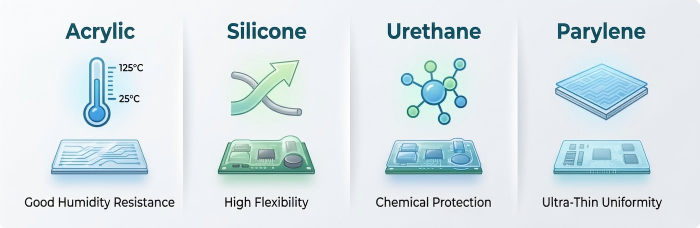
Urethane coatings are also a good choice for industrial applications, as they are highly resistant to chemicals and abrasives.
Parylene coatings are recommended for use in extreme conditions, when maximum protection and uniformity are required.
Each material has its own advantages, and the right choice of material depends on environmental conditions and product requirements.
Application Process: The Key to Consistent Quality
Although the materials used are of the highest quality, they will never produce the expected result without the application process. A good conformal coating application process includes several important steps.
First, the boards are cleaned to ensure that no contaminants will interfere with the adhesiveness of the coating. Precise application, usually done with the help of automated selective coating equipment, is also important to ensure that the boards are uniformly coated even with complex board layouts. Curing is also an important aspect to ensure that the coating is fully effective. Finally, masking is necessary to ensure that connectors are protected.
A good application process will not just produce high-quality products but will also save on rework and production costs.
Conformal Coating Vs. Potting: Which Is Better?
Both conformal coating and potting are used to protect the PCBAs, but they are used differently.
While conformal coating is used to provide a lightweight and cost-effective solution with accessibility for inspection and maintenance, potting completely encapsulates the board. This provides maximum protection but renders any rework impossible. Moreover, it also adds to the weight.
In industrial automation applications, conformal coating is the better choice.
Design Tips for Better Coating Performance
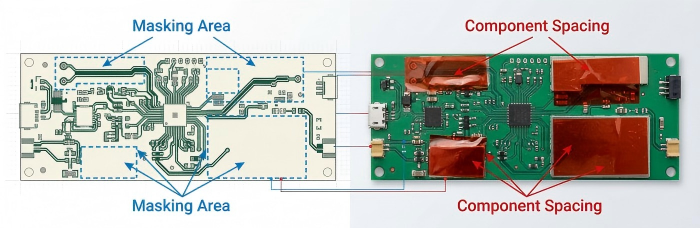
In order to obtain maximum benefits from a conformal coating, consideration should be given to the coating during the early stages of the PCB design process. The spacing between components and the definition of masking areas are important to ensure that functional problems are avoided, while ensuring that compatibility exists between materials and different coatings used.
Environmental testing is an important factor that determines the performance of conformal coatings.
Why Conformal Coating Is Essential for Industrial Automation
Industrial automation is spreading its domain to increasingly hostile environments, and the need for reliable and ruggedized electronic components is bound to grow, and conformal coatings can play an important role in this area to offer a solution that would protect PCBAs from hostile environments, resulting in a reduction of failure rates and increasing product lifespan.
For manufacturers and OEMs, conformal coatings are no longer just a means to protect electronic components, but a means to ensure continuity and a low cost of ownership.
Partner with PCBCart for Reliable PCBA Solutions
For industrial automation, reliability begins at the manufacturing stage. From material choice to precision coating techniques, every step counts.
At PCBCart, we provide innovative solutions for PCBA manufacturing and conformal coating, specifically developed for industrial applications. With a strong emphasis on quality, consistency, and customer needs, we help create reliable high-performance products for you—ready to perform reliably, wherever they are deployed.
Boost Reliability Today with Expert PCBA Coating Solutions
Helpful Resources
• General Aspects You Should Know about Conformal Coating Applied on PCB
• PCB Protection: Potting or Conformal Coating?
• How to Ensure the Quality of PCBs
• Printed Circuit Boards Assembly Process


