



For procurement teams managing high-mix, low-volume (HMLV) electronics programs, lead time is rarely a single figure. It is the sum of several sequential stages, each with distinct bottlenecks and distinct potential for compression. A quoted lead time of "eight to ten weeks," offered without a stage-by-stage breakdown, leaves a buyer with no basis for negotiation and no means of distinguishing a manufacturing delay from a material delay. This playbook decomposes the lead time into its constituent stages and identifies concrete levers available at each one.
Deconstructing the Lead Time: Six Sequential Stages
A typical complex HMLV PCBA order moves through six sequential stages: design-for-manufacturing (DFM) review, material procurement, engineering preparation, SMT production, testing, and shipping. DFM review and initial engineering setup usually take a few days when submissions are clean, but can stretch to a week or more when files are incomplete or require multiple review cycles. SMT production itself — placement, reflow, inspection — is often the fastest stage, sometimes completed in a day or two once everything upstream is ready. Testing and final shipping preparation typically add a few more days depending on program complexity.

The stage most frequently underestimated by buyers, and the one offering the greatest scope for negotiation, is material procurement. On a complex board with long-lead components, procurement alone can account for 60-70% of total quoted lead time. This stage warrants the greatest scrutiny — not because the EMS partner's process is inefficient, but because global component allocation, rather than factory capacity, is typically the binding constraint.
The Primary Constraint: Long-Lead Material Procurement
Because material procurement dominates the overall timeline, three strategies address it directly.
Blanket purchase agreements with staged release. Rather than issuing a purchase order only once the design is finalized, a framework agreement allows the EMS partner to pre-position long-lead components against a forecast and release stock as actual orders are confirmed. This removes procurement time from the critical path and shifts it to a parallel track that begins well before the final bill of materials (BOM) is locked.
A pre-validated equivalent-component library. Many long-lead integrated circuits have form-fit-function equivalents from alternate manufacturers that have not been qualified for a given design. An EMS partner that maintains a pre-validated cross-reference library — components already verified for electrical and mechanical equivalence — can substitute components without initiating a new validation cycle, reducing procurement time considerably when primary sourcing is constrained.
Customer-furnished critical components (semi-consignment). For the small number of components driving the longest lead times — typically high-value, high-scarcity ICs — a buyer may elect to source and deliver these directly to the EMS provider, which then manages the remainder of the process. This approach is most effective where the buyer holds supplier relationships or allocation the EMS partner does not. It does, however, transfer procurement risk and inventory carrying cost to the buyer, and should therefore be adopted deliberately rather than as a default practice.
Compressing Engineering Preparation Through Parallelization
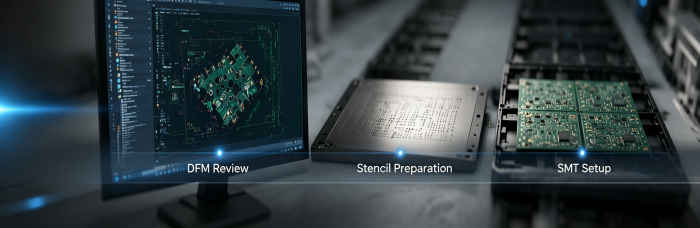
The conventional engineering workflow proceeds sequentially: DFM review, followed by stencil fabrication, programming, and first-article build, with each stage awaiting full completion of the one preceding it. A more efficient approach runs DFM review and stencil fabrication concurrently, since stencil design can proceed once the board outline and pad geometry are confirmed, even while DFM comments on secondary details remain under resolution. This form of parallelization typically saves two to three days on a standard program — a modest gain in isolation, but a meaningful one against a fixed customer deadline.
Negotiating Production Scheduling Priority
Once materials have arrived and engineering preparation is complete, buyers can often negotiate expedited scheduling priority on the SMT line. Reasonable expedite premiums typically range from 15-25% above standard pricing, reflecting the cost of resequencing other customers' jobs, overtime labor, or dedicated line allocation. An important caveat applies: expediting is only effective once materials are physically on hand. Paying a rush premium while components remain in transit does not shorten overall lead time; it only shortens the wait once every other input is ready. Before agreeing to an expedite fee, buyers should confirm with their EMS partner precisely which stage the premium is intended to accelerate.
Design-Stage Levers for Faster Turnaround
Lead time is not determined solely after the design is complete; a number of decisions made at the design stage materially affect how quickly a board can move through production.
Avoid stepped or multi-thickness stencils where feasible. Standard single-thickness stencils are typically in stock and quick to cut, whereas stepped stencils require additional fabrication steps and correspondingly longer lead times.
Limit the number of specialty processes combined on a single board. Each additional process — conformal coating, non-standard finishes, or custom testing — introduces its own scheduling dependency.
Favor mainstream component packages the EMS partner already stocks. Common footprints reduce both procurement risk and line changeover time.
Submit design files for DFM pre-review before the BOM is fully locked. Early feedback surfaces manufacturability issues while there is still time to address them without affecting the critical path.

A Framework for Estimating Lead Time
As a general framework, total lead time can be estimated from three inputs: BOM complexity (the number of unique parts and the presence of any long-lead or obsolete components), order quantity, and whether the design incorporates specialty processes. Evaluating these inputs against an EMS partner's baseline stage durations produces a reasonable estimate of both total lead time and the location of the critical path — the latter being the more actionable figure, as it identifies the stage most worth negotiating.
Program-specific variables make generic quotes an unreliable basis for planning. The most reliable way to obtain a lead time estimate specific to a given BOM is a direct engineering review. PCBCart offers a free DFM review for this purpose: buyers who submit design files and a bill of materials receive a realistic lead time breakdown alongside manufacturability feedback prior to committing to a supplier.
Helpful Resources
• Frequently Asked Questions
• Turnkey Prototype PCB Assembly & Fabrication
• PCB Assembly Quote — Full Turnkey Assembly
• Some Handy Methods in Evaluating SMT Assembler's Capabilities


