



Assembled boards need three things from their packaging: control of static charge, no board-to-board or board-to-carton contact, and a label set your receiving dock can read. For export, write all three into the purchase order as a short packaging spec, because a supplier's default packing is built for the supplier's convenience, not your incoming inspection.
This article covers pcba packaging esd choices, how to think about cushioning, what belongs on the carton, and how to get your own packaging requirements into the PO so they are enforceable.
Which ESD packaging do assembled boards need?
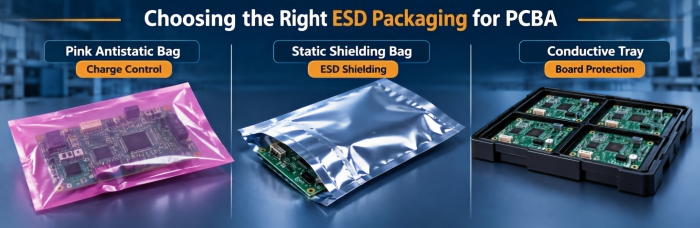
Most assembled boards need a shielding or dissipative container, not just a pink poly bag. Pink antistatic poly only reduces charge generation and does not stop an external field from reaching the board. If the board carries ESD-sensitive parts (MOS devices, precision analog, RF front ends, high-speed memory), a static-shielding bag is the normal starting point.
Metalized static-shielding bags are the usual choice for assembled boards on long export routes. Size the bag so the board does not push on the seal or the corners. Pink poly is fine as an inner wrap for non-ESD parts or low-sensitivity boards, but not as protection for a sensitive assembly.
Conductive or dissipative trays suit boards with tall parts, edge connectors or fragile heat sinks. The pocket has to match the board outline, so confirm the design with our engineering team before the first shipment. Conductive foam works for heavier boards, but loose foam particles count as a defect, so use skinned foam or keep a bag between the foam and the board.
A moisture barrier bag (MBB) with desiccant and an indicator card is a separate decision from ESD. If your parts carry a moisture sensitivity level requirement, say so on the PO and cite J-STD-033. State the shielding requirement separately, because not every MBB is a shielding type.
Also decide who opens the carton. If a receiving clerk will open it at an ordinary desk, mark the bag with an ESD caution label, or put a note on the outer carton that the inner bag must be opened at a protected workstation.
Name the standard in your spec: ANSI/ESD S541 for packaging materials and IEC 61340-5-3 for classifying ESD protective packaging. Do not quote resistance ranges from memory in a PO, because the packaging supplier's datasheet is what you will audit against.
Cushioning and carton design
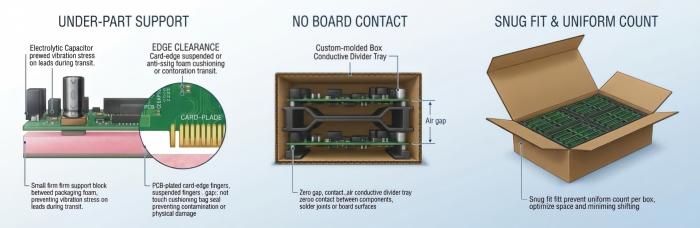
Cushioning has one job: keep the board from moving relative to the box. How you do that depends on board weight, tall components, and whether the board has a heat sink or a battery holder. Vibration over a long export route tends to damage solder joints on heavy through-hole parts and tall electrolytic capacitors, so those boards need support under the part, not only around the edge.
A few judgment points we apply when a customer asks for a packing recommendation:
Boards should not touch each other. If you stack, use a separator or a tray with pockets. Stacked bare boards with only a bag in between will rub through the film over a long trip.
Edge connectors and card-edge fingers should be kept out of contact with foam or the bag seal. A pocketed tray or a corner support does this better than loose wrap.
Foam is cheaper than trays, and for light boards with low-profile parts it is often enough. For anything with a tall heat sink or a heavy transformer, a tray or a cut-out foam insert is worth the cost.
Carton strength matters at the outer layer, but carton size matters more. A carton too big for its contents lets the load shift. If the order is split across multiple cartons, we would rather see a uniform carton count per box than a mix of full and half-full boxes.
Palletizing and outer wrap are mostly a logistics decision, and your forwarder may have rules for the destination. If you have a preferred pallet pattern or a maximum carton weight for your dock, put it in the PO. Do not assume the supplier will guess it. This article does not cover transit time or carrier choice.
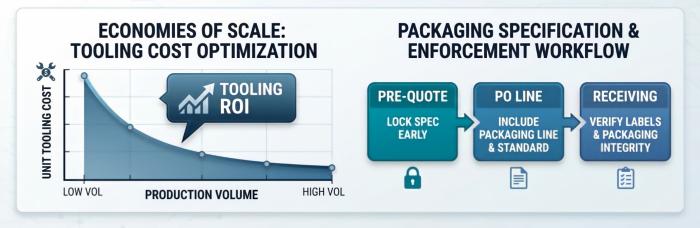
For prototype quantities the packing question is slightly different. A few boards in a single carton can use a simple tray-and-bag approach. When the program moves to higher volume, the packing spec often needs to change with it, and that conversation is easier if the PO already names the version. Our low-volume assembly work usually ships in smaller mixed cartons, while a high-volume assembly order tends to justify a dedicated tray or custom insert, because the tooling cost spreads across more units.
Labels and lot information on the box
A carton label should let your receiving team identify the contents without opening the box. That means part number, revision, quantity, PO number, and a lot or date code that ties back to the build record. If your own system uses a customer part number that differs from ours, name which one goes on the outer label.
For labeling, what we usually ask the customer to settle in advance:
Which identifier is primary on the outer carton: customer part number, supplier part number, or both.
Whether a barcode is required, and in which symbology your receiving system reads.
Where the ESD caution mark and the moisture-sensitive mark go, and whether they appear on the inner bag, the outer carton, or both.
Whether a packing list goes inside the carton, outside in a pouch, or both.
Whether the lot or date code is on the carton, on each bag, or on each board.
Traceability depends on lot information surviving from build to dock. If your quality system needs board-level serial numbers readable without opening the bag, say so, since it affects where the label goes and whether the bag must be transparent. Smart MES records on our side tie a build to its materials and process data, but what appears on the outside of the box is only what the PO asks for.
Country of origin marking and customs paperwork are separate from packaging. Your forwarder or broker will have their own list.
How to put custom packaging into your PO
Write the packaging requirement as its own numbered line, not as a comment on the item. A comment on the item gets lost when the PO is converted into a work order. A separate line, or an attached packaging specification referenced by document number and revision, survives the handoff.
What a workable packaging clause includes:
The packaging type for each part number, named in plain words (for example, static-shielding bag, then tray, then carton), with the standard if you have one.
Any customer-supplied packaging, and who pays for it, who stores it, and who replaces it if it is damaged.
Label content and placement, with a sample label or drawing attached.
Moisture control requirements, if any, including the dry-pack standard and indicator card expectations.
What happens to a shipment that arrives with damaged packaging: reject, inspect and accept, or hold for your decision.
The revision of the packaging spec the order refers to.
If you want a packaging change after the order is placed, send a revised document rather than an email thread. Packaging changes affect materials and sometimes carton count, and confirming the change formally is easier than reconciling two versions at the dock.
Customer-specified packaging is something to raise before quoting, not after. Tray tooling, custom foam inserts, and printed labels all have lead times that depend on the supplier, and we do not commit to any of that until our engineering team has seen the drawing. For the question of what our quality system documents and what it does not, the certifications page lists what we hold, and anything beyond that should be treated as unconfirmed.
If your boards are going into a larger enclosure or a finished product after assembly, the packaging requirements may differ between the loose board and the box-build unit. Our box build assembly page describes the scope we offer, and any packaging that depends on enclosure sealing or connector protection should be confirmed with our engineering team before it goes into a PO.
Packaging spec checklist
Use this as a pre-PO check. If you cannot answer an item, that is the item to raise with the supplier.
| Item | Question to answer | Where it goes |
|---|---|---|
| ESD protection | Shielding bag, dissipative tray, or both? Which standard? | PO packaging line |
| Moisture control | Is MBB, desiccant or an indicator card required? Which dry-pack standard? | PO packaging line |
| Cushioning | Foam, tray, or corner support? Any tall or heavy parts needing local support? | Packaging drawing |
| Board separation | Can boards touch? If stacked, what separates them? | Packaging drawing |
| Edge connectors | Are fingers or connectors kept clear of foam and seals? | Packaging drawing |
| Carton | Size, count per carton, maximum weight, outer marking | PO packaging line |
| Labels | Part number, revision, quantity, PO, lot or date code, barcode type | Label drawing |
| Caution marks | ESD and moisture marks, on bag, carton, or both | Label drawing |
| Documents | Packing list location, any certificate of conformance | PO packaging line |
| Customer-supplied packaging | Who supplies it, who stores it, what if damaged | PO packaging line |
| Damage handling | Reject, inspect, or hold on arrival of damaged packaging | PO terms |
| Revision | Which packaging spec revision does this order use? | PO header |
FAQ
Is a pink antistatic bag enough for assembled boards?
Not for boards with ESD-sensitive devices. Pink poly limits charge generation but does not shield from an external field, so use a static-shielding bag or a conductive tray instead.
Do I need an MBB if my boards are already assembled?
Only if the assembly has moisture-sensitive devices or your quality plan requires it. Cite the dry-pack standard in the PO, and state separately whether the MBB must also shield.
Can I supply my own trays or boxes?
Usually yes, if it is agreed in writing. Cover who owns the packaging, who stores spares, and what happens if trays arrive damaged. Confirm custom trays with our engineering team before the first shipment.
Where should the lot code go if I want traceability to individual boards?
A lot or date code on the carton label is the common choice. Board-level serial numbers are possible, but raise them at the quoting stage because they affect labeling and bag choice.
What if the packaging arrives damaged?
Decide the rule before shipping: reject, inspect first, or hold for your decision. Write it into the PO terms and photograph the damage at receiving.
Helpful Resources
• How to Prevent ESD Damage in SMT Assembly Process
• Mitigating Moisture Sensitivity Level (MSL) Risks in High-Density SMT Assembly
• MES Traceability Architecture for IEC-Regulated Industrial Electronics
• How to Quote and Order PCB Assembly Services


