



When a Field Failure Becomes a Recall Decision
The first question an industrial OEM asks when a fielded controller fails is not "what failed?" but "which serial numbers are at risk?" If the answer requires cross-referencing paper travellers, shift logs, and supplier delivery notes, the recall decision defaults to the same outcome every time: isolate the entire production lot.
In one representative scenario, a European machine builder discovered ESR drift in a specific capacitor population across a batch of PLC backplanes. Because the EMS provider could not produce reel-level binding data, the customer initiated preventive replacement across 2,300 boards delivered over 18 months. With component-level MES traceability, the affected population would have resolved to 47 boards from a single shift—a cost delta in the six-figure range at European field service rates.
IEC 62443's asset identification and change management requirements implicitly demand that IACS operators identify, within a defined time window, the exact scope of a suspect hardware population. Machinery Directive 2006/42/EC reinforces this through technical file requirements that extend to critical electrical subassemblies. For regulated industrial electronics, traceability is a baseline legal obligation.
The Four-Layer MES Data Chain
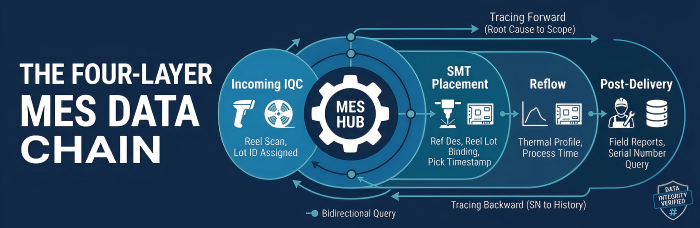
A production-grade traceability system is not a single database—it is a data chain binding every manufacturing event to a unique board identifier, enabling bidirectional query in either direction: suspect lot to affected serial numbers, or serial number back to complete manufacturing history.
At incoming IQC, every reel and tray is scanned and assigned an internal lot number encapsulating the supplier CoC reference, manufacturer date code, quantity, and IQC disposition. No material reaches the production floor without a resolved status. This lot number is the root node of the traceability tree.
At SMT placement, the machine transmits a record for every component pick: feeder slot ID, reel lot number, reference designator, board ID, timestamp, and vision alignment offset. The binding is per-component, per-board—no aggregation at panel or batch level.
At reflow, every board generates a process record tied to its board ID: actual peak temperature (±2°C resolution), time above liquidus, and ramp rate. This is the primary manufacturing evidence in any solder joint reliability dispute—it answers definitively whether the board was processed within the qualified thermal window.
At laser marking, the Smart MES inscribes a unique serial number on each board before final inspection. This SN is the index key linking all upstream data—IQC lot, placement records, reflow profile, inspection results—into a single queryable record and the sole entry point for all post-delivery traceability requests.
Inspection Nodes and Data Retention
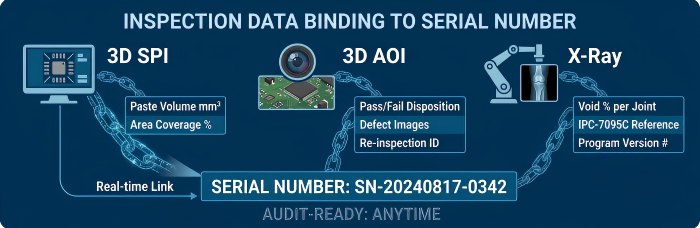
Three inspection nodes are most frequently audited in industrial customer reviews, and each must be bound to the board SN at the moment of measurement rather than archived separately.
At 3D SPI, the system records paste volume per pad (mm³), area coverage (%), and offset (μm), along with any closed-loop feedback trigger events. At 3D AOI, pass/fail disposition, defect images, and the re-inspection engineer ID are written to the board record. At X-ray, void percentage per joint and the IPC-7095C threshold reference under which the judgment was made are captured alongside the inspection program version number—because a program version change constitutes a process change, and that change needs to be traceable to specific serial numbers.
On retention: industrial equipment lifetimes commonly run 15 to 25 years. Ten years is the industry minimum floor; for safety-rated control systems, 20 years is more defensible. Database format portability needs to be resolved at system design time, not when a legacy record is first requested.
Audit Drill: 15 Minutes from Failure Report to Affected Scope
A customer identifies C47 (100 µF / 25 V, X7R) ESR degradation in a subset of industrial gateway boards delivered in Q3, and provides one confirmed failure board: SN-20240817-0342.
The first MES query retrieves the placement record for C47 on that board and returns feeder lot LOT-CAP-240812-07. The second query returns all 83 board serial numbers where that lot was loaded at the C47 position, with production dates concentrated between August 12 and 15. The third cross-references those 83 boards against order data: 72 shipped, 11 in finished-goods inventory.
The response is immediate. The 11 inventory units go on NCR Hold before the call ends. The customer receives a field notification listing exactly 72 serial numbers—not a date-bracket estimate, not a lot range, but a specific enumeration. Three queries, no manual search, under 15 minutes. Without reel-level binding, the only available answer is: isolate everything in the production window and negotiate from there.
Access Control and Data Integrity
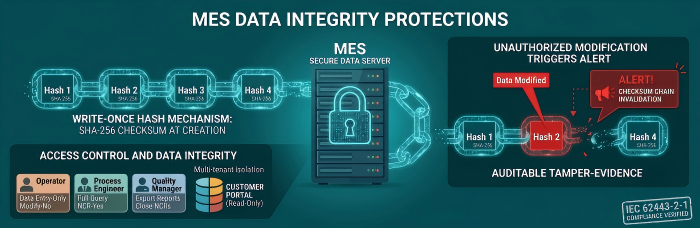
Operators can enter data for their assigned workstation only and cannot modify submitted records. Process engineers have full query access and NCR initiation rights. Quality managers can export audit reports and close NCRs. Customers access a read-only portal scoped exclusively to their own order history, with multi-tenant isolation enforced at the database partition level.
Timestamp integrity is enforced through a write-once hash mechanism: each record generates a SHA-256 checksum at creation. Any modification invalidates the checksum chain and triggers an alert—providing auditable tamper-evidence aligned with IEC 62443-2-1 electronic record integrity requirements.
Evidence vs. Assertion in a Supplier Audit
On material source verification, a non-traceable supplier offers a supplier name and a PO number. A traceable supplier produces reel lot, date code, IQC disposition, and CoC reference—linked to the specific components on the board under review. On failure scope determination, the non-traceable supplier's answer is an estimate; the traceable supplier's answer is a list.
The difference between presenting a traceability procedure document and demonstrating a live "SN → lot → affected scope" query in the audit room is not subtle. Our IATF 16949 quality system establishes the procedural framework; the MES data architecture is what makes that framework empirically verifiable in real time.
Request a FREE DFM Review for your next industrial PCBA project—we will include a walkthrough of how your bill of materials maps to our MES traceability schema before production begins.
Helpful Resources
• A Comprehensive Introduction of PCBA
• Printed Circuit Boards Assembly Process
• Some Handy Methods in Evaluating SMT Assembler’s Capabilities
• Elements Influencing SMT Soldering Quality and Improvement Measures
• Turnkey PCB Assembly (PCBA) Service With Multiple Value-added Options


