



A Certificate of Conformance confirming the boards were built to your specified standard should be a standard, no-extra-cost deliverable with any production shipment, and full traceability — lot numbers and date codes linked to the specific production run — should be available on request even if not automatically included.
What a CoC Should Actually Confirm
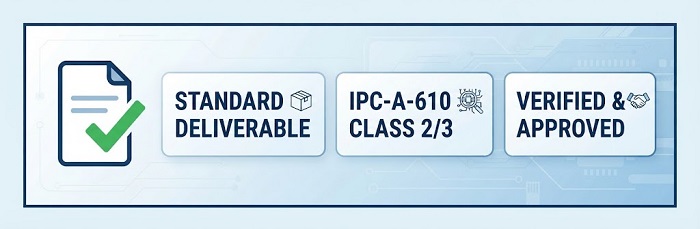
A proper Certificate of Conformance states the boards were built and inspected to the agreed standard — commonly IPC-A-610 Class 2 or 3 — references the specific order and production run, and typically notes any approved substitutions made during the build. If this isn't offered by default, ask for it explicitly before the order ships, not after.
Why Traceability Matters Most After Delivery, Not Before
Traceability data is your primary tool if a field failure surfaces months after delivery. Being able to trace a specific lot or date code back to the exact production run lets you determine whether a failure is isolated to one batch or systemic across your entire order — a distinction that materially changes your response, from a spot repair to a broader recall decision.
A Useful Reference Point for How Much Traceability You Actually Need
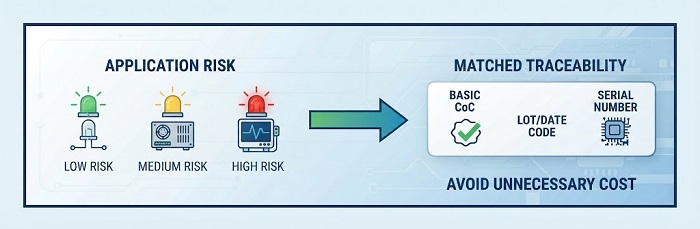
Rather than treating traceability as an all-or-nothing choice, it helps to think of it in tiers. The public IPC-1782 standard, which covers manufacturing and supply chain traceability for electronic products, lays out this idea formally — describing several tiers of traceability from basic documented practice up to comprehensive component-level tracking, with the appropriate tier set by agreement between customer and supplier based on how much risk the application actually carries. A simple, low-criticality board doesn't need the same tracking depth as a board going into a life-sciences device or precision test equipment, and matching the tier to the real risk avoids paying for tracking depth you don't need.
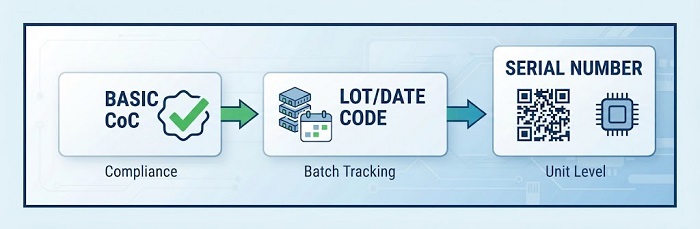
This tiered thinking is worth applying deliberately rather than defaulting to whatever a supplier offers by default. A batch/lot-level approach — tracking the same component lots and process settings across an entire production run rather than per individual unit — fits lower-criticality boards reasonably well: power distribution boards, non-signal-path interface boards, and cost-sensitive programs where unit-level tracking isn't justified by the actual failure-mode risk. Serial-number-level tracking, at the other end, makes sense specifically when a field failure needs to be traced to one exact unit rather than just a batch — which matters most for applications where the cost or consequence of a false-positive recall across an entire lot would be disproportionate to the actual scope of the problem.
| Traceability Level | What's Tracked | Best For |
|---|---|---|
| Basic CoC | Standard/class compliance confirmation | Any standard order |
| Lot/date-code tracking | Component batch linked to production run | Products with warranty obligations |
| Serial-number-level tracking | Individual unit tracked to production data | Life-sciences, industrial, and test-equipment applications with high failure consequences |
How Long Records Should Be Retained
Ask what level of traceability is retained and for how long on the supplier's side — commonly a minimum of 1-2 years for compliance-driven industries, though this varies by supplier and industry requirement. Also confirm the delivery format: a scanned PDF per shipment is standard, while a searchable digital record tied to serial numbers is a stronger long-term asset if your production volume grows.
A Scenario Worth Walking Through
A buyer shipping a diagnostic or monitoring device requests serial-number-level traceability from the outset, at a modest per-unit fee. Some months later, a field issue is reported on a small number of units. Because serial-number tracking was in place, the buyer traces the issue to a single production run and a specific date-coded component lot, confirming the problem is isolated rather than systemic — avoiding a costly broader investigation across every unit ever shipped. A different buyer on a simpler, lower-stakes design skips the extra tracking entirely and relies on a basic CoC, which is the right call for that product, since the cost of serial-level tracking wouldn't be justified by the actual risk involved.
Checklist for Traceability Requirements
• Confirm a CoC is included by default, and ask for it explicitly if it's not offered automatically.
• For products with warranty obligations, request lot/date-code traceability as standard practice.
• For higher-consequence applications, request serial-number-level tracking even on a small run — most suppliers can add this for a modest per-unit fee.
• Ask how long the supplier retains traceability records and in what format.
• Match the traceability tier to the actual risk of the application, rather than defaulting to either extreme.
FAQs
1. If I skip serial-number tracking now, can I add it retroactively to an already-shipped order? No — traceability has to be built into the production run itself, so this is a decision to make before the order ships, not something you can layer on after the fact.
2. Does a CoC protect me legally if a component turns out to be counterfeit? Not on its own — a CoC confirms build-to-standard, but sourcing-specific documentation (distributor records, date codes) is what actually supports a counterfeit-related claim.
3. If my end customer audits my supply chain, will a supplier's traceability records satisfy that audit directly? Not necessarily — ask whether the format and retention period match what your own customer requires, since a supplier's default records may not be structured for a third-party audit.
4. Does requesting a higher traceability tier partway through a production relationship require renegotiating the whole order? Usually not for a future run, but ask specifically — retrofitting tracking onto an in-progress batch is generally not possible, so a tier change typically applies starting with the next order.
5. Is there a standard reference for deciding how much traceability a given product actually needs? IPC-1782 is a useful public reference point for this, laying out traceability tiers by risk level rather than leaving the decision purely to guesswork.
Helpful Resources
• How to Evaluate a PCB Manufacturer or Assembler
• PCB Quality Certifications: ISO, UL, and RoHS
Ready to confirm your own traceability requirements before production? Request a PCB Assembly quote and specify the tier you need in writing.


