



In the electronic manufacturing industry, not all production partners are created equal. While many providers compete on speed and upfront price, seasoned engineering leaders know that the true cost of manufacturing lies in risk, yield, and lifecycle reliability. For High-Mix Low-Volume (HMLV) projects and mission-critical Electronic Manufacturing Services (EMS), the difference between a successful product launch and a costly recall often comes down to one factor: Design for Manufacturability (DFM) depth.
At PCBCart, we don't just assemble boards; we validate manufacturability at a digital level before production begins. By leveraging the Siemens Valor NPI ecosystem—recognized globally as the "Rolls-Royce" of DFM technology—and combining it with senior engineering expertise, we offer a level of risk control and process assurance that standard platforms simply cannot match. Here is why choosing PCBCart means choosing certainty over compromise.
Process-Aware Virtual Validation: Beyond Basic DFM
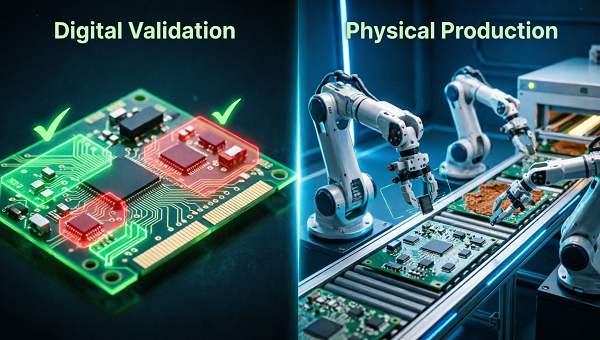
Many manufacturing providers offer "free DFM" as a standard service, but there is a significant gap between a basic geometric check and a process-aware virtual validation.
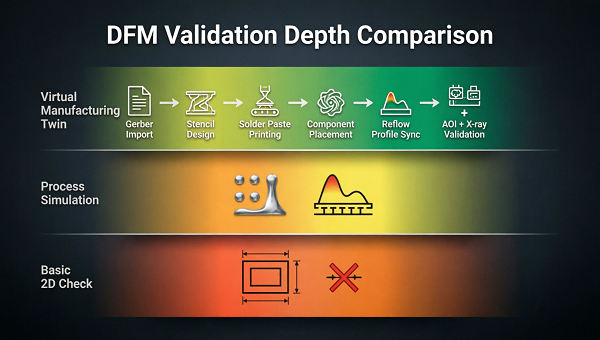
Standard Providers: typically rely on entry-level tools that perform superficial 2D checks (e.g., minimum line width, spacing) based on basic Gerber files. They answer the question: "Is the data valid?" Consequently, process conflicts are often discovered only after physical trial builds or post-production inspection.
The PCBCart Advantage: We utilize the Siemens Valor NPI ecosystem to create a Virtual Manufacturing Twin, answering the critical question: "Will this design fail on the production line?"
Intelligent Data & Simulation: Unlike simple geometric tools, we utilize intelligent data formats (ODB++/IPC-2581) to integrate network logic and material attributes. Using Valor's library of 1,000+ manufacturing rules, we simulate the entire production lifecycle—from solder paste printing to reflow profiling—without physical trial runs.
Manufacturing Driven Design (MDD): Our system is configured with our specific equipment parameters. A design validated in our digital environment is guaranteed to be manufacturable on our physical floor.
Proactive Risk Prevention: By simulating actual manufacturing logic, we analyze soldering feasibility, component density, and test probe accessibility. This allows us to identify and prevent up to 90% of potential assembly risks—including tombstoning, bridging, and insufficient annular rings—before production begins.
The BOM Blind Spot: Why Most Providers Miss Material Risks
One of the most common causes of production delays is BOM (Bill of Materials) misalignment. A design might be perfect, but if the purchased component doesn't match the footprint, production stops.
Standard Providers: Often treat the BOM and PCB design as separate entities. Verification is frequently manual or limited to basic part number matching.
PCBCart Advantage: Our integrated Valor BOM Manager acts as a rigorous material-design auditor.
MPN vs. Pad Validation: We automatically verify that every Manufacturer Part Number (MPN) physically aligns with the PCB pad design and footprint specifications.
Alternative Component Logic: If a primary part is unavailable, our system validates approved alternatives (AVL/AML) to ensure their physical dimensions fit the existing design, preventing "wrong part" errors.
Consistency: We ensure designators (RefDes) match across all files, eliminating the risk of component misplacement.
Value: This eliminates a major source of production line downtime that plagues projects managed by providers with disconnected data systems.
Automation Augmented by Human Expertise: The "Engineering Report" Difference
Automation is powerful, but in high-stakes manufacturing, it cannot replace human judgment. Many platforms rely solely on automated reports filled with technical red dots that require the customer to interpret.
Standard Providers: Deliver automated, generic error reports. The burden of interpretation and solution finding falls entirely on the customer.
PCBCart Advantage: We employ a "Valor Automated Scan + Senior Engineer Secondary Review" workflow.
Smart Filtering: Our engineers filter out false positives from the automated scan, focusing only on critical risks.
Production Feasibility Engineering Report: Instead of a raw data log, you receive a professional report with clear error localization, process-specific optimization suggestions (e.g., wave soldering pallet design, reflow profile recommendations), and visual references.
Consultative Approach: Our engineers don't just point out errors; they provide actionable solutions tailored to our production floor capabilities. This human-in-the-loop approach ensures every recommendation is practical and optimized for yield.
Closed-Loop Quality: Data That Drives Production
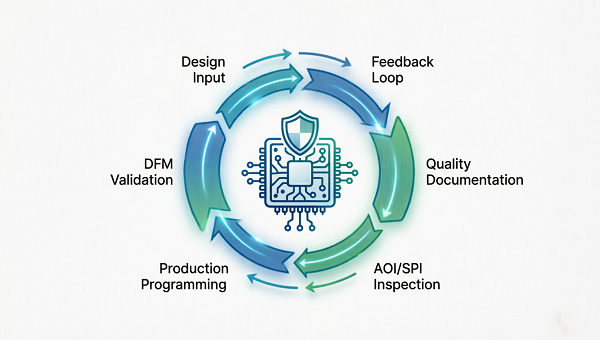
For many manufacturers, the DFM process ends once the report is sent. At PCBCart, the validation data becomes the foundation of production.
Standard Providers: DFM data is often siloed from the production floor. Machine programming may be done manually, introducing potential human error.
PCBCart Advantage: We maintain a closed-loop digital workflow.
Direct Drive: The validated design data from Valor directly drives pick-and-place programming and SPI/AOI inspection standards.
Factory-Aware (MDD): Our Valor system is configured with our specific equipment parameters (placement precision, reflow profiles). A design validated in our system is guaranteed to be manufacturable on our floor.
Traceability: Every shipment is accompanied by quality control documentation tied back to the initial DFM validation, ensuring full traceability for industries like automotive, aerospace, and medical.
Scalability Without Compromise
A common pitfall in the industry is the "Prototype Trap"—where a design works for a small batch but fails when scaled due to undocumented process adjustments.
Standard Providers: Often require re-validation or process reconfiguration when moving from prototype to volume, introducing new risks.
PCBCart Advantage: Our digital workflow ensures seamless scalability.
Data Continuity: The same digital design data and BOM alignments used for the prototype are retained and scaled directly to production.
Consistent Standards: Whether producing 10 units or 10,000, the same Valor-validated rules apply, ensuring consistent quality without the need for risky re-validation.
Conclusion: Total Cost of Ownership vs. Unit Price
Choosing a manufacturing partner is not just about the unit price; it's about the Total Cost of Ownership (TCO). While some platforms may offer lower upfront costs, the hidden expenses of delayed launches, production reworks, and field failures can be devastating.
PCBCart stands apart because we combine industrial-grade digital precision (Siemens Valor NPI) with deep manufacturing expertise (Senior Engineering Review). We don't just build what you send; we ensure what you send can be built reliably, efficiently, and to the highest global standards.
For projects where reliability is non-negotiable—whether in 5G infrastructure, automotive systems, medical devices, or industrial IoT—PCBCart offers the peace of mind that comes from true manufacturing excellence. We invite you to experience the difference of a partner who validates your success before production even begins.
Helpful Resources
• SMT Assembly Capability
• Automated Optical Inspection (AOI)
• Medical PCB Solutions
• Reflow Soldering Process Guidelines


