



Per-unit price typically drops 20-50% moving from a 5-50 unit prototype run to a 500+ unit production run, driven by amortized setup costs and volume component pricing — not by any change in build quality or process.
Why the Process Itself Doesn't Change, But the Economics Do
The board fabrication and assembly process is usually identical between prototype and production runs — same DFM rules, same IPC class, same machines. What changes is purely economic: fixed engineering costs get divided across far more units, and component purchasing shifts from small-quantity distributor pricing to volume pricing.
The Two Levers That Actually Move Production Pricing
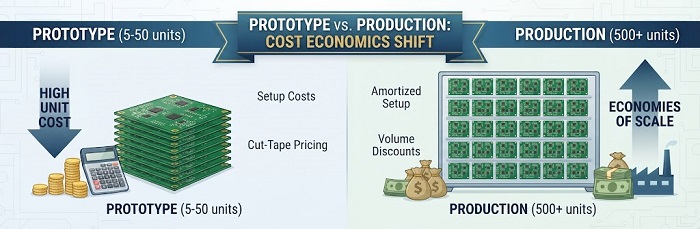
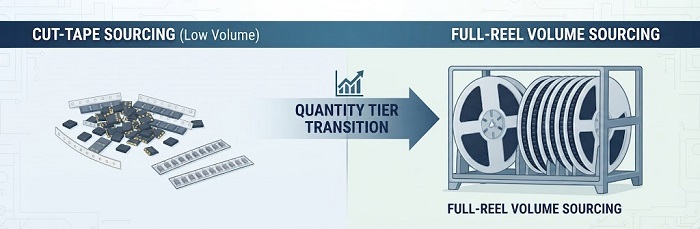
1. Component sourcing tier. At low volumes, distributors quote "cut-tape" or small-reel pricing carrying a 10-20% premium over full-reel volume pricing used in production buys. Moving from prototype quantities to a 1,000+ unit order typically unlocks full-reel pricing across most of the BOM.
2. Panel utilization. Prototype runs often use single boards or small panels with more per-unit waste; production runs are panelized for higher board-per-panel yield, which can cut fabrication cost per unit by 10-15% through better material utilization.
Prototype vs. Production Cost Comparison
| Factor | Prototype (5-50 units) | Production (500+ units) |
|---|---|---|
| Component pricing tier | Cut-tape/small-reel (+10-20%) | Full-reel volume pricing |
| Panel utilization | Lower yield, more waste | Optimized, 10-15% less waste |
| NRE/stencil cost per unit | High (spread over few units) | Negligible per unit |
| Process/inspection standard | Same as production | Same as prototype |
A Real-World Scenario
A buyer prototypes 25 units at $38/unit assembled. After validating the design, they request a 1,000-unit production quote from the same supplier. The production price comes back at $19/unit — a 50% drop — driven roughly two-thirds by component volume pricing and one-third by amortized setup and improved panel yield. Nothing about the physical process changed; only the purchasing tier and batch economics did. When the buyer asks for a line-by-line comparison against the prototype quote, the supplier confirms that the board fabrication and assembly labor lines dropped only modestly per unit, while the component-cost line dropped the most — consistent with the general pattern that component sourcing tier, not process change, drives most of the prototype-to-production discount.
Why You Should Request Both Quotes at Once
Because the underlying process doesn't change between prototype and production, most suppliers can provide a projected production-volume budgetary quote in the same 24-48 hour window as your prototype quote. Requesting both upfront lets you validate the design's unit economics before committing to tooling, rather than discovering the real production cost only after prototyping is complete.
Common Mistakes When Moving From Prototype to Production
· Ordering production quantity from the prototype supplier by default. Loyalty is understandable after a good prototype experience, but production-volume component pricing is worth shopping across 2-3 suppliers — the price gap can be larger than buyers expect.
· Not re-checking component availability before locking a production order. A part that was in stock during a 25-unit prototype run may hit allocation at 1,000-unit volume; production-scale procurement can surface shortages that never appeared at prototype scale.
· Assuming the prototype's inspection results guarantee production yield. A small prototype batch can pass cleanly by chance even if there's a marginal DFM issue that only shows up statistically across a larger production run — don't skip a second DFM check just because the prototype passed.
· Failing to ask about panel utilization at production volume. Buyers who only see the prototype's per-unit fabrication cost sometimes assume that figure holds at scale, missing the additional 10-15% savings available through better panel yield.
How to Negotiate the Production Quote
Once your design is locked, treat the production quote as a fresh negotiation rather than an assumed continuation of the prototype price. Ask your prototype supplier for their best production-volume number, then get at least one competing quote from a second supplier using the identical files and BOM — this is the only way to know whether your prototype supplier's production pricing is actually competitive or simply convenient. If you plan to reorder this design regularly, raise the possibility of a standing production price agreement at this stage, since suppliers are generally more willing to offer volume-based pricing commitments once a design has been fully validated and is moving into a repeatable production cadence.
It's also worth timing the conversation deliberately. Suppliers are typically most willing to negotiate favorable production pricing right after a successful prototype run, while the relationship is warm and before you've signaled where else you're shopping the quote — waiting too long, or opening with a competing quote as leverage, can make the conversation adversarial rather than collaborative. A simple, direct ask — "now that the design is validated, what can you do on a 1,000-unit production run, and is there a better number if we commit to a second order later this year" — tends to surface the supplier's real flexibility faster than an open-ended request to "sharpen the pencil."
How the Prototype-to-Production Discount Varies by Design Type
Not every design sees the same 20-50% drop — how much you save moving to volume depends heavily on what dominates your BOM.
| Design Type | Typical Prototype-to-Production Discount | Why |
|---|---|---|
| Passive-heavy, simple 2-layer board | 15-25% | Component cost is already low; setup amortization is the main lever |
| Board with several common semiconductors | 25-40% | Full-reel pricing kicks in meaningfully on the semiconductor lines |
| Board with allocated or specialty ICs | 10-20% | Component cost stays high regardless of volume tier; savings are muted |
| High layer-count or advanced fab (HDI, rigid-flex) | 20-35% | Panel utilization gains are larger on complex, higher-waste fabrication |
This is worth knowing before you get a production quote back, because it sets your expectations correctly: if your BOM leans on allocated or specialty components, don't expect the full 50% drop that a passive-heavy design might see — the ceiling on your savings is set by how much of your cost is component-driven versus setup-driven in the first place.
Negotiating When the Discount Looks Smaller Than Expected
If your production quote comes back with a smaller discount than you anticipated, the first thing to check is the BOM composition, not the supplier's honesty. A board dominated by one or two expensive, allocated ICs will show a much flatter prototype-to-production cost curve than a board full of passives and common logic chips, simply because there's less room for volume pricing to work on the components that make up most of the cost. In that situation, the more productive negotiation isn't pushing on the per-unit price — it's asking whether the supplier can lock in current component pricing with a forward purchase commitment, or whether splitting the order across two batches lets you qualify for a better distributor pricing break on the specific parts driving your cost.
Checklist Before Scaling to Production
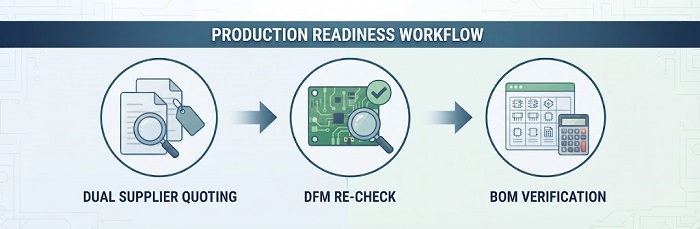
· Request a production-volume budgetary quote alongside your prototype quote, not after.
· Ask which BOM lines will change pricing tier at your target production volume.
· Re-quote production runs with 2-3 suppliers once the design is locked — your prototype supplier isn't automatically your best production price.
· Confirm whether prototype tooling (stencil) carries over to production or needs re-validation at higher speed.
· Budget a buffer for components that don't hit volume-pricing thresholds at your specific quantity.
· Re-run a DFM check at production volume even if the prototype passed cleanly.
FAQs
1. Should I request both quotes upfront?
Yes — ask for a prototype quote and a projected 500- or 1,000-unit production quote in the same request, since this lets you validate the design's unit economics before committing to any tooling spend.
2. Will my prototype supplier's production price always be the best?
Not automatically — re-quote production volumes with 2-3 suppliers once the design is locked, since prototype convenience doesn't guarantee the most competitive production-scale component pricing.
3. Does prototype tooling carry over to production?
Stencils usually carry over unchanged, but fixtures and programming setups may need re-validation at the higher throughput speeds used in production runs.
4. Why did my production quote come back higher than expected?
Check for component lead-time premiums or newly-allocated parts first — a component that was freely available at prototype quantity can hit allocation constraints at production volume.
5. Is there a volume threshold where pricing plateaus?
Most of the per-unit cost improvement happens by 500-1,000 units; beyond that threshold, component cost — not setup amortization — dominates the remaining price, so further volume increases yield diminishing per-unit savings, and the exact plateau point shifts depending on how component-cost-heavy versus setup-cost-heavy your specific BOM is.


