



The prototype to New Product Introduction (NPI) process is among the most complicated and risky stages of a product development in high-end Electronics Manufacturing Services (EMS). When prototypes are used to test the design concepts and functionality, NPI will be the process that converts the design concepts into scalable, manufacturable, and market-ready products.
Such a change is not merely a handoff but it is an organized process that is multi-stage so as to minimize risk, maximize cost and provide uniform quality. Actually, NPI is the vital linking point between innovation and mass production that integrates engineering, supply chain, and manufacturing into one implementation plan.
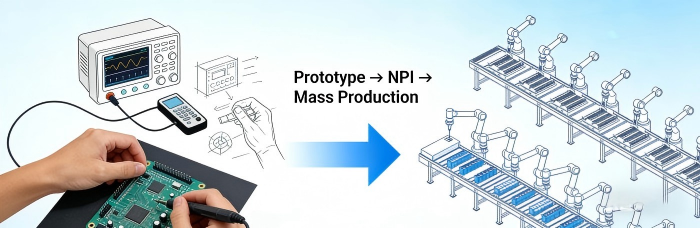
Understanding the Prototype NPI Gap
Prototyping Phase: Speed and Testing
The prototype phase is geared towards quick development and testing. Such distinctive features are:
Fast iteration cycles
Functional and performance testing
Eligible sourcing of components
Small scale production volumes
Innovation is usually at this point, a priority over manufacturability. Interim measures like hand assembly or alternative parts are usual.
Phase NPI Phase: Scalability and Control
NPI on the contrary injects discipline and order into the process. It encompasses:
Design to Manufacturability (DFM) optimization
Supply chain stabilization
Validation and documentation of processes
Pilot manufacturing and quality control
This is aimed at being able to produce the product in size with a low cost and with reliability targets.
Critical Phases in the Gap Bridging
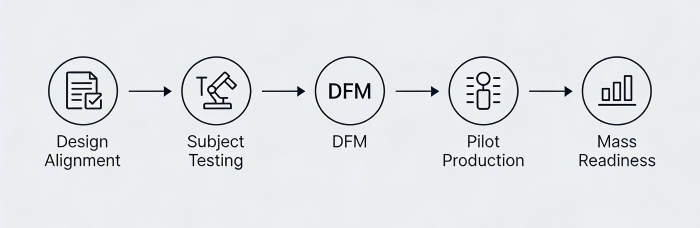
Design Alignment and Feasibility
The NPI process starts with feasibility analysis, which is a review of technical specifications, constraints of manufacture and cost objectives. Early alignment also prevents the later re-designing in the lifecycle at a high cost.
Prototype Development and Testing
Prototyping develops into complex functional models to production-ready development. This stage includes:
Engineering validation
Functional testing and environmental testing
Reinforcement of design
The purpose of these iterations is to make sure that the design is not only performance- and manufacturability-driven but also scalable.
Design for Manufacturability (DFM)
DFM is a building block to effective NPI. It focuses on:
Streamlining assembly procedures
Reducing material waste
Enhancing on production efficiency
There is a need to have close cooperation between design and manufacturing phases so that the possible problems could be detected at the initial stages and in order to design the production of high volumes.
Pilot Production
Pilot builds are the point of critical transition in the prototype and full scale manufacturing. During this phase:
Tests and improvement of production processes are carried out
There is optimization of assembly workflow
Rates of yield and defect risks are examined
The step helps the manufacturers to determine the bottlenecks and confirm that they are ready to mass production.
Mass Production Readiness
As soon as pilot production is confirmed, the attention is paid to:
Scaling production volumes
Introducing automation and testing system
Maintaining quality and cost control
At this point the product is ready to launch in the market.
Core Challenges in the Transition
Design Maturity
The design of prototypes is frequently not optimized to create a manufacturing design. Complex assemblies or tight tolerances may be a problem without DFM integration to enable scaling.
Supply Chain Complexity
It requires a strong and robust supply chain. NPI requires:
Consistent sourcing of components
Supplier qualification
Shortage or obsolescence mitigation risk
Supply chain planning guarantees continuity in production and the control of costs.
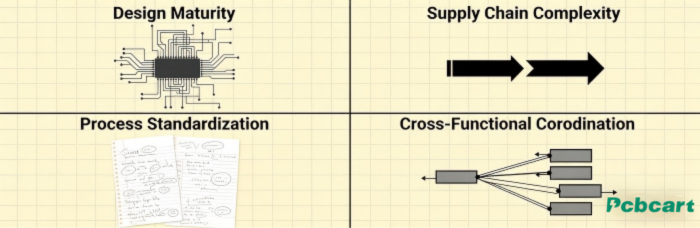
Process Standardization
Mockup construction can be based on ad hoc or manual. NPI demands:
Work instructions are to be standardized
Managed manufacturing conditions
Reproduction and scaling of workflows
Cross-Functional Coordination
NPI involves smooth co-operation between:
Design engineering
Manufacturing engineering
Supply chain teams
Quality assurance
Misalignment may cause delays, re-work and cost increase.
Best Practices for a Smooth Transition
Early EMS Involvement
EMS partners should be invited in the design stage to point out manufacturability problems and shortens the NPI process.
Structured NPI Framework
An established NPI process would be consistent and less risky. Key elements include:
Engineering Validation Testing (EVT)
Design Validation Testing (DVT)
Production Validation Testing (PVT)
These phases confirm product design as well as the manufacturing and finally full-scale production.
Integrated Prototyping and NPI
A disciplined and cooperative prototyping and pre-production can greatly minimize the number of mistakes and facilitate the process of transition to the volume manufacturing. Close integration at the initial stages reduces future risks in the production.
Digital Integration
The use of digital tools, including PLM, MES, and real-time monitoring systems, would boost traceability, increase decision-making, and minimize errors.
The Strategic Role of EMS Providers
Contemporary EMS manufacturers are much more strategic than the ancient manufacturers. Their works are:
Technological assistance (DFM, DFA, DFT)
Complex prototyping skills
Supply chain management
Quality assurance and testing
As a combined force, the EMS providers will assist firms in overcoming the intricacies of NPI and cut time to market.
Measuring Success in NPI
The key performance indicators (KPIs) of assessing the transition are:
Time-to-market
First-pass yield
Production ramp-up speed
Cost variance vs. target
Rate of defects and measures of reliability
These measures give the idea of the efficiency of the operations as well as the quality of the product.
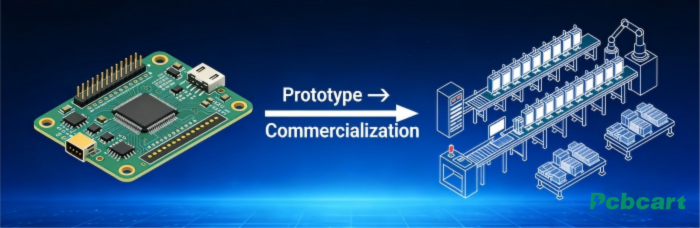
The transition between a prototype and NPI in high-end EMS is a very important phase in the conversion of innovative ideas to successful products. It involves a defined methodology, working with cross-functions, and a high degree of manufacturability, stability of supply chains and quality assurance.
Companies with strong NPI strategies will greatly minimise the risk, speed up the release of products and have scalable production at low costs.
PCBCart offers comprehensive EMS solutions—from rapid prototyping to full-scale production—helping bridge the gap between concept and commercialization with precision and confidence.
Scale Your PCB Prototype to Mass Production with PCBCart
Helpful Resources
• PCB Prototype Assembly
• Low-Volume PCB Assembly (HMLV)
• Creating a Qualified BOM
• Supply Chain Risk Mitigation


