



Most failed EMS transitions aren't caused by picking the wrong partner — they're caused by treating the switch as a logistics task instead of a structured program with gates and acceptance criteria.
Changing contract manufacturers while a product is live in the market is one of the highest-risk moves a supply chain leader can make. The visible costs — requoting, tooling, freight — are usually the smallest part of the exposure. The real cost shows up later: lost process knowledge, yield regression during ramp-up, and supply chain gaps that only surface after the handoff is already done.
This guide breaks the transition into five decision points, each with the framework or checklist you need to get it right.
1. Timing: Does Your Inventory Runway Support a Switch Right Now?
Most switch decisions are triggered by accumulating quality complaints, chronic delivery slippage, or an incumbent using leverage to push through price increases. All three are legitimate reasons to leave. None of them tell you when it's safe to leave.
The variable that actually matters is your risk window — the gap between current finished-goods/WIP inventory and your next committed delivery date:
| Inventory Coverage | Next Delivery Date | Risk Level | Recommended Action |
|---|---|---|---|
| >8 weeks stock | >12 weeks out | Low | Begin transfer now, standard pace |
| 4–8 weeks stock | 8–12 weeks out | Moderate | Begin transfer now, compress documentation phase |
| <4 weeks stock | <8 weeks out | High | Run dual-track (Section 5) before cutting over |
| <2 weeks stock | <4 weeks out | Critical | Negotiate short-term bridge supply from incumbent first |
A supplier's quality problems don't disappear because you're frustrated — but neither does the risk of a supply gap if you leave without a buffer.
2. Documentation: What to Secure Before the Incumbent Knows You're Leaving
Leverage peaks before your current EMS suspects the relationship is ending. Request these categories now, while the conversation is still "business as usual":
Fabrication and design files — Gerbers/ODB++, current revision history
Full BOM with approved vendor list entries, approved alternates, and NCNR (non-cancellable/non-returnable) flags identified
Process parameter files — reflow profiles, paste specs, torque values
Test procedures with explicit pass/fail criteria per test stage
Test fixture specifications — wiring diagrams, probe coordinates, equipment dependencies
Historical defect/yield data (12–24 months minimum)
Material inventory ledger — on-hand, on-order, and consigned stock
Tooling ownership records — jigs, stencils, bed-of-nails fixtures
Two items get contested most often: yield/defect history (it exposes the incumbent's own performance) and tooling ownership (frequently left ambiguous in older contracts). Address this in writing — documentation and customer-owned tooling should revert to the OEM on request, full stop. If your current agreement is silent on this, fix it before you need it, not while you're already mid-transfer negotiating from a weaker position.
A documentation package that looks complete but contains outdated revisions is arguably worse than an incomplete one — it produces builds that fail first-article inspection for reasons that look like new problems but are actually old ones nobody caught. Have a cross-functional reviewer (hardware, test, sourcing) validate every document against the current production unit before it leaves the outgoing site.
3. Qualification: A Staged Path, Not a Single Cutover
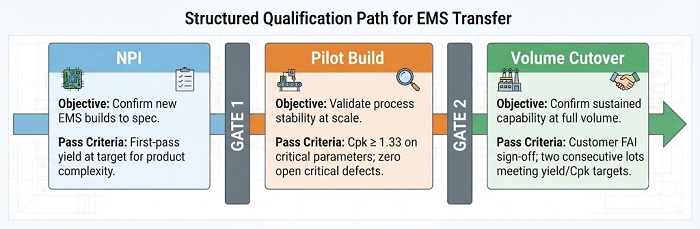
Rushing straight to volume production is the single most common way transfers go wrong. Use a staged approach with defined exit criteria at each gate:
| Stage | Objective | Pass Criteria |
|---|---|---|
| NPI | Confirm the new EMS can build to spec | First-pass yield at target for this specific product complexity |
| Pilot build | Validate process stability at scale | Cpk ≥ 1.33 on critical parameters; zero open critical defects |
| Volume cutover | Confirm sustained capability at full volume | Customer FAI sign-off; two consecutive lots meeting yield/Cpk targets |
Pilot volume typically runs 100–300 units depending on product complexity — enough for line operators, process engineers, and test technicians to build the tacit handling knowledge that no document transfers automatically. Treating the pilot as a deliverable production run, rather than a validation exercise, just defers the learning curve to volume — where fixing it costs far more.
One structural trap worth flagging: if your new partner is a large, multi-site EMS group, NPI success at one plant doesn't guarantee the volume plant will execute the same way. Insist the plant that will run long-term production is involved from NPI onward, not brought in after qualification is "done."
An EMS operating under an IATF 16949-certified quality system should already have standardized qualification documentation — FAI reports, process capability studies, control plans — built into its NPI process, rather than needing to construct this rigor specifically for your account.
4. Material and IP Handover: Close the Gaps Before They Become Disputes
Materials and data are where transitions get expensive in ways that don't show up on a purchase order. Your handover agreement should explicitly cover:
Consigned material return — reconciled inventory count, signed by both parties
WIP disposition — completed, scrapped, or shipped in-process to the new EMS
Pre-committed material — who absorbs cost for stock bought against your forecast that can't transfer
Component traceability — lot/date codes preserved when material moves sites
IP protection during the overlap period — NDA coverage with the incoming partner before any files are shared, access-controlled document transfer, and a contractual deadline for the outgoing EMS to certify destruction or return of your materials
That last point is the one OEMs most often skip — and it's how proprietary test software or firmware images end up sitting indefinitely at a facility you no longer have a relationship with.
5. Dual-Track Production: Bridging the Gap Without Overpaying for It
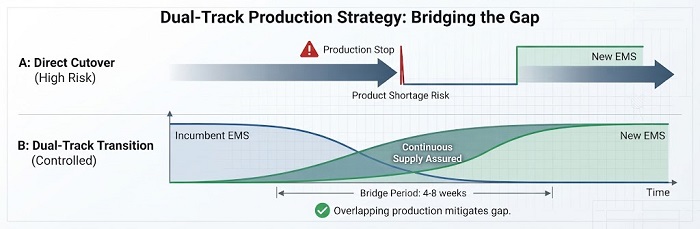
Once the new EMS clears pilot, you face a choice: cut over immediately, or keep the incumbent shipping small volumes while the new site ramps to full qualification.
Dual-track costs money — duplicate tooling, split MOQs, added coordination. A full stoppage while you wait usually costs more, in expedited freight and missed shipments. If Section 1 placed you in the "High" or "Critical" tier, dual-track isn't optional — it's what buys you the time your inventory runway doesn't otherwise give you.
Typical duration: 4–8 weeks, scaled to complexity — closer to 4 for simple, low-mix assemblies; 6–8 for high-mix builds with custom test fixtures. The stopping point isn't a calendar date — it's the same milestone from Section 3: two consecutive stable lots from the new EMS at full volume.
A Second Opinion, Before You Switch
Sequenced correctly, an EMS transition is a manageable program: risk window first, documentation second, staged qualification third, material and IP handover fourth, dual-track only as long as it's needed.
If you're currently evaluating a switch, request a free DFM review from PCBCart's engineering team. We'll assess your current design package, flag transfer-specific risks based on your product's complexity, and help you think through a realistic qualification timeline before you commit to a cutover date.
Helpful Resources
• Some Handy Methods in Evaluating SMT Assembler's Capabilities
• Elements Ensuring Your First-Time Success in New Product Introduction (NPI)
• Printed Circuit Board Assembly Inspection Methods
• How to Enhance PCB Supply Chain Transparency?


