



For procurement leaders sourcing PCB assembly, the turnkey-vs-consignment question isn't academic — it determines who carries component risk, who absorbs price volatility, and who answers for a counterfeit part six months after shipment. Yet many teams default to whichever model their last supplier offered, rather than choosing deliberately. Here's a framework to make that call order by order, not by habit.
The Core Difference: Who Owns the Materials Decision?
Turnkey PCBA means your EMS partner sources, qualifies, and procures every component on the bill of materials. You hand over a design; they hand back finished boards. You've transferred procurement workload — and procurement risk — to the manufacturer.
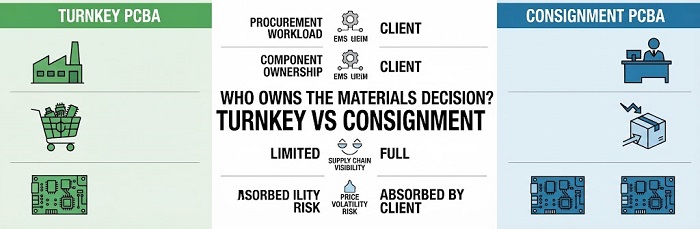
Consignment PCBA means you supply all (or nearly all) materials. The EMS provider assembles what you send. You retain full visibility into component sourcing, cost, and supplier relationships, but you also retain the labor of managing that supply chain.
Neither model is inherently better. The right choice depends on your order profile, your internal bandwidth, and — increasingly in 2026 — how exposed your specific components are to tariff and lead-time volatility. Getting the definitions straight now avoids the most common contract dispute: disagreement over who was responsible for a bad part.
When Turnkey Makes Sense
Advantages: You eliminate the procurement headcount burden. A qualified EMS provider buying in volume across multiple clients often secures better pricing and priority allocation from distributors than a single company can alone.
Risks: Sourcing transparency drops unless contractually specified. Counterfeit or gray-market components remain a real exposure in categories with tight allocation. And when component prices spike, some EMS providers pass the increase through with limited notice — so your "fixed" unit cost isn't always fixed.
Turnkey fits well when your order has these five characteristics:
| Order Characteristic | Why Turnkey Works |
|---|---|
| Standard, non-exotic components | Lower counterfeit and allocation risk |
| No internal procurement team | EMS absorbs the workload entirely |
| Moderate-to-high volume, repeat production | EMS achieves real volume pricing leverage |
| Design is largely finalized (low ECO frequency) | Less rework from mid-cycle sourcing changes |
| Supplier has documented component traceability | Reduces IP and counterfeit exposure |
On that last point, ask any turnkey candidate how they document component genealogy — batch and lot tracking through their MES system is a fair, direct question, and a supplier without a clear answer is a red flag, not a technicality.
When Consignment Makes Sense
Advantages: You control sourcing entirely — which supplier, which lot, which price you locked in and when. For companies with existing component contracts or in-house procurement expertise, this often beats anything an EMS can negotiate.
Risks: Kit completeness errors (missing or wrong parts shipped) become your problem to catch before assembly starts. Moisture-sensitive device (MSD) handling responsibility needs explicit contract language — who's liable if a part isn't baked correctly before use. And material handoff creates ambiguity around damage or shortage: whose loss is it if a reel goes missing at receiving?
Consignment fits well when your order has these five characteristics:
| Order Characteristic | Why Consignment Works |
|---|---|
| Existing strategic component contracts | You keep negotiated pricing intact |
| High-value or single-source components | You control allocation and avoid markup |
| Strong internal supply chain team | You have bandwidth to manage kitting |
| Regulatory or industry sourcing mandates | You maintain full chain-of-custody control |
| Low tolerance for third-party sourcing risk | You eliminate the "who bought this?" question |
The 2026 Supply Chain Variables Changing the Calculus
Two forces are reshaping this decision beyond the traditional cost-vs-control tradeoff:
Unstable semiconductor lead times and shifting tariff schedules mean the "price discovery" cost embedded in turnkey quotes has gone up. EMS providers are quoting with wider contingency buffers, and some are unwilling to hold firm pricing for as long as they used to on tariff-exposed categories. That erodes one of turnkey's core selling points — price certainty.
EMS inventory stockpiling risk is the flip side. Providers holding excess buffer stock against future allocation crunches can create write-off exposure that eventually shows up in your pricing, or in disputes over obsolete inventory at program end. For your most critical, highest-cost, or longest-lead-time components, consignment increasingly makes sense even inside an otherwise turnkey program — you don't want someone else's stockpiling risk sitting inside your unit cost.
A practical rule for 2026: if a component's lead time or price has shown material volatility in recent quarters, consider pulling it out of turnkey scope and sourcing it directly, even if the rest of your BOM stays turnkey.
The Hybrid Model: Semi-Turnkey
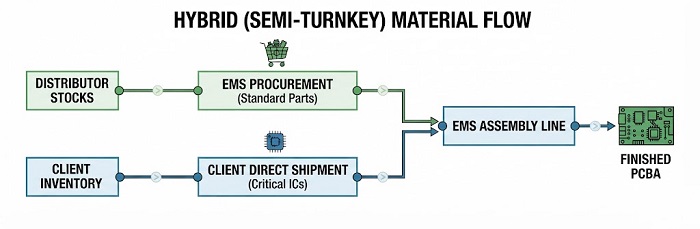
The fastest-growing pattern in HMLV (high-mix, low-volume) production is semi-turnkey: standard components — passives, connectors, PCB — stay turnkey, while critical or volatile ICs are supplied on consignment.
This requires precise contractual division of responsibility:
Which line items on the BOM are turnkey vs. consigned (documented per revision, not just per program)
Who owns yield loss and rework cost for consigned parts damaged during assembly
How kit shortages are resolved without stalling the turnkey portion of the build
Traceability continuity — an EMS operating under IATF 16949 should be able to track consigned and turnkey materials through the same MES system without a documentation gap
Done well, semi-turnkey captures most of turnkey's convenience while ring-fencing your highest-risk components under direct control.
A 5-Minute Decision Matrix
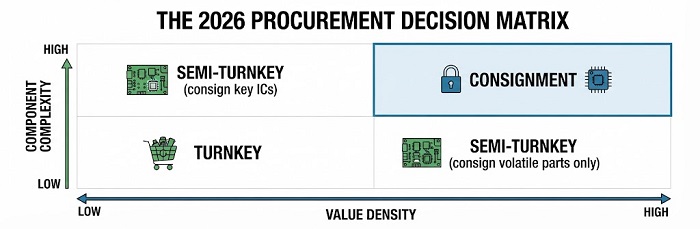
Plot your order on two axes:
| Low Component Complexity | High Component Complexity | |
|---|---|---|
| High Value Density | Semi-turnkey (consign key ICs) | Consignment |
| Low Value Density | Turnkey | Semi-turnkey (consign volatile parts only) |
If your BOM sits in the high-value, high-complexity corner, don't default to a supplier's standard offering — negotiate the split explicitly.
Next Step
Every order profile is different, and the right model often changes across a product's lifecycle. If you're weighing this decision for an upcoming build, request a free DFM review — it will surface which components on your BOM carry sourcing risk worth managing directly, and give you a concrete basis for choosing turnkey, consignment, or a hybrid split before you commit to a program structure.
Helpful Resources
• How to Evaluate PCB Manufacturers And Pick Up the Most Reliable Supplier for Your Project?
• Some Handy Methods in Evaluating SMT Assembler's Capabilities
• How to Enhance PCB Supply Chain Transparency?
• How to Create A Qualified BOM for Quick PCB Assembly Quotation and Production
• Electronics Manufacturing Services


