



Why X-Ray Inspection Is Non-Negotiable for Industrial Power Modules
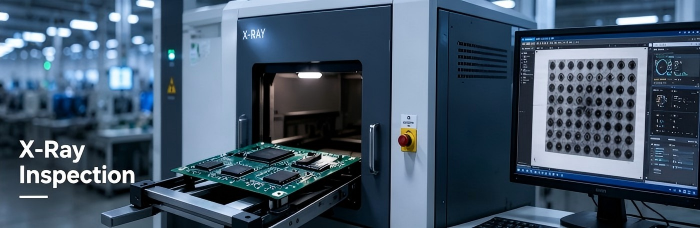
On an SMT line building industrial power modules, the most dangerous defects are the ones you cannot see. BGA and QFN solder joints sit hidden beneath the package body, completely inaccessible to AOI or manual visual inspection. The only way to look inside that solder ball is X-Ray transmission imaging.
For industrial power modules, the consequences of voiding are more severe than in consumer electronics. A void is essentially an air gap inside the solder joint's thermal path, and air conducts heat at roughly a thousandth of the rate of solder alloy. Once a single solder ball's void area exceeds 25% of its projected footprint, that joint's thermal resistance typically rises by 40–60%. Under full-load operating conditions, that increase can push the junction temperature (Tj) of the power device past its rated limit, triggering thermal runaway or accelerated long-term degradation. These modules are usually running continuously, in enclosed housings with limited or no forced-air cooling — and by the time the failure shows up, it's already in the field.
That is why X-Ray inspection is treated as a mandatory step before shipment, not an optional add-on, for this product category.
IPC-7095D Void Acceptance Criteria
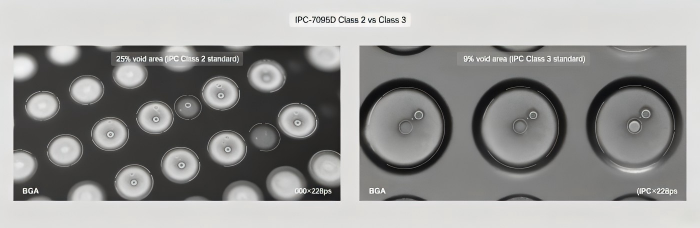
IPC-7095D is the industry-recognized standard for evaluating and accepting BGA solder joint voiding. The core metric is the void area of a single solder ball expressed as a percentage of that ball's projected area.
Two acceptance levels are commonly referenced. Class 2 allows up to 25% void area per solder ball and is typically applied to consumer electronics and general industrial controls. Class 3 tightens that limit to under 10% void area per ball, and is reserved for continuous high-load industrial applications and other high-reliability use cases.
Choosing between Class 2 and Class 3 isn't purely a cost decision — it should be driven by how the product is actually used in the field. Industrial power modules typically share three characteristics that push the requirement toward Class 3:
Continuous operation. The module stays powered for extended periods, so solder joints are under sustained thermal cycling stress, and any void-related thermal resistance penalty compounds over time rather than showing up once.
Elevated ambient temperature. Many industrial power modules operate inside control cabinets or outdoor enclosures above 50°C ambient, where thermal margin is already tight. A void-driven increase in local thermal resistance eats directly into that margin.
No field rework option. Once a module is deployed — inside a production line control cabinet or a rail transit power cabinet, for example — BGA-level rework is generally not feasible. The only real quality checkpoint is inspection before the unit ships.
For these reasons, when we take on industrial power module orders, we default to IPC-7095D Class 3 for BGA/QFN void inspection rather than the more commonly used Class 2.
Setting X-Ray Inspection Parameters
Detection accuracy depends heavily on how the X-Ray system is configured, particularly for packages with stacked or overlapping solder balls.
Tube voltage and current. For the mid-to-large BGA packages common in industrial power modules (0.5–0.8mm ball pitch) mounted on thick-copper substrates, we typically set tube voltage in the 90–110kV range. Too low, and penetration is insufficient, producing a washed-out, low-contrast image. Too high, and contrast drops in a way that can mask the edges of smaller voids.
Magnification versus focal distance. Detecting borderline voids — ones sitting close to the acceptance threshold — requires higher geometric magnification, which means shortening the distance between the sample and the radiation source. Higher magnification comes at the cost of reduced depth of field, so it needs to be paired with oblique-angle imaging to stay reliable.
Oblique-angle imaging to separate stacked joints. In package-on-package (PoP) constructions or double-sided assemblies, solder balls at the same X-Y position on different layers can overlap in a straight-on image, making them impossible to distinguish. We tilt the stage more than 5° for these inspections, using the resulting geometric offset to separate the upper and lower layer's solder balls in the image and avoid misreading a defect that isn't there — or missing one that is.
Common Void Formation Mechanisms and Process Root Causes
Voiding is not random. It almost always traces back to one of three identifiable process root causes.
The first is incomplete outgassing of solder paste volatiles. If the reflow profile's ramp rate is too steep — above roughly 2°C per second — the flux solvent in the paste doesn't have enough time to evaporate during preheat before the paste enters reflow, and it gets trapped inside the molten solder as it liquefies.
The second is flux residue gassing off through a poorly designed pad structure. Via-in-pad layouts that aren't resin-plugged or plated shut allow trapped air or flux vapor inside the via to expand under reflow heat and vent upward through the solder ball, producing a characteristic via-related void.
The third is oxidation on the PCB surface finish. ENIG (electroless nickel immersion gold) finishes carry a known "black pad" risk, where nickel layer oxidation weakens solder wetting to the nickel underneath. That uneven wetting leads to uneven shrinkage during cooling and produces microscopic voids.

Closing the Loop: A Preheat Time Adjustment Case
During a production run of an industrial power module, X-Ray sampling flagged an average BGA void rate of 18%, well above the under-10% threshold required for Class 3.
Comparing the X-Ray images against the reflow oven's recorded temperature profile pointed to insufficient preheat dwell time as the root cause — the line was running a 60-second preheat, which wasn't giving the flux enough time to fully outgas before entering the reflow zone. We extended the JTR-1200D-N reflow oven's preheat time from 60 to 90 seconds and reduced the ramp rate from 2.2°C/second to 1.5°C/second, giving volatiles more time to escape.
Across three subsequent production lots, the average BGA void rate dropped from 18% to 7%, and the maximum single-ball void rate fell from 31% to 9.5% — comfortably inside the Class 3 requirement, with margin to spare. This kind of root-cause analysis depends on more than the imaging capability of the X-Ray system itself; it also depends on an MES that ties each reflow oven's temperature log to its corresponding inspection data, so a defect can be traced back to a specific process parameter instead of being chalked up to general experience.
A 5-Step Void Risk Self-Check
For engineers evaluating an EMS supplier — or reviewing their own line — a few quick checks can surface void risk early:
Confirm the package type. Is it BGA, QFN, or PoP, and does the layout include via-in-pad?
Check the pad drawing. Is any via-in-pad structure resin-plugged and plated shut?
Review the reflow profile. Is preheat dwell time at least 60 seconds, and is the ramp rate no more than 2°C per second?
Confirm the surface finish. Is ENIG plating thickness and nickel oxidation risk within a controlled range?
Ask for actual void rate data. Request the supplier's real X-Ray void inspection report rather than a general statement that the board "passed AOI."
Addressing via-in-pad treatment and pad sizing during DFM review is almost always more cost-effective — and more likely to eliminate the root cause — than relying on X-Ray as an after-the-fact filter once the product is already in production.
Void control isn't something that can be inspected in at the end of the line — it has to be built into the reflow profile, the pad design, and the incoming material controls, with X-Ray data feeding back into all three. That closed-loop discipline is what separates a supplier who can show you a passing image from one who can show you a stable process. At PCBCart, this is how we run Automated X-Ray Inspection on every industrial power module build — tied back through our Smart MES to the reflow lot and pad design that produced it, not treated as an isolated pass/fail check at the end of the line.
Helpful Resources
• Why is X-ray Inspection Technology So Important in PCB Assembly
• Effective Measures for Quality Control on Ball Grid Array (BGA) Solder Joints
• Comparison of AOI, ICT and AXI and When to Use Them during PCB SMT Assembly
• Solder Ball Issues of BGA Components and How to Avoid Them
• Advanced PCB Assembly Services


