



Why Counterfeit Risk Rises During Supply Chain Tightness
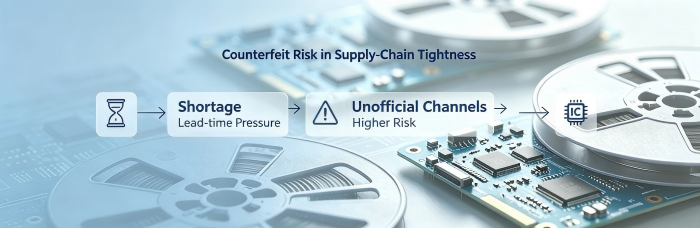
Component shortages and extended lead times create conditions where counterfeit and refurbished parts enter the supply chain more easily. When allocation tightens on specific part numbers — often mature analog ICs, connectors, or passives caught in demand spikes — buyers under schedule pressure are pushed toward channels outside authorized distribution. This is a well-documented industry pattern: organizations such as ERAI and SAE International (through the AS6081 and AS5553 standards) have tracked recurring waves of counterfeit incidents tied directly to shortage cycles, since counterfeiters concentrate effort on exactly the part numbers where legitimate supply is constrained.
For HMLV (High-Mix, Low-Volume) PCBA programs, the exposure is compounded by the sheer number of distinct part numbers moving through a build plan at any given time. A single high-mix build can carry component counts an order of magnitude higher than a comparable high-volume program, which multiplies the number of individual sourcing decisions — and therefore the number of points where a counterfeit part could be substituted.
Authorized Channel vs. Independent Distribution: Risk Profile and When Each Applies
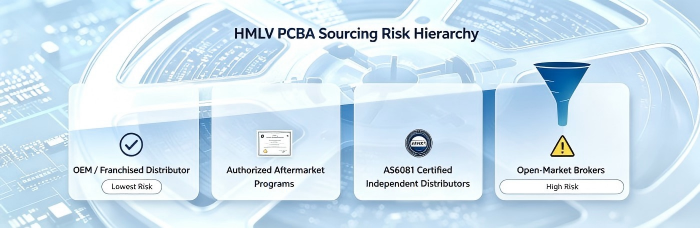
Authorized/franchised distribution — sourcing directly from a manufacturer or its named distributors — carries the lowest counterfeit risk because the chain of custody is unbroken and traceable back to the OEM. This should be the default sourcing path whenever the part number and required quantity are available through franchised channels, even at a lead-time or price premium.
Independent/open-market distribution becomes necessary when a part is obsolete, allocated, or unavailable through franchised channels within the program's schedule. Independent brokers can be legitimate and are sometimes the only practical source for long-lifecycle or end-of-life components common in industrial automation and semiconductor test equipment designs. However, this channel carries materially higher risk because:
Chain-of-custody documentation is often incomplete or unverifiable
Parts may have been reclaimed, reballed, or relabeled
Multiple resale hops obscure the original source
A practical sourcing hierarchy for HMLV programs:
OEM/franchised distributor (default)
OEM-authorized aftermarket/allocation programs
Independent distributors with documented AS6081 or ERAI-aligned quality processes
Open-market brokers — only with enhanced incoming inspection and customer sign-off
When a part must be sourced independently, that decision should be flagged explicitly in the build documentation, not absorbed silently into standard procurement — the customer sourcing-risk conversation belongs at the sourcing decision point, not after receipt. This is also where a dual/multi-vendor sourcing strategy can reduce single-source exposure before allocation pressure forces a rushed independent-channel buy.
Incoming Inspection (IQC): Authenticity Verification Practices
Independently sourced components warrant an inspection tier beyond standard dimensional and visual IQC. Practices applicable at incoming inspection include:
Marking and Package Verification
Cross-referencing date codes, lot codes, and country-of-origin markings against the distributor's documentation for internal consistency
Checking font, laser-mark depth, and surface finish against known-good reference samples or manufacturer package datasheets, where reference parts are available
Screening for resurfacing indicators (sanding marks, inconsistent texture, blacktopping) under magnification
Batch and Lot Traceability Cross-Check
Verifying that lot/date codes on the physical parts match the certificate of conformance and packing list supplied by the distributor
Where the manufacturer provides lot-level traceability tools, checking submitted lot numbers against those records
Sampling-Based Verification
Electrical parametric sampling against datasheet specifications for a statistically drawn subset of the lot, rather than 100% functional test, which is generally impractical at IQC
X-ray inspection of a sample subset can surface internal construction anomalies — inconsistent die size, wire-bond pattern, or lead-frame configuration relative to known-good references — as a supplementary screening step. This should be understood as a manufacturing-record inspection capability, not a certified counterfeit-detection or forensic analysis service
For components flagged by the above checks, escalation to specialized third-party test labs (decapsulation, XRF material analysis) is the appropriate path — this typically sits outside standard assembly-house IQC scope and should be scoped with the customer in advance for suspect lots
None of these methods individually guarantees detection; the value comes from applying a graduated set of checks weighted to the sourcing channel's risk level, and documenting the checks performed regardless of outcome.
MES: Recording Source and Lot Data for Downstream Traceability
Once material clears IQC, traceability needs to persist through the build so that any downstream issue — a field failure, a customer audit, or a supplier quality escalation — can be traced back to the specific incoming lot and source.
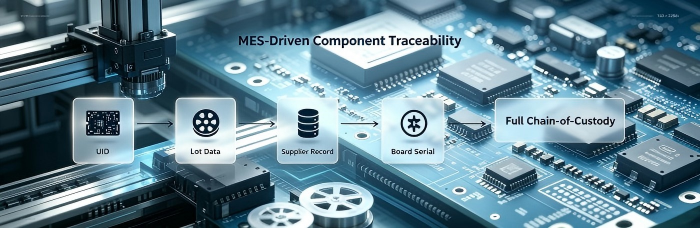
A Smart MES platform with UID-based tracking supports this by:
Associating each reel, tray, or tube with its incoming lot number, supplier, and IQC disposition at receipt
Linking that material record to the specific work order, board serial number (via laser marking), and placement position during SMT assembly
Preserving the chain of custody from goods-receipt through placement, reflow, and final test in a queryable record
This structure means that if a component-level quality issue surfaces after shipment — for example, a supplier issues a field advisory on a specific date code — the affected board serial numbers can be identified from the MES record rather than requiring a full-lot recall or blind rework campaign. For long-lead-time or scarce parts sourced through non-standard channels, this traceability record is also the documentation customers typically request as part of their own supply chain risk audits. This same UID-linked record is what supports long-term component obsolescence tracking across a product's production lifecycle, not just the initial build.
Supply Chain Risk Self-Check
Before releasing a build with independently sourced or allocation-constrained components, run through this check:
Is this part number available through franchised distribution at any lead time or price point? If yes, is the schedule impact of waiting actually worse than the counterfeit risk of not waiting?
Does the distributor provide a certificate of conformance with traceable lot/date code data?
Has the customer been informed that a given part number is being sourced outside franchised channels?
Is enhanced IQC (marking verification, sampling, X-ray screening where applicable) scoped and budgeted for this lot?
Is the incoming lot linked to MES records before it reaches the SMT line?
For flagged or ambiguous parts, is there an agreed escalation path to third-party lab testing?
If more than one of these boxes goes unchecked on a current BOM, that's the point to raise sourcing risk before quoting or release — not after the lot is on the shelf.
Summary
Counterfeit exposure in HMLV PCBA sourcing is not evenly distributed — it concentrates on the specific part numbers where allocation is tight and franchised supply falls short of program schedules. Managing that exposure comes down to three linked practices: keeping independent-channel sourcing as a deliberate, documented exception rather than a default; scaling IQC verification to match the risk of the channel a part came from; and maintaining MES-based lot traceability so that any downstream issue can be traced to a specific batch rather than triggering a blanket investigation. None of these require exotic tooling — they require consistency in applying them at the right point in the sourcing decision, starting from quoting rather than after material arrives.
For BOMs carrying long-lead-time or allocation-constrained components, sourcing risk is easier to manage at the quoting stage than after material is already in hand. Get a sourcing risk assessment for your BOM and scope the IQC and traceability approach before the build is released.
Helpful Resources
• Are the Components Genuine, and How Is Authenticity Verified?
• Components Sourcing Service
• Printed Circuit Board Assembly Inspection Methods
• Traceability from Silicon to System: MES Implementation in Life Sciences Manufacturing
• Essential Principles of PCB Sourcing


