



In high-power electronics, military systems, electric vehicles, and industrial automation, heavy copper PCBs (typically defined as copper weight ≥2 oz/ft², or approximately 70 μm in thickness) are indispensable for their superior current-carrying capacity and thermal conductivity. However, as copper weight increases—ranging from 2 oz to extreme 20 oz/ft² and beyond—solderability becomes a critical and often overlooked challenge. Solderability, the ability of molten solder to wet, adhere, and form reliable metallurgical bonds with copper pads and traces, is profoundly shaped by copper weight. This article explores the multifaceted impacts of copper weight on solderability in heavy copper PCBA projects, analyzes core challenges, and presents actionable solutions, while highlighting key design and manufacturing best practices.
Understanding Copper Weight and Heavy Copper PCB Basics
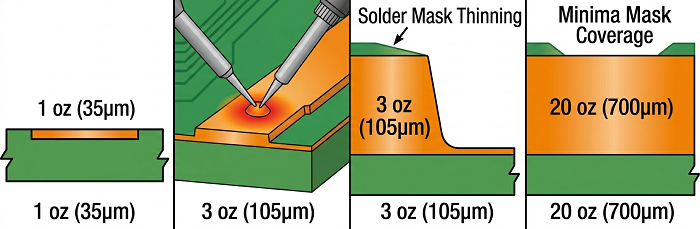
Copper weight, measured in ounces per square foot (oz/ft²), directly corresponds to copper thickness: 1 oz/ft² equals ~35 μm (1.37 mils), 2 oz equals ~70 μm (2.74 mils), 3 oz equals ~105 μm (4.11 mils), and heavier weights (4–20 oz) scale proportionally. Unlike standard PCBs (1 oz copper), heavy copper PCBs feature thick copper layers that enhance power handling and heat dissipation but alter thermal, mechanical, and chemical interactions during soldering.Heavy copper is categorized by weight: 2–3 oz as “moderate heavy copper,” 4–10 oz as “heavy copper,” and above 10 oz as “extreme heavy copper”. Each category introduces distinct solderability risks, rooted in thermal mass, surface morphology, and material compatibility.
Core Impacts of Copper Weight on Solderability
1. Thermal Mass Disparity: The Root Cause of Solder Defects
Copper’s exceptional thermal conductivity (401 W/m·K) becomes a liability in heavy copper PCBs. As copper weight rises, thermal mass increases exponentially—thick copper planes act as massive heat sinks, rapidly drawing heat away from solder joints during reflow, wave, or manual soldering.
Standard 1 oz copper: Heats evenly at 150–180°C preheat, reaching solder liquidus (217°C for SAC305) in 60–90 seconds.
2–3 oz copper: Requires 180–200°C preheat and extended dwell time (90–120 seconds) to offset heat loss.
≥4 oz copper: Demands aggressive preheating (200–220°C) and peak temperatures 5–10°C higher than standard profiles; even minor heat loss causes cold joints—dull, grainy, and mechanically weak connections with incomplete intermetallic formation.This thermal imbalance is the primary cause of solderability failures in heavy copper PCBA projects, accounting for over 70% of assembly defects.
2. Surface Morphology and Wetting Challenges
Thick copper layers (≥2 oz) exhibit rougher surfaces and steeper edge profiles due to aggressive etching and lamination processes. Unlike smooth 1 oz copper pads, heavy copper pads have:
Increased surface roughness: Etching for thick copper creates micro-grooves and uneven topography, reducing solder wetting area and promoting dewetting (solder beads up instead of spreading).
Sharp edge heights: Copper thickness of 3 oz (~105 μm) creates step heights that thin solder masks (standard 0.1 mm) cannot fully cover, exposing copper edges and causing solder bridging or insufficient coverage.
Oxidation susceptibility: Thicker copper has more surface area prone to rapid oxidation during high-temperature preheating; copper oxides (CuO, Cu₂O) prevent solder adhesion, leading to non-wetting defects.
3. Design Rule Constraints Compromising Solderability
Heavy copper’s electrical and mechanical requirements force design tradeoffs that indirectly harm solderability:
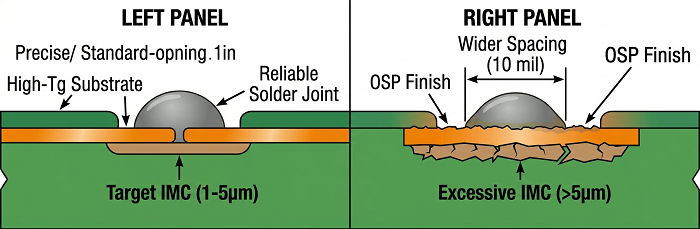
Wider trace/spacing: 2 oz copper requires minimum 8 mil spacing, 3 oz needs 10 mil, and 6 oz demands 13–15 mil—larger gaps reduce pad density and increase the risk of solder starvation (insufficient solder volume for large pads).
Asymmetric copper distribution: Unbalanced layer weights (e.g., 2 oz outer layers, 1 oz inner layers) cause PCB warpage (bow/twist) during soldering, misaligning pads with components and creating uneven solder joints.
Large power planes: Solid copper pours (common in heavy copper designs) amplify heat sinking, making localized soldering (e.g., fine-pitch SMT components) nearly impossible without specialized processes.
4. Intermetallic Compound (IMC) Formation Risks
Solder reliability depends on a thin, uniform IMC layer (Cu₆Sn₅, Cu₃Sn, target thickness 1–5 μm) between copper and solder. Heavy copper disrupts IMC formation:
Excessive IMC growth: High thermal mass prolongs time above liquidus (TAL), causing thick, brittle IMC layers (>5 μm) that crack under thermal cycling (-40°C to 125°C).
Uneven IMC distribution: Rough copper surfaces create variable IMC thickness—thin regions fail electrically, thick regions fail mechanically.
Common Solderability Defects in Heavy Copper PCBA Projects
Cold Joints: Dull, grainy appearance, weak shear strength (<3N vs. 5N for reliable joints), caused by insufficient heat to reach liquidus.
Dewetting/Non-Wetting: Solder beads up or fails to cover pads, caused by oxidation, rough surfaces, or insufficient flux activation.
Solder Bridging: Short circuits between adjacent pads, caused by excessive solder volume or uneven mask coverage over copper edges.
Pad Lift: Copper pads detach from the substrate, caused by thermal stress from uneven heating or poor copper-substrate adhesion.
Excessive IMC: Brittle joints prone to cracking, caused by extended TAL or high peak temperatures.
Actionable Solutions to Mitigate Copper Weight-Related Solderability Issues
1. Design Optimization for Solderability
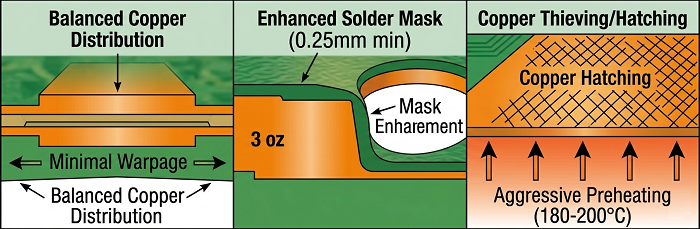
Balanced copper distribution: Use symmetric layer stackups (e.g., 2 oz outer/2 oz inner) to prevent warpage; split heavy copper across multiple layers instead of concentrating it on one layer.
Pad enlargement: Increase pad size by 20% (e.g., 0805 pad: 1.2mm×0.72mm vs. standard 1.0mm×0.6mm) to improve solder coverage and mechanical strength.
Solder mask enhancement: Specify minimum 0.25mm thick solder mask with 0.1mm larger openings than pads to cover copper edges and prevent bridging.
Copper thieving/hatching: Add non-functional copper features (thieving) or cross-hatch patterns to large copper planes to balance thermal mass and improve etching uniformity.
2. Soldering Process Tuning
Aggressive preheating: For 2–3 oz copper: 160–180°C preheat, 90–120 seconds dwell; for ≥4 oz copper: 180–200°C preheat, 120–180 seconds dwell (bottom-side IR + forced convection for even heating).
Modified reflow profiles: Peak temperature 245–260°C (SAC305), TAL 45–60 seconds; avoid prolonged high temperatures to prevent excessive IMC.
Specialized soldering methods: For ≥6 oz copper, use selective soldering (extended dwell times, high-thermal-capacity nozzles) or induction heating instead of standard wave soldering.
High-performance flux/solder: Use slow-cooling, high-activity flux to remove oxides; select high-melting-point solder (SAC305, 221°C melting point) for heavy copper applications.
3. Material and Surface Finish Selection
Oxidation-resistant finishes: Replace standard HASL with ENEPIG or OSP with high-temperature stability; these finishes prevent oxidation during preheating and enhance wetting.
High-Tg substrates: Use FR-4 with Tg ≥180°C to resist thermal stress and pad lift during high-temperature soldering.
Best Practices for Heavy Copper PCBA Solderability
Early DFM collaboration: Involve manufacturers in design phase to validate copper weight, trace width, and stackup for solderability.
Copper weight localization: Use heavy copper only in high-current regions; use standard 1 oz copper for signal layers to balance performance and solderability.
Thermal simulation: Run finite element analysis (FEA) to predict hotspots and thermal gradients before production.
Prototype testing: Validate soldering profiles and surface finishes on small-batch prototypes to avoid mass production defects.
Conclusion
Copper weight is a double-edged sword in heavy copper PCBA projects: it enables high-power performance but introduces significant solderability challenges rooted in thermal mass, surface morphology, and design constraints. By understanding these impacts, optimizing designs for thermal balance, tuning soldering processes for high thermal mass, and selecting compatible materials, engineers can mitigate defects and achieve reliable solder joints in heavy copper PCBs.
For high-quality heavy copper PCB and PCBA services that balance performance, solderability, and cost, trust PCBCart—your reliable partner for high-power electronics manufacturing. With years of expertise in heavy copper design, precision manufacturing, and process optimization, PCBCart delivers robust, reliable solutions for even the most demanding heavy copper PCBA projects.
Helpful Resources
• Design Issues on Thick/Heavy Copper PCBs for Military and Aerospace Applications
• Relationship between Copper Weight, Trace Width and Current Carrying Capacity
• PCB Surface Finishes Introduction and Comparison
• Design for Manufacture and Assembly of PCBs


