



Most counterfeit electronic components get into a build through the purchase order, not through the SMT line. When a contract manufacturer sources your parts, the controls that matter most are which channel it buys from by default, who approves a buy outside that channel, and what records tie each reel back to its source. No CM can honestly promise zero risk, but a few direct questions will tell you quickly whether that risk is being managed.
Where do counterfeit parts enter the supply chain?
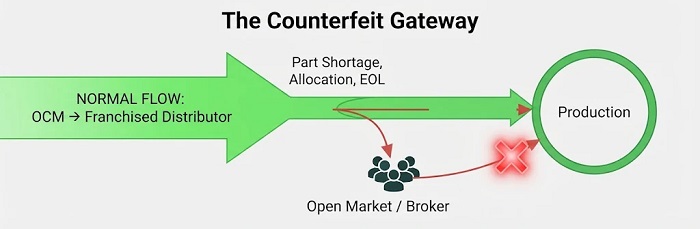
They enter when a part gets hard to buy. As long as a device sits in stock at franchised distributors, nobody has a reason to look elsewhere. The trouble starts when a part goes on allocation, lead times stretch past the build date, or the manufacturer issues an end-of-life notice. At that point someone in the chain, whether the OEM buyer, the CM's purchaser or a sub-tier supplier, starts calling brokers, and the stock that turns up often has no paper trail back to the original component manufacturer (OCM).
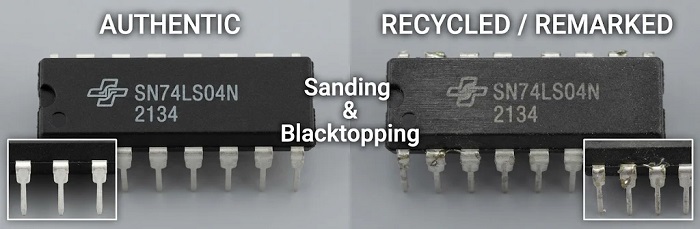
The fakes themselves fall into a few recognisable types. The most common is recycled parts: devices pulled from scrapped boards, cleaned, re-tinned or re-balled, then re-marked with a fresh date code and sold as new. Remarked parts are a close cousin. A lower-grade device has its top surface sanded and recoated (blacktopping) and a higher-grade part number printed on it, so a commercial-temperature part is sold as industrial, or an old date code is sold as recent. After that come factory rejects and test escapes that left the OCM through the back door, overproduced units from a subcontracted fab, and outright clones with a different die or no die at all.
There is also a grey zone that isn't strictly counterfeit but produces similar failures: genuine excess inventory from another manufacturer with no record of how it was stored. A moisture-sensitive BGA that sat unbagged in a warehouse for an unknown time is authentic, and it can still crack or pop during reflow.
Long-lifecycle programs run into this more than most. Test equipment and life sciences instruments often stay in production long after the design is frozen, so component obsolescence pushes buyers toward the open market exactly when the remaining stock is oldest and hardest to verify.
Authorized vs independent distributors: what actually differs?
The difference is the traceability chain, not the price tag. An authorized (franchised) distributor buys directly from the OCM under a franchise agreement, so its stock carries a documented path back to the factory and usually the manufacturer's warranty. An independent distributor buys wherever it can find stock, including other distributors' excess, OEM surplus and brokers, and its parts are only as trustworthy as its own inspection and testing.
Independent doesn't mean dishonest. Some independents run serious counterfeit avoidance programs, and SAE AS6081 was written specifically for distributors in that position. But the burden of proof shifts. With franchised stock, authenticity is the starting assumption. With independent stock, it has to be demonstrated lot by lot.
| Authorized (franchised) distributor | Qualified independent distributor | Open-market broker | |
|---|---|---|---|
| Where stock comes from | Directly from the OCM | Excess and surplus from OEMs, CMs and other distributors | Any source, often several hands removed |
| Traceability to OCM | Documented through the franchise | Partial; depends on the supplier's records | Usually none |
| Manufacturer warranty | Normally passes through | Normally not | No |
| Typical paperwork | Distributor CoC, OCM packaging and labels | Own CoC, test reports if requested | Own CoC, sometimes photos |
| Testing before use | Label and documentation check | Visual, X-ray and sample electrical test, scaled to risk | Full test plan, or don't buy |
| When it makes sense | Default for every line | Allocated or EOL parts, with buyer approval | Last resort; rarely worth it for production |
We purchase from authorized distributors by default. Our components sourcing service buys from leading authorized distributors such as Digi-Key, Mouser Electronics, Arrow Electronics and Avnet, and that holds unless you ask us to do something different.
The something different is a real option, and we'd rather explain it plainly than bury it. If a project is under tight budget pressure, we can buy from suppliers you recommend. In that case we can't guarantee the quality and performance of those parts, because the channel decision, and the risk that comes with it, is yours. Either way, we don't substitute a part without your approval. That rule matters more than it looks, since a lot of grey-market exposure starts with a well-meant swap to an "equivalent" that happened to be in stock somewhere.
What checks happen on incoming parts?
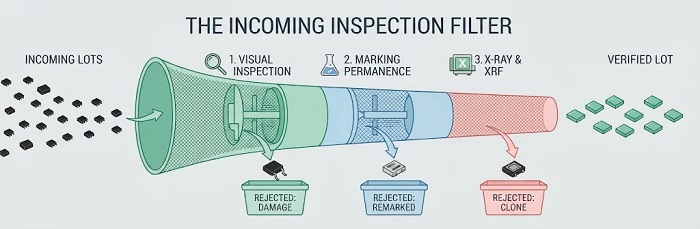
Incoming inspection catches crude fakes and handling damage, but it is a sampling filter, not a certificate of authenticity. How deep it goes should depend on where the parts came from. The common methods compare like this.
| Check | What it catches | What it misses | When it earns its cost |
|---|---|---|---|
| Documentation and label review (PO match, CoC, OCM label format, date and lot codes, MSL bag and humidity indicator card) | Wrong part, mismatched codes, inconsistent labels, broken moisture barrier | Well-made fakes in convincing packaging | Every lot, every source |
| Visual inspection under magnification (IDEA-STD-1010 is a common reference) | Sanded or recoated tops, ghost marks, re-tinned or bent leads, mixed lots in one reel | Clones with a clean surface finish | Every lot from non-franchised sources |
| Marking permanence / solvent test | Blacktopping and ink re-marking | Laser re-marking on an unsanded surface | Independent and broker stock |
| X-ray against a known-good sample | Wrong or missing die, different lead frame, missing bond wires | Wrong speed or temperature grade on the correct die | Parts of uncertain origin, especially ICs |
| XRF | Lead finish that doesn't match the datasheet | Anything inside the package | When finish matters for process or compliance |
| Decapsulation | Die markings, die revision, manufacturer logo | Function; it also destroys the sample | High-risk ICs where losing samples is acceptable |
| Electrical test (curve trace, parametric, functional) | Dead, damaged or wrong-grade parts | Latent reliability defects | Broker stock for anything critical |
For parts that arrive from franchised stock in sealed OCM packaging, documentation and label checks are usually proportionate. X-raying a full reel of franchised MLCCs adds cost and handling without catching much. For independent or broker stock, the minimum we'd want to see is visual inspection, a marking permanence test and X-ray comparison against a known-good sample, plus sample electrical testing for any IC the board can't afford to lose. If your quality team wants a published framework to point at, SAE AS6171 lays out test methods by risk level.
Keep two limits in mind. Sampling means a few bad parts in a large lot can pass. And a genuine die re-marked as a higher grade can pass everything short of full parametric testing at temperature. That's why channel control does more of the work than inspection does: inspection catches what the channel let through, but it can't make a bad channel safe.
If you want to know exactly what incoming checks would apply to your BOM, and how we handle counterfeit avoidance in our sourcing, ask our sales team before you order. It's a fair question, and we'd rather answer it at quote stage than after a failure.
What should you ask your CM?
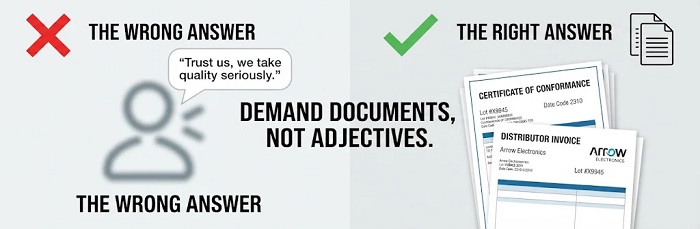
Ask questions whose answers are documents, not adjectives. "We take quality seriously" tells you nothing, while a distributor invoice for a specific lot tells you a lot. These are the questions we'd ask if we were on your side of the table:
1. What channel do you buy from by default, and can you show the distributor invoice or certificate of conformance for a specific lot on my build?
2. When a line item isn't available from authorized stock, what happens next? Who approves a buy from an independent source, and is that approval recorded?
3. Will you ever substitute a part without asking me? What counts as an approved alternate?
4. What inspection applies to non-franchised parts, is it written down, and will I see the results?
5. Can you trace a part on a finished board back to its reel, lot and date code?
6. What happens to a suspect lot? Is it quarantined and kept off the market rather than returned to the seller?
7. What happens to leftover parts from my job? Are they returned, held for my next build, or used elsewhere?
Question 6 is the one most buyers skip. A suspect counterfeit sent back to a broker for a refund tends to get sold to someone else. Good practice is to quarantine the lot, tell the customer, and report it through an industry database such as GIDEP or ERAI instead of letting it re-enter the market.
The other half of this is your BOM. A BOM with full manufacturer part numbers and approved alternates removes most of the guesswork that drives purchasing toward the open market. A generic line like "10k 0603 1%" is fine for a resistor where you genuinely don't care about the brand. For ICs, connectors and anything with a qualification history, give us the MPN and say whether alternates are allowed.
Buyer checklist
Use this to walk a turnkey order from RFQ to delivery. Each line should end with something you can file, not a verbal assurance.
| Stage | Check | What good looks like |
|---|---|---|
| Before RFQ | BOM lists full MPNs and approved alternates | No ambiguous descriptions on ICs or qualified parts |
| Before RFQ | Lines at EOL or on allocation are flagged | You know which lines may need non-franchised stock before the quote arrives |
| At quote | Default sourcing channel confirmed in writing | Authorized distributors, unless you've chosen otherwise |
| At quote | Rule for substitutions and independent buys | No change without your written sign-off |
| At quote | Inspection plan for any non-franchised line | Named checks, sample sizes and who receives the results |
| At order | Date-code and storage requirements on the PO | A date-code limit and MSL handling that match your reliability needs |
| At order | Leftover parts disposition agreed | Return, hold or scrap, decided in advance |
| At delivery | Sourcing records available on request | Distributor invoices or CoCs for critical lines |
| After a failure | Suspect-lot handling | Quarantine, customer notification, no resale |
FAQ
Does consigning my own parts remove counterfeit risk?
No, it moves the risk to your own purchasing team. When you supply parts, a CM normally checks quantity, part-number labels and visible condition, not authenticity, unless a specific inspection has been agreed. If you consign parts bought from brokers, ask for the same inspection you'd expect on a turnkey broker buy and budget for it.
Is a certificate of conformance proof that a part is genuine?
Only as far as the issuer can be trusted. A CoC from an authorized distributor ties back to the OCM through the franchise. A CoC from a broker is the broker's own statement, and forged OCM certificates do circulate. Check that the lot and date codes on the certificate match the reel labels, and that the document looks like what the named distributor normally issues.
Can a genuine part still cause a failure?
Yes. A genuine moisture-sensitive device with a broken dry pack, or one with an old date code, can crack in reflow or show poor solderability. That's why the PO should carry a date-code limit and storage requirements, and why "authentic" and "fit to build" are two separate checks.
Are passive components counterfeited too?
They are, though it gets less attention because the parts are cheap. The practical risk is a part that doesn't meet its rating, such as a capacitor with a different dielectric or voltage rating than the reel label claims. Most MLCCs carry no top marking, so visual inspection tells you almost nothing. Authorized channels are the main control, with sample electrical measurement as the fallback for anything bought elsewhere.
If my CM buys only from authorized distributors, is my risk zero?
No, but it is the lowest practical level. The remaining risk comes from mislabeled reels, mixed leftover stock and handling mistakes inside the factory rather than from fakes. Lot traceability and clear rules for leftover parts cover most of that.
Helpful Resources
• Full Turnkey PCB Assembly
• Consignment PCB Assembly
• PCBCart Certifications


