



MSL handling comes down to one clock. Once a dry bag is opened, a moisture-sensitive part has a fixed amount of time in factory air before it has to be reflowed or baked. In a turnkey build the assembler owns that clock from the day the parts arrive; in a consigned build the owner is responsible for how the parts arrive, the assembler for what happens after, and the bag status needs to be written down before the kit ships.
What do MSL levels mean on the line?
MSL is a rating, set under J-STD-020, for how long a moisture-sensitive surface-mount package can sit in factory air before it must be baked or reflowed. Plastic packages absorb moisture slowly, and during reflow that moisture turns to vapor fast enough to crack or delaminate the package. Large plastic BGAs and fine-pitch QFNs are the packages where this gets expensive, and the damage is often internal, so a part can look fine after reflow.
The level is printed on the moisture barrier bag label, together with the floor life and the peak reflow temperature the classification was done at. That last field matters. A part can be classified differently at a higher peak temperature than at a lower one, so read the label on the bag in your hand, not the datasheet from last year's build.
The levels run from loose to tight. MSL 1 has no floor-life limit at ≤30°C / 85%RH and needs no dry pack. From there, floor life at ≤30°C / 60%RH shortens step by step: 1 year for MSL 2, 4 weeks for 2a, 168 hours for MSL 3, 72 hours for MSL 4, 48 hours for MSL 5, and 24 hours for 5a. On a typical line, the practical break is around MSL 3: below it you have days to weeks of slack, above it you are counting hours and the kitting plan has to respect that.
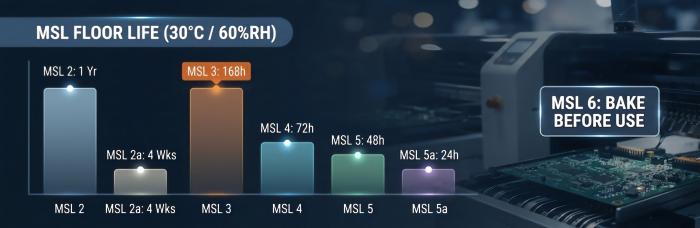
Level 6 is the odd one out. It has no floor life in the usual sense, so every reel gets baked before it goes on a feeder. If a BOM line shows MSL 6, plan for that step at quote time instead of discovering it at kitting.
Floor life, dry pack and humidity indicator cards
Floor life starts when the bag is opened, and it is cumulative. A reel that is opened, run for half a shift, pulled off the feeder and left on a shelf keeps burning its clock the whole time. The same goes for kitted parts waiting for a second-side reflow pass and for trays staged beside the machine. People tend to count only the hours on the placement machine, and that undercounts the exposure.
J-STD-033 describes the dry pack: a heat-sealed moisture barrier bag, desiccant, a humidity indicator card (HIC) and the label. A sealed bag is good for at least 12 months from the seal date when stored below 40°C and 90%RH. The seal date is on the label, and an old date on a bag that has been stored warm is a reason to look harder at the card when you open it.
The HIC is the quick check. Read it right after opening, using the spot that the card's printed instructions tie to the part's level. If that spot has changed color, the parts took on more moisture than the bag should have allowed, and the question stops being floor life and becomes baking.
Seal dates, open times and card readings are only worth anything if somebody writes them down. Reel and lot data sit in our Smart MES; how exposure time is recorded per reel for your specific job, confirm with our engineering team. Parts that go back into a bag go back with fresh desiccant and a fresh card, and the time they spent out stays on the record.
When do parts need baking?
Parts need baking when the dry-pack condition or the floor-life budget can no longer be trusted. Under J-STD-033 that means four situations:
The accumulated time out of the bag has exceeded the floor life on the label.
The HIC shows the parts were over the humidity threshold when the bag was opened.
The bag was punctured, unsealed or arrived without a working moisture barrier.
The part is MSL 6 and is about to be used.
Bake time and temperature are not something to guess. They depend on the package body thickness, the MSL, and the carrier the parts sit in, and J-STD-033 has the schedules. The carrier point is where jobs go wrong. Many tape-and-reel carriers are not rated for a high-temperature bake, which pushes you toward the lower-temperature schedule in the standard, and that takes far longer. If the carrier is not marked as bake-rated, ask before the parts go in an oven.
Baking everything as a precaution is rarely worth it. It costs time, it adds handling and ESD exposure, and repeated bakes can hurt the solderability of terminations. A part with a clean HIC and an honest floor-life record should go to the line, not the oven. If a supplier says they bake all reels before use "to be safe", ask whether bake history is recorded per reel, because the second bake is where the trouble starts.
Who is responsible in turnkey vs consigned builds?
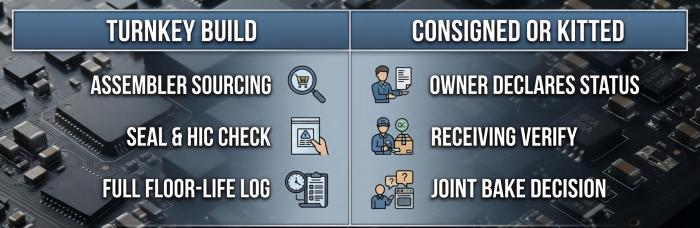
The split follows who controls the parts at each point in their history. The table below is the version we use to frame the conversation; the exact terms go into the quote.
| Item | Turnkey | Consigned or kitted |
|---|---|---|
| Purchase channel and sealed-bag condition at purchase | Assembler | Owner |
| Bag condition and HIC status on arrival | Assembler checks, buys sealed | Owner declares, assembler verifies |
| Floor-life tracking after opening | Assembler | Assembler, starting from the declared status |
| Bake decision and schedule | Assembler, per J-STD-033 | Agreed with owner before bake |
| Cost of baking or re-packing | Assembler's process cost | Agree in writing before the PO |
| Parts with unknown history | Not applicable if sealed | Owner decides: bake, replace or accept the risk |
In a turnkey build, the assembler's component sourcing process buys parts through the channel, receives sealed bags, and keeps the floor-life record. The buyer's job is smaller but not zero: put the MSL in the BOM, and ask how seal integrity is checked when the bags come in. If the BOM has alternates, check the MSL of each one, because two pin-compatible parts from different manufacturers can carry different levels.
In the consigned assembly route, the owner has full control of how the parts were bought, stored and shipped, and the assembler cannot see any of that. The assembler can only verify what is in front of the receiving bench: a sealed bag with a readable label and a normal card, or something else. That is why we ask for the sealed-or-opened status, the seal date and the storage conditions of every MSL 2a to 6 line in the kit, before parts ship. Nobody should be deciding bake schedules from a guess.
What if consigned parts arrive opened?
Treat the floor life as unknown unless the owner can prove otherwise. A bag that arrives open, with no record of when it was opened or how it was stored, cannot be given a partial credit. The usual decision is to bake before placement, or to replace the parts, and the owner makes that call because the parts are theirs.
A practical sequence for the receiving bench:
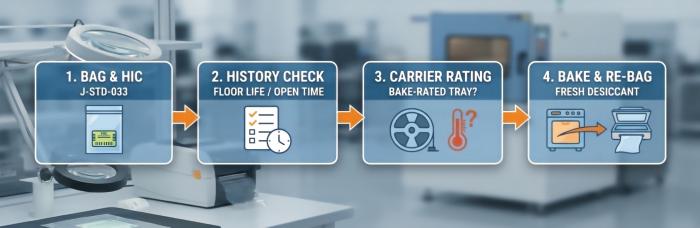
Check the bag: sealed or open, label legible, seal date, MSL and peak reflow temperature.
Read the HIC against its printed instructions and note the result.
Ask the owner for the open date, storage conditions and any earlier bake history.
If the history is missing, decide with the owner: bake per J-STD-033, replace, or run at the owner's risk with that on record.
Check the carrier for a bake rating before any oven time. If it is not rated, moving parts to bake-rated trays means extra handling, and the owner should approve that.
Re-bag with fresh desiccant and a fresh card after baking, and log the new clock start.
Large plastic BGAs and fine-pitch QFNs deserve the closest look in this step, since they are the parts where a hidden crack shows up as a field failure. For those, the BGA assembly page covers placement and inspection, and the SMT packages page lists what package types our lines handle.
Baking adds time, and how much depends on the package and the level. We do not quote it before we see the parts. For whether baking and dry storage for your kit can be handled on our side, confirm with our engineering team.
FAQ
Can a dry cabinet stop the floor-life clock?
Only under the conditions J-STD-033 sets for dry storage, and only if the records can prove it. A cabinet that is opened all day does not qualify. For what can be done for your job, confirm with our engineering team.
How should MSL appear in the BOM?
Add an MSL column next to the manufacturer part number, and fill it from the manufacturer's current data, not from an older build. For every alternate, record its MSL separately. Two parts that fit the same footprint can carry different levels.
Does cut tape need dry pack too?
Yes, if the part is MSL-rated. Cut tape in a loose bag has no moisture barrier, so its floor-life status is unknown. If you cut tape from a reel for a prototype run, put it in a barrier bag with desiccant and a card, and note the time it was out.
Does rework count as another exposure?
Rework puts heat on the board and on neighboring packages. The MSL rating covers the reflow passes the part was qualified for in J-STD-020, so a planned rework step should be discussed with us before the build, not after a failure.
Who decides that a part is MSL 6?
The label does. If the label says level 6, the part is baked before use and must be reflowed within the time on the label. If the label is missing or unreadable, ask the manufacturer or distributor for the part's classification before the kit ships.
Helpful Resources
• Effective Ways of Moisture Sensitive Device Storage and Handling
• Factors Affecting the Quality of BGA Assembly
• Turnkey vs. Consigned: Choosing the Right Assembly Model for Your Project
• Contrast on Soldering Technologies Used in Lead and Lead-Free Reflow Soldering


