



An engineering change order that lands after a batch has entered production is not an exception in high-mix low-volume (HMLV) PCBA — it is a routine event that the production system has to be built to absorb. The question for a buyer isn't whether ECOs will hit an active run, but whether the supplier has a defined process for evaluating impact, classifying urgency, and preventing the wrong board revision from shipping.
Why ECO Frequency Runs Higher in HMLV Production
High-volume, single-product lines see infrequent ECOs because the design is frozen for long production windows and any change is amortized across a large run. HMLV assembly for industrial automation, life sciences, and semiconductor test equipment customers works against a different set of pressures:
● Smaller lot sizes mean more distinct board revisions move through the shop concurrently, so the sheer number of active work orders creates more opportunities for a change to intersect an in-progress build.
● Customers in these verticals — instrument builders, test cell integrators, industrial controller OEMs — iterate designs against field feedback and calibration data on a rolling basis rather than a fixed model-year cycle.
● Component allocation constraints and manufacturer discontinuations force approved-vendor-list (AVL) substitutions mid-program more often than in commodity consumer electronics, where second-sourcing is typically designed in from the start.
● Low-volume programs often run first-article or early-production builds concurrently with design finalization, so change requests generated by first-article test results can arrive while later units in the same order are already on the line.
The component allocation pressure above is closely tied to component obsolescence and shortage risk on long-lifecycle industrial and semiconductor test equipment programs: a substitution-driven ECO is frequently the first visible symptom of a supply-side problem rather than a design defect, which is why it needs to be routed through the same impact-assessment process as any other change, not treated as a quick swap.
None of this makes ECO handling optional overhead — it makes it a core competency that should be evaluated at supplier selection, not discovered mid-program.
Assessing ECO Impact on a Batch Already in Production
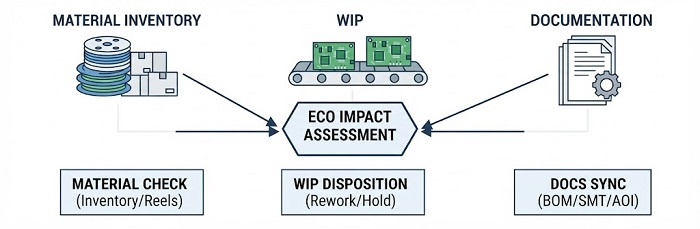
Before an ECO is dispositioned, the engineering and production teams need a structured impact assessment covering three areas. Skipping any one of them is how mixed-revision boards end up on a shipping dock.
Material Inventory Impact
The first question is whether the change touches a component already kitted, in feeders, or committed to incoming inventory. This requires cross-referencing the ECO's affected reference designators against:
● Component lots already released to the floor for the current work order
● Reels currently loaded on placement machines for that program
● On-order material against the pre-change BOM revision, including any minimum-order-quantity commitments made to distributors
Where the change affects a component with existing on-hand or on-order stock, the buyer and supplier need an explicit disposition decision: use up the old-revision stock on units the ECO doesn't legally or functionally require, scrap it, or return it if the vendor agreement allows. Leaving this undecided is the most common source of mixed-BOM confusion in HMLV shops.
Work-in-Process (WIP) Disposition
Separately from inventory, every unit already through some stage of assembly needs an explicit disposition against the new revision:
● Units not yet started: build to the new revision once released
● Units mid-process (post-SMT, pre-final-inspection): assess whether rework is physically possible without violating IPC-A-610 rework limits, or whether the unit proceeds as a documented deviation
● Completed units in finished-goods inventory: hold pending disposition rather than ship on the assumption the change is cosmetic
This disposition should be a formal record, not a verbal agreement between the production planner and the account manager — it is exactly the kind of decision that gets challenged later if a field issue surfaces.
Documentation Synchronization
An ECO isn't complete when the BOM is updated. The gerber/BOM package, the approved-vendor list entry, the SMT programming (placement and reflow profiles where the change affects a thermally sensitive part), the inspection program (AOI golden board, X-ray reference images for BGA/QFN where applicable), and the traveler or router used on the floor all need to move together. A change that updates the BOM but not the AOI reference library will generate false-reject alarms on the very units the ECO was meant to correct.
ECO Classification: Urgent vs. Routine
Not every change needs the same response speed, and treating all ECOs as equally urgent both slows down genuinely critical changes and creates unnecessary line disruption for changes that don't need it. A two-tier classification is a practical starting point:
● Urgent — changes tied to a safety issue, a functional defect discovered in test, a component that has gone end-of-life with no remaining stock, or a customer stop-ship instruction. These require immediate production hold on affected work orders pending disposition.
● Routine — cosmetic changes, documentation corrections, non-critical component substitutions with functionally equivalent parts, or design refinements scheduled for the next build cycle rather than the current one.
Response-time commitments for each tier should be agreed in the quality agreement or purchase terms specific to a given program rather than assumed from a generic policy — turnaround depends on the change's complexity, whether new tooling or programming is required, and current line loading. A buyer evaluating a PCBA partner should ask how urgent-tier changes are flagged and escalated internally, not just whether an ECO process exists on paper.
How MES Effectivity Control Prevents Old/New Revision Mix

The mechanical risk in any mid-run ECO is a mixed-revision batch — some units built to the pre-change BOM, some to the post-change BOM, shipped together or indistinguishable on the shelf. This is a data-binding problem, and it is where a Smart MES with UID traceability earns its keep.
Because every board carries a laser-marked unique identifier bound to its full manufacturing genealogy — component lot, placement record, reflow profile, and inspection results — the same MES traceability architecture that supports recall-scope determination also supports ECO effectivity control: the change record is tied to a specific date range and lot, not a general changelog entry.
In practice, this means:
● The ECO's effective date and lot boundary are entered into the MES before the change is released to the floor, not after.
● Component pick records at SMT placement are cross-checked against the approved BOM revision for that specific board UID — a feeder loaded with the wrong-revision reel produces a mismatch the system can flag before placement, rather than a defect found downstream.
● Any unit built prior to the effectivity date is queryable as a distinct population, which is what makes the material inventory and WIP disposition decisions enforceable rather than aspirational.
Without lot- or serial-level effectivity binding, an ECO is a document; with it, an ECO is a control boundary the production system can actually hold to.
ECO Management Checklist for Buyers
● Confirm the ECO's affected reference designators against current on-hand inventory, loaded reels, and on-order material
● Obtain an explicit WIP disposition decision (rework, deviation, or hold) for every unit already in process
● Verify that BOM, AVL, SMT programming, and inspection reference data are updated together, not just the BOM
● Classify the change as urgent or routine against agreed criteria — not by default urgency inflation
● Confirm the ECO's effectivity date and lot boundary are entered into the MES before release to the floor
● Request written confirmation of which serial numbers or lots fall before versus after the change
● Retain the ECO record, impact assessment, and disposition decision as part of the program's permanent documentation, not a standalone email thread
ECOs during active production are a normal part of HMLV PCBA — the difference between a controlled change and a documentation gap that surfaces months later is whether the impact assessment, classification, and MES effectivity binding happened before the change reached the floor.
To discuss how a specific engineering change would be evaluated and controlled against an active work order, contact PCBCart to walk through your program's ECO process.
Helpful Resources
● Quality Documentation & Traceability Requirements for Semiconductor Test Equipment OEMs


