



What Is Fine-Pitch Wire Bonding, and Why Does Pitch Matter?
Wire bonding connects a die's bond pads to a substrate using fine wire — the general mechanics of that process, including why wire diameter matters, are covered in our Die Attach and Wire Bonding guide. What that piece doesn't cover is pitch: the center-to-center spacing between adjacent bond pads, and why shrinking it changes what a design can do.
Standard wire bonding processes work within a comfortable pitch range that suits most designs. Fine-pitch wire bonding refers to processes capable of handling significantly tighter pad spacing. Getting there isn't just a matter of finer wire — it depends on bonder placement accuracy, capillary tip geometry, and tighter process windows for temperature, pressure, and ultrasonic energy. As pitch shrinks, the margin for placement error shrinks with it, which is why fine-pitch capability is treated as its own process tier rather than a simple extension of standard bonding.
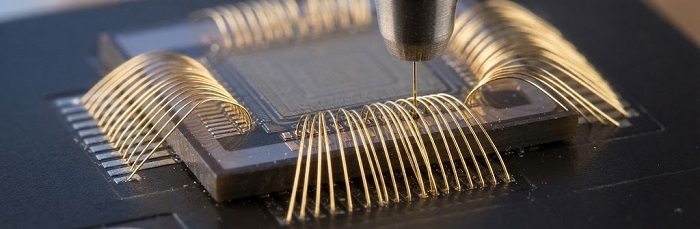
The practical payoff is I/O density. A die with a fixed footprint can carry more bond pads — and therefore more electrical connections — if those pads can be spaced more tightly. For chips that need to move more signals, power rails, or grounds off the die without growing the die itself, pitch reduction is often the only lever available.
Does Your Design Actually Need Higher I/O Density?
Several trends are pushing more designs toward higher I/O counts within the same or shrinking footprint:
Functional integration: Sensors, processors, and RF or power components increasingly need to share a single package rather than being split across separate ones.
Space-constrained form factors: Wearables, implantable medical devices, and compact industrial modules leave little room for larger packages, even as functionality increases.
Signal and power segregation: High-speed digital designs often need dedicated pin groups for signal integrity, power distribution, and grounding, multiplying pin count without multiplying die size.
Sensor and ATE fan-out: Test and measurement systems, and multi-channel sensor arrays, frequently require far more I/O per unit area than general-purpose logic packages.
When a design's I/O requirements outgrow what standard-pitch wire bonding or a single-die package can support, the next design decision usually isn't "bond wires closer together" in isolation — it's whether the whole packaging approach needs to change.
What Do MCM and Stacked-Die Assembly Actually Enable?
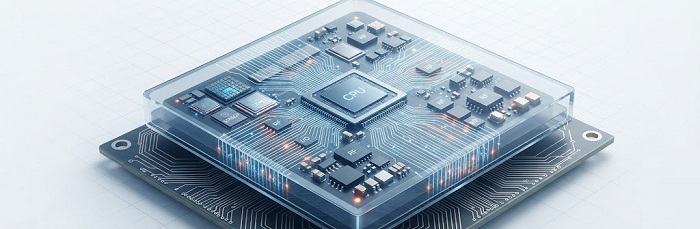
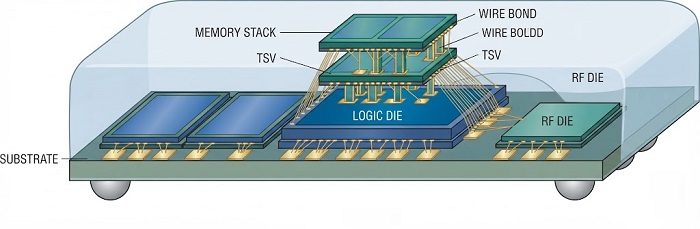
Multi-chip module (MCM) assembly places two or more die — sometimes from different process nodes or even different foundries — into a single package, connected internally rather than through separate packages on a PCB. Stacked-die packaging takes this further by placing die vertically, connected by wire bonds or other interconnects, rather than laying them side by side.
These approaches solve problems that fine-pitch wire bonding alone cannot:
Space savings: Stacking or tightly clustering die within one package footprint reduces board area compared to mounting multiple discrete packages.
Heterogeneous die integration: MCM assembly allows a design to combine, for example, a logic die, a memory die, and an analog or RF die in one package — each fabricated on the process best suited to its function, rather than compromising on a single process node for the whole design.
Shorter interconnect paths: Die-to-die connections within a package are typically shorter than the equivalent board-level traces between separate packages, which can help with signal integrity and parasitic reduction in high-speed designs.
Reduced system-level part count: Consolidating multiple functions into one package can simplify board layout and assembly, even if the module itself is more complex to build.
For engineers evaluating whether a design needs this level of packaging, the underlying question is usually whether the I/O density, footprint constraints, or die heterogeneity of the design have outgrown what standard single-die, standard-pitch packaging can support.
What Tradeoffs Should You Weigh Before Choosing This Route?
MCM and stacked-die assembly with fine-pitch wire bonding are not default choices — they come with real tradeoffs that should factor into a design decision:
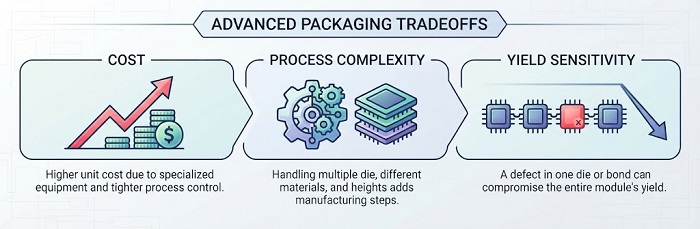
Cost: Fine-pitch bonding and multi-die assembly require tighter process control, specialized equipment, and often more inspection steps, which typically raises unit cost compared to standard single-die packaging.
Process complexity: Handling multiple die in one package — potentially with different heights, materials, or thermal characteristics — adds steps and constraints that a single-die process doesn't have.
Yield sensitivity: Because multiple die are combined into one package, a defect on any one die, or a bonding failure at fine pitch, can affect the entire module's yield rather than a single component's yield. This compounding effect is one of the most important factors to model early in a design's cost and reliability planning.
These tradeoffs don't argue against advanced die-level packaging — they argue for evaluating it deliberately, with a clear understanding of what the design actually requires versus what it could get from simpler packaging.
If your project involves advanced die-level packaging decisions, PCBCart's engineering team can help you think through the tradeoffs relevant to your design as part of capabilities we are developing in COB and die-level assembly. [Learn more about our PCB Assembly services →]
Ressources utiles
• Fine-Pitch SMT & BGA Assembly Best Practices
• PCB Assembly Overview
• Assembly Equipments
• Glossary of Terms


