



Diagnostic and monitoring devices — pulse oximeters, patient monitors, benchtop analyzers, point-of-care readers — spend their working life in environments that assemblies for sealed industrial enclosures rarely see: repeated disinfectant wipe-downs, occasional splash exposure, and temperature swings between storage, transport, and clinical use. Conformal coating is the primary barrier protecting the PCBA from that environment, but "coat it and move on" is not a selection strategy. The chemistry, the process sequencing, and the keep-out geometry all have to be decided deliberately.
This framework covers coating chemistry selection, how coating interacts with inspection processes, and thickness/keep-out rules — scoped specifically to non-implantable diagnostic and monitoring PCBA.
A note on scope and certification: PCBCart is IATF 16949 certified for automotive-grade process discipline carried into industrial and life-sciences manufacturing, but we do not hold ISO 13485 certification. For any device requiring ISO 13485-certified manufacturing as part of its regulatory submission, that requirement needs to be met by a certified partner or through your own quality system — we're stating this plainly rather than implying otherwise.
Three Coating Chemistries: Chemical Resistance, Thermal Cycling, Repairability
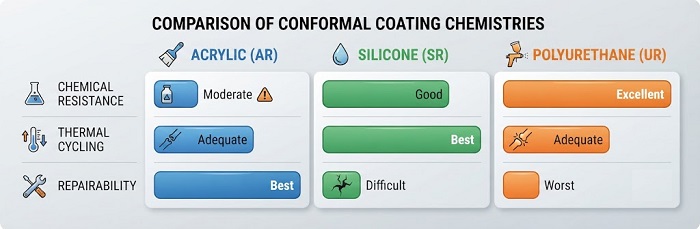
The three chemistries most commonly specified under IPC-CC-830 for electronic assemblies are acrylic (AR), silicone (SR), and polyurethane (UR). Each trades off differently across the three axes that matter for diagnostic/monitoring hardware.
Acrylic (AR)
Chemical resistance: Moderate. Acrylics resist water and mild aqueous cleaners reasonably well, but they are known to soften or dissolve under isopropyl alcohol and xylene — both relatively weak solvents by conformal-coating standards — which is a real concern given how often clinical-adjacent devices get wiped with IPA-based disinfectants.
Thermal cycling: Adequate in typical service ranges, with low internal stress and low shrinkage during cure. Upper continuous operating temperature tops out around 125°C for common formulations, below silicone's range.
Repairability: Best of the three. Acrylic is the most user-friendly chemistry to rework — it can be locally softened with the same weak solvents (IPA, xylene) that make it chemically vulnerable in the first place, without heat or abrasive stripping.
Application: Fast cure, minimal cure exotherm (safe for heat-sensitive components), lowest overall process cost.
Silicone (SR)
Chemical resistance: Good general resistance to humidity, salt spray, and a wide solvent range, but silicone is notably softened by ketone-based solvents (acetone is in fact the standard agent used to deliberately soften silicone coating for removal).
Thermal cycling: Best of the three chemistries. Silicone tolerates the widest temperature range of common conformal coatings — continuous operating temperatures can exceed 200°C — and stays flexible across cycling, which matters for devices moving between refrigerated storage and body-temperature contact.
Repairability: Difficult. Because the same chemistry that resists everyday solvents also resists easy removal, silicone typically needs a longer soak in stronger solvents or specialized strippers, plus mechanical agitation — noticeably slower than acrylic rework.
Application: Higher material cost, longer cure times, but tolerant of dispensing/spraying process variation. Applied roughly twice as thick as acrylic to reach equivalent protection.
Polyurethane (UR)
Chemical resistance: Excellent — among the best of the common chemistries against solvents, fuels, and general chemical exposure, and one of the hardest/most abrasion-resistant films available.
Thermal cycling: Constrained by an upper-temperature ceiling rather than low-temperature brittleness — many polyurethane formulations begin to break down above roughly 125°C, which matters for reflow-adjacent rework heat or high-ambient storage. Polyurethane is also less flexible than silicone, so it handles sustained vibration and flex-cycling less gracefully; low-temperature cracking specifically is not the well-documented weakness it's sometimes assumed to be.
Repairability: Worst of the three for field rework. Two-part polyurethanes cure into a hard, cross-linked film that resists the common weak solvents by design — the same solvent resistance that makes it protective also makes it the hardest to strip for local rework, often requiring heat plus mechanical removal.
| Property | Acrylic (AR) | Silicone (SR) | Polyurethane (UR) |
|---|---|---|---|
| Disinfectant/IPA resistance | Weak | Good | Good |
| Max continuous operating temp (typical) | ~125°C | >200°C | Formulation-dependent, often ~125°C ceiling |
| Rework/repairability | Best | Difficult | Worst |
| Relative material cost | Low | High | Moderate |
| Typical cure | Fast | Slow | Slow (2-part) |
Selection Logic Based on Exposure Environment
For diagnostic and monitoring PCBA, the exposure profile — not a generic "medical-grade" label — should drive the chemistry choice.
Frequent disinfectant wipe-down (patient monitors, POC devices)
If the device housing is regularly wiped with IPA-based disinfectants and there's any possibility of ingress at connector seams or vents, silicone is generally the stronger default despite its rework penalty, because acrylic's known vulnerability to IPA and xylene is a real long-term reliability risk if any coating breach occurs near a wipe-down surface.
Occasional bodily-fluid contact risk (non-implantable, e.g., splash near sensor cabling)
This is a sealing/enclosure design problem first and a coating problem second — conformal coating is a secondary barrier, not a substitute for IP-rated enclosure design. Where PCBA-level protection matters (e.g., near a connector that could see splash ingress), silicone's broader general solvent tolerance again favors it over acrylic, though localized heavier-build acrylic in a small zone can be acceptable if paired with good mechanical sealing.
Storage/transport thermal range (cold-chain diagnostics, portable monitors)
If the device sees storage at low temperature followed by rapid warm-up in clinical use, silicone's flexibility across a wide operating range reduces risk of coating stress at solder joints and via fillets. Acrylic is an acceptable middle ground where the range is narrower and rework access matters more; polyurethane is a reasonable fit if chemical exposure dominates and the ambient range stays comfortably under its formulation's upper limit.
High rework/NPI environments
Early in a program, when boards get touched repeatedly for engineering changes, acrylic is the pragmatic choice even if the production-intent chemistry will later be silicone or polyurethane — switching coating chemistry at DVT/PVT transition is a normal and low-risk change.
Process Consideration: Coating Creates Inspection Blind Spots
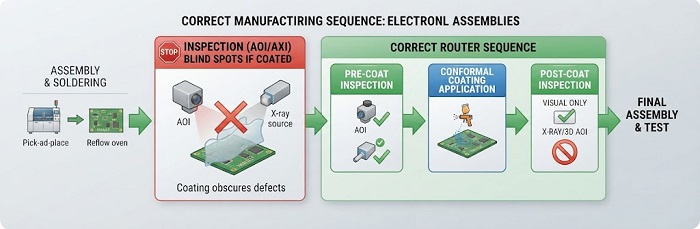
Conformal coating is optically and radiographically disruptive. Once applied, coating:
Obscures solder joint fillets from optical AOI cameras (surface reflectivity and coating meniscus distort edge detection).
Can trap voiding or bridging defects underneath a layer that visually looks uniform.
Does not meaningfully interfere with X-ray transmission, but coating cure can mask or complicate rework access to defects found afterward.
The practical sequencing principle here is straightforward: all 3D AOI and BGA/QFN X-ray inspection should be completed and dispositioned before conformal coating is applied — never after. This follows directly from the optical and mechanical realities above — 3D SPI/3D AOI closed-loop inspection depends on unobstructed optical geometry, and post-coat rework to correct a defect found after coating means stripping coating first, which adds cost and risk regardless of which chemistry was used. Coating is best treated as a downstream, effectively irreversible process step, not an intermediate one.
Coating Thickness and Keep-Out Zone Rules
Two design decisions determine whether coating helps or hurts:
Thickness targets
Industry guidance built around IPC-CC-830 gives dry-film thickness ranges by chemistry, though the specific numbers cited vary somewhat by publishing source:
Acrylic/Urethane: commonly cited around 25–130 µm depending on source
Silicone: typically applied roughly twice as thick as acrylic to achieve equivalent protection, often in the 50–210 µm range
Treat these as directional starting points, not a single universal figure — confirm the target against your specific coating vendor's qualified datasheet. Thickness should be verified by wet-film or cured-film thickness gauge sampling; visual "coverage looks even" judgment isn't sufficient for a defensible process record.
Mandatory keep-out (no-coat) zones
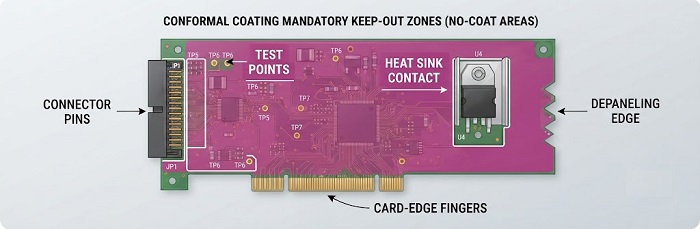
Connectors and headers: Coating on mating contact surfaces causes intermittent connection failures; keep-out masking (or selective dispense programming) is required on all connector pins and card-edge fingers.
Test points and ICT/FCT probe pads: Any coating on a bed-of-nails test point defeats future in-circuit or functional test access; these must be masked, or the test strategy must be revised to accept destructive re-access.
Board edges intended for future rail depaneling or fixturing: Coating buildup at edges can interfere with fixture seating in later assembly steps.
Heat sinks and thermal pads: Coating on thermal interface contact surfaces degrades thermal transfer; these areas require masking even when adjacent components are coated.
Selective spray or jet dispensing (rather than dip or full-panel spray) is generally the more controllable method for meeting these keep-out requirements at fine pitch, since masking film/tape adds labor and risk of residue at panel scale. Whether coating application is performed in-house or through a qualified coating partner, these masking and sequencing principles hold regardless of which side of that line the work sits on.
Practical Selection Checklist
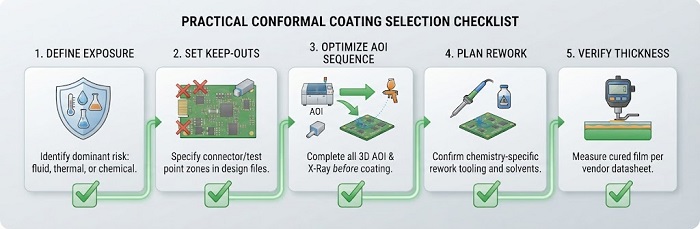
Identify the dominant exposure risk — disinfectant contact, thermal range, or splash/fluid risk — and pick the chemistry that best matches the dominant risk, not all three equally.
Confirm test point and connector keep-out zones are defined in the fab/assembly drawing before DFM, not added after first-article coating.
Sequence 100% AOI and X-ray disposition before any coating step — build this into the router, not just the work instruction.
Decide rework strategy chemistry-by-chemistry before production release; don't assume silicone or polyurethane rework capability exists on the line without confirming tooling and solvent handling.
Verify cured film thickness by sample gauge measurement against the vendor datasheet, not visual inspection or a generic published range alone.
None of these steps require exotic tooling, but they do require sequencing discipline — which is where most conformal coating field-failure investigations actually trace back to: not a coating chemistry mismatch, but a masking or sequencing gap.
Ressources utiles
• How Much Do You Know About Flying Probe Test for PCB and PCBA?
• IPC-A-610 Class 3 Standards for High-Reliability Life Sciences Electronics Assemblies
• Why Precision Matters: Choosing PCBCart for Medical PCBA Services


