



One of the most important reliability parameters affecting the functionality of all modern diagnostic instruments is the thermal reliability. In medical electronics applications, whether it's in the field of molecular diagnostics, laboratory automation platforms, imaging systems, or point-of-care testing devices, the electronics must be able to perform their functions continuously, with stable measurement accuracy over many years of service life.
Although thermal management is often thought of as heatsinks, airflow and component selection, many reliability problems can begin at the PCB assembly level. System performance can be degraded over time as a result of manufacturing-induced thermal stress, defects caused by moisture, or degradation of solder joints long after products have passed functional testing.
However, for medical device startups and R&D teams, thermal reliability is a design and manufacturing challenge. Being able to regulate thermal stress during assembly, check the accuracy of solder joints and ensure full process traceability can be the deciding factor in whether a product will perform reliably in the clinical environment.
At PCBCart, we help medical innovators address these challenges through High-Mix Low-Volume (HMLV) medical electronic manufacturing, combining advanced assembly processes, IPC Class 3 workmanship standards, and Smart MES traceability to deliver Tier-1 quality control without the constraints of high-volume production requirements.
Why Thermal Reliability Matters in Diagnostic Instrument PCBA
Thermal cycling is an unavoidable phenomenon during continuous operation of a diagnostic instrument during its service life. Heat generated by embedded processors, power management circuits, imaging modules and electronics that condition the sensors causes localized hot spots that cause electronic components, solder joints and PCB materials to repeatedly expand and contract.
The Two Primary Failure Mechanisms
Thermal reliability issues generally arise in two primary ways when viewed from a manufacture point of view: solder joint fatigue and multilayer PCB delamination.
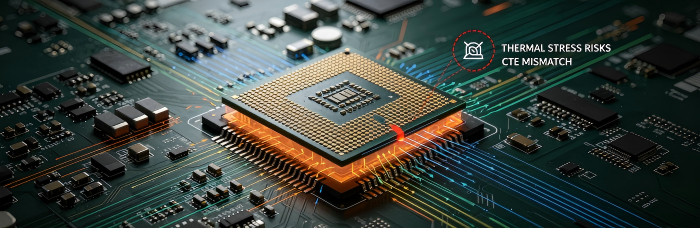
During the repeated heating and cooling cycles solder joints experience, differences in the coefficient of thermal expansion (CTE) of components, solder alloys and PCB substrates create mechanical stress in the solder joint and lead to solder joint fatigue. These stresses can over time result in micro-cracks, failure of solder structures and lead to intermittent or permanent electrical failure. For example, assemblies with BGAs, large ceramic packages or multilayer designs with a high density are particularly vulnerable.
Meanwhile, moisture imbibed by PCB laminates can be a hidden reliability risk. In soldering, the trapped water quickly turns into vapor in the heated soldering iron. This expansion may lead to damage of the internal board structures, resulting in layer separation, cracking of the barrel, and mechanical integrity decrease. These defects can be internal, and may be only identified on extended field operation.
The medical electronics manufacturer has the challenge of not only finding these failure modes, but also being able to eliminate them in the product before the product is delivered to service.
Controlling Thermal Stress During Assembly
The degree of thermal stress applied during assembly is a major factor in the reliability of the assembly. Severe moisture control, reduced board deformation, and accurate temperature profiles during soldering are essential for good thermal management during the manufacturing process.
A Three-Layer Approach to Thermal Stress Reduction
The first line of defense is moisture control. PCBCart moisture sensitive boards are pre-baked for 4-8 hours under controlled conditions prior to assembly. The moisture absorbed by the board before soldering will be eliminated, thus mitigating the danger of vapor-induced delamination especially for multilayer boards in complex designs, such as in diagnostic instruments.
The second layer focuses on mechanical stability during reflow. Exposure to higher temperatures can cause warpage of large multilayer PCBs leading to coplanarity problems and irregular solder joint formation. Synthetic Stone Fixtures are employed to support the board and hold it dimensionally stable during the actual reflow process to counteract these risks.
The last step is accurate thermal profiling. Peak temperatures, temperature differences and cooling rates that are either too high or too low can lead to high residual stresses in solder joints and cause long-term fatigue mechanisms to occur more quickly. With the JTR-1200D-N Re-flow Oven, product specific temperature profiles are created to carefully control ramp rates, soak zones, peak temperatures, and cooling. The goal is to create solder joints that are both acceptable and minimize residual stresses that can affect product reliability down the road.
These three process controls form a manufacturing base, which can be used to minimize the risks of failure caused by changes in temperature before the product is used in clinical settings.
Reducing Secondary Thermal Exposure During Soldering
A large number of diagnostic instrument assemblies use a mix of SMT and through-hole technologies. This hybrid method of technology is very flexible in terms of design but may also cause excessive thermal stress if the soldering processes are not well controlled.
Why Selective Wave Soldering Matters
After the SMT components are reflowed, any further heating may subject the assemblies to secondary heat stress. Exposure to high and repeated temperatures can lead to premature degradation of solder joints, stress on components, and impact to long-term reliability.
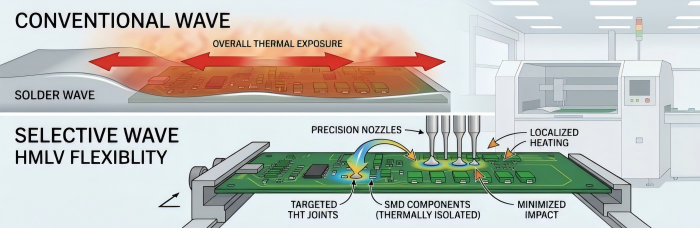
To reduce this risk, PCBCart is using ZSWHPS-11-2 Selective Wave Soldering technology. Compared to conventional wave soldering techniques, which heat an extensive area of the assembly, selective is highly specific and only heats the specific locations of through-holes.
This localized process allows for reduced thermal impact on nearby SMD components, and provides consistent through-hole solder quality. Selective soldering is an improved and reliable method of mixed technology assembly for delicate electronic components with precision analog circuits, imaging modules or temperature sensitive components.
Verifying Reliability Beyond the Soldering Process
Even with the best assembly control system, objective verification is still necessary. Reliability is not a given, it needs to be proven by workmanship requirements and advanced testing methods.
IPC Class 3 as the Acceptance Standard
When IPC Class 3 PCB assembly is used as a diagnostic instrument assembly criterion for long-term operation, it is used as a basis for quality acceptance.
Special emphasis is given to through-hole solder joints where the amount of solder material has a direct effect on mechanical strength and thermal expansion tolerance. Assemblies are validated to IPC Class 3 standards with a goal of 75% or more through-hole fill to aid in long-term durability. A high amount of barrel fill helps to increase the strength of the barrel, and the soldered joints withstand multiple thermal cycles during the product's life.
Combining 3D AOI and AXI for Defect Detection
Inspection is very important to find defects that could affect thermal reliability.
Advanced 3D AOI systems are able to measure solder volume consistency, component placement accuracy and the surface-level quality of the assembly with much higher accuracy than traditional inspection techniques. When soldered joints cannot be seen, Automated X-Ray Inspection (AXI) provides further assessment of BGA connections, internal voiding levels, insufficient solder conditions and other hidden defects.
3D AOI and AXI make for a complete inspection solution that can identify both visible and hidden assembly problems prior to products entering service.
Taking Tier-1 QC to HMLV Medical Manufacturing
It's a tough choice that medical device startups frequently have to make. Low-volume suppliers can be flexible but may not have the advanced quality infrastructure, and big manufacturers often only have sophisticated process controls for high-volume programs.
Addressing MOQs and Quality Challenge
The idea of PCBCart was created to eliminate such a compromise.
Our HMLV manufacturing model is designing to be flexible, yet retaining the same philosophy of process control that is normally found in a large-scale manufacturing environment. Advanced equipment such as Jet Printing, 3D SPI, AOI, AXI, precision reflow soldering and selective wave soldering all work integrated into a Smart MES driven manufacturing ecosystem where total traceability can be easily maintained from assembly to inspection.
All key production parameters are digitally recorded and connected to the entire production process. This allows for quick root cause analysis, continuous process improvement and greater assurance of product reliability in the future for medical device manufacturers.
The outcome is Tier-1 quality control, without compromising flexibility for prototype, NPI and low-volume production programs—an ideal fit for R&D teams and emerging medical device companies.

Thermal reliability of diagnostic instrument PCBA is more than just component selection and thermal simulation. Long-term performance is dependent on manufacturing processes that limit moisture exposure, reduce thermal stress, safeguard sensitive assemblies and are able to ensure the integrity of solder joints during manufacturing.
Medical device manufacturers can use PCBCart's 4-8 hour controlled pre-bake procedures, 3D AOI inspection, advanced 3D AXI inspection, ZSWHPS-11-2 selective wave soldering, IPC Class 3 verification and Smart MES traceability to create assemblies that will perform reliably across the most extreme environments found in clinical use.
Contact us and let our engineering team assess your design for thermal reliability risks, manufacturability improvements, and long-term diagnostic instrument performance before production begins.
Helpful Resources
• A Comprehensive Introduction of PCBA
• Printed Circuit Boards Assembly Process
• Process Control Measures to Stop Defects in SMT Assembly
• Wave Soldering vs. Selective Soldering for PCB Assembly
• Essential Standards for Medical PCB Assembly


