



Why Nitrogen Atmosphere Reflow Is Critical for Fine-Pitch Connector Reliability
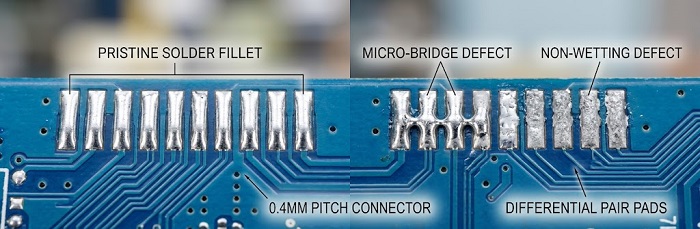
Industrial communication PCBA for factory automation and semiconductor test equipment requires ultra-stable soldering performance, especially for boards equipped with 0.4mm pitch backplane connectors, M.2 sockets, and fine pads adjacent to high-speed differential pairs. These compact, high-density fine-pitch layouts are extremely sensitive to high-temperature oxidation during reflow. Unlike consumer electronics, minor soldering defects in industrial-grade boards do not always trigger immediate failure, but they gradually deteriorate under long-term thermal cycling and 24/7 continuous operation, causing intermittent signal dropout, unstable contact resistance, and premature field failure.
| Reflow Environment | Fine-Pitch Connector Bridging Rate | Solder Paste Non-Wetting Rate |
|---|---|---|
| Air Atmosphere | 1.20% | 0.85% |
| Nitrogen (N2) Atmosphere (<500ppm O2) | 0.18% | 0.12% |
The root cause of most fine-pitch soldering defects lies in high-temperature tin oxidation in ambient air reflow environments. Oxide films formed on tiny pads block solder wetting and uniform diffusion, resulting in frequent bridging and non-wetting failures on ultra-fine spacing pins. Our accumulated HMLV industrial PCBA production data clearly quantifies the yield gap between air and nitrogen reflow processes:
For industrial communication hardware that demands long-term operational stability, these subtle fine-pitch defects create latent reliability hazards. While basic functional tests may pass post-production, structural defects worsen over time. Nitrogen atmosphere reflow fundamentally suppresses high-temperature oxidation, optimizing solder wetting consistency and greatly reducing fine-pitch defect rates for industrial-grade PCBA.
Stable N2 Reflow Environment and Precision Oxygen Control
The performance advantages of nitrogen reflow rely on precise, stable oxygen control and rigorous furnace cavity sealing management. We leverage the JTR-1200D-N reflow oven with dedicated nitrogen atmosphere configuration, tailoring industrial-grade process parameters exclusively for high-complexity fine-pitch communication board assembly.
Strict Low-Oxygen Threshold for Fine-Pitch Soldering
The core threshold for qualified fine-pitch nitrogen soldering is maintaining a continuous furnace oxygen content below 500ppm. Once oxygen concentration exceeds this standard, tin oxide generation surges exponentially, completely eliminating the anti-oxidation and wetting advantages of nitrogen environments. Unlike consumer electronics that allow fluctuating process parameters, industrial communication boards require full-cycle low-oxygen protection covering preheating, soaking, and reflow stages to avoid local intermittent oxidation on fine pads.

Cavity Sealing and Zonal Oxygen Monitoring
Furnace cavity sealing directly determines nitrogen consumption and atmospheric stability. A high-sealing oven structure effectively reduces air infiltration, balancing production cost control and low-oxygen environment stability. To eliminate local oxidation risks, we implement zonal oxygen monitoring across the oven’s first eight temperature zones, solving the common leakage problem at the furnace inlet and outlet.
The furnace tail is the most vulnerable area to air leakage due to frequent board loading and unloading. Infiltrated air causes localized oxygen elevation, leading to asymmetric oxidation and inconsistent soldering quality on board-edge fine-pitch connectors. Real-time zonal monitoring promptly identifies abnormal leakage points, ensuring uniform soldering quality for every batch of industrial communication boards.
No-Clean Solder Paste Tuned for N2 Reflow Environments
Virtually all high-density industrial communication boards adopt a no-clean soldering process, a necessity dictated by structural limitations. Densely arranged fine-pitch connectors and adjacent plug-in components form enclosed blind areas at the board bottom that cleaning fluids cannot access. Residual flux in these gaps triggers signal interference and long-term corrosion risks. Pairing low-activity no-clean solder paste with a nitrogen atmosphere creates the ideal high-reliability process solution for these designs.
We standardize ROL0/ROL1 ultra-low activity no-clean solder paste for nitrogen reflow workflows. In ambient air environments, low-activity solder paste lacks sufficient oxidation resistance, easily causing virtual soldering and poor wetting. However, the low-oxygen nitrogen environment (<500ppm) offsets the solder paste’s low activity, significantly enhancing pad wetting tension and improving the uniformity of fine-pitch solder joint formation.
Production verification confirms that the optimized combination of ROL1 solder paste and nitrogen reflow reduces fine-pitch solder joint void rates to below 3%. This process eliminates flux residue pollution from post-soldering cleaning while fully meeting the long-term thermal cycling and reliability requirements of industrial automation equipment.
Solving Board Thermal Imbalance With Precision Reflow Profiling
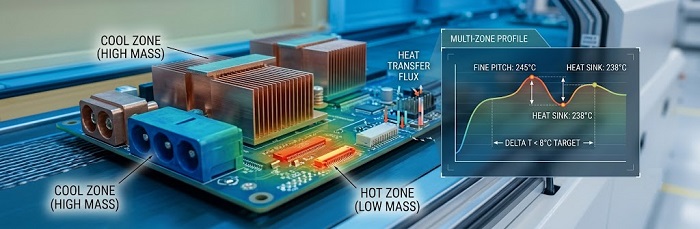
Mixed component layouts on industrial communication boards create severe thermal imbalance during reflow, which is a key hidden cause of fine-pitch soldering defects. Ultra-fine pitch connectors feature low thermal capacity and heat up rapidly, prone to overheating, tin overflow, and bridging. In contrast, neighboring large power connectors and heat dissipation patches have high thermal capacity, heating slowly and easily resulting in cold soldering and insufficient tin adhesion.
Unoptimized single-temperature reflow curves cannot adapt to this thermal difference, leading to simultaneous defects of fine-pitch bridging and large-component cold soldering. We calibrate multi-zone temperature parameters on the JTR-1200D-N reflow oven, targeting a strict board-wide temperature difference (Delta T) < 8°C to achieve balanced heating for mixed components.
Gradient temperature rise in the preheating zone narrows the temperature gap between high and low thermal capacity components. The extended soaking zone ensures uniform heat conduction across the entire board before formal reflow, while the steady slow cooling zone avoids solder joint crystallization defects caused by rapid temperature changes. This refined profiling method stabilizes 0.4mm ultra-fine pitch solder joint forming quality and eliminates batch thermal inconsistency.
3D AOI Inspection Strategy for Micro Fine-Pitch Defects
Traditional 2D optical inspection fails to capture micro-scale fine-pitch defects, including tiny bridging and hidden open circuits on 0.4mm pitch pins and M.2 interfaces. We deploy high-precision 3D AOI equipment equipped with laser profilers, building a defect-specific inspection workflow for high-density industrial communication PCBA.
The 3D AOI system delivers full three-dimensional height scanning and solder volume detection, accurately identifying micro-bridging as small as 0.02mm and open circuits caused by insufficient tin deposition. Balancing inspection accuracy and HMLV production efficiency, we control single-board inspection time at 45–90 seconds, achieving zero missed detection of fine-pitch defects while adapting to low-volume, high-mix production rhythms.
All soldering and inspection processes follow IATF 16949 quality management protocols. Our automotive-grade process standards exceed conventional reliability requirements for non-implantable medical and general industrial electronics. Supported by a smart MES system and laser SN marking, every component boasts full UID-level traceability, ensuring complete process repeatability and quality consistency for complex industrial PCBA projects.
Practical DFM Layout Fixes to Reduce Fine-Pitch Reflow Risk
Nitrogen reflow process optimization greatly improves fine-pitch assembly yield, but targeted PCB layout design can further eliminate inherent soldering risks. Drawing on years of HMLV industrial PCBA manufacturing experience, we’ve summarized three practical DFM optimization guidelines tailored for fine-pitch communication board designs:
Differential pair pad size compensation: Appropriately increase the pad width of fine-pitch pins adjacent to high-speed differential pairs (compensation range 0.03–0.05mm), optimize solder paste printing volume balance, and avoid bridging caused by insufficient tin distribution uniformity while ensuring signal integrity.
Connector peripheral solder mask window design: Adopt segmented window opening for fine-pitch connector areas, reserve isolation solder mask between pins, limit solder paste overflow range, and fundamentally reduce micro-bridging defects during reflow.
Heat dissipation patch zoning layout: Keep high heat capacity heat dissipation patches and large copper foil areas away from 0.4mm fine-pitch connector zones, reduce board temperature difference during reflow, and cooperate with temperature curve control to improve overall soldering consistency.
Get a Free DFM Review for Your Industrial Communication PCBA
Fine-pitch connector assembly for industrial communication boards is a systematic optimization project, requiring coordinated tuning of PCB layout design, solder paste selection, reflow atmospheric environment, temperature profiling, and post-soldering inspection. Minor design or parameter flaws can lead to low assembly yield and degraded long-term field reliability.
If you are facing fine-pitch soldering defects, low production yield or DFM design confusion for industrial communication PCBA projects, apply for our FREE professional DFM Review now to obtain targeted process optimization suggestions. You can also download our exclusive EMS Supplier Evaluation Scorecard to scientifically assess the reliability and process capability of PCBA suppliers.
Helpful Resources
• Elements Influencing SMT Soldering Quality and Improvement Measures
• Stencil Design Requirement on QFN Components for Optimal Performance of PCBA
• Design PCBs to Better Take Advantage of PCBCart's PCB Assembly Capabilities
• Printed Circuit Boards Assembly Process
• SMT, Surface Mount Technology Assembly


