



Modern PLC and industrial control boards are not high-volume commodity builds. A single board revision for a motion controller or distributed I/O module routinely carries 200–350 unique part numbers. Production lots run 50–200 units. The engineering overhead required to set up, validate, and tear down each run can consume more than 40% of total production hours — before a single component is placed.
That ratio is the reason most Tier-1 EMS providers quietly decline this work. Their economics depend on amortizing setup cost over thousands of units. When your lot size is 75 boards, their overhead model breaks. You absorb it as lead time and premium pricing, or you don't get a response.
This article walks through the specific process controls that make HMLV PLC assembly viable — and where conventional EMS workflows break down.
The Changeover Problem Is Primarily a Stencil Problem
In conventional SMT lines, every new board revision requires a laser-cut stencil. Procurement takes 3–5 business days. Inspection, cleaning, and storage add process steps that scale with mix frequency. For a contract manufacturer running 8–12 different assemblies per week, stencil logistics alone become a scheduling constraint.
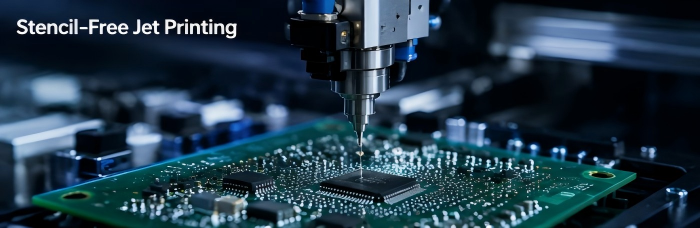
Jet printing eliminates this dependency entirely. The MYCRONIC jet printing platform deposits solder paste from a digitally controlled dispense head — no aperture geometry, no stencil artwork, no lead time. Program changeover between board revisions takes under 15 minutes, including paste-volume verification on the first deposit cycle.
The cumulative impact on a 50-unit industrial control board order is direct and measurable. A stencil-based line adds 3–5 days of procurement lead time before setup even begins, followed by 45–90 minutes of changeover per revision. Jet printing reduces changeover to under 15 minutes with zero stencil lead time, compressing a typical 10–14 day turnaround for a 50-piece lot down to 5–7 days. For fine-pitch geometries at 0402 and below, aperture mismatch is a persistent defect source on physical stencils; jet printing eliminates that failure mode by design.
For a PLC manufacturer managing 6–10 board variants per quarter, this is not a marginal improvement — it restructures what's possible within a production sprint.
Moisture-Sensitive Component Handling at HMLV Scale
High-mix production introduces a materials risk that volume manufacturers rarely confront at the same frequency: moisture-sensitive devices (MSDs) cycling in and out of dry storage across multiple small-quantity kits.
IPC/JEDEC J-STD-033 defines floor life by MSD level. A component classified MSL 3 has a 168-hour floor life at ≤30°C/60% RH. In HMLV production, where a reel of 500 components may supply three separate orders over six weeks, tracking cumulative exposure requires discipline that informal processes cannot sustain.
Bake protocols are applied to any MSD component that has exceeded its floor life exposure budget. MSL 2 and MSL 2a components are baked at 125°C for a minimum of 48 hours. MSL 3 parts require 168 hours at the same temperature. MSL 4 requires 96 hours, and MSL 5 or 5a components require a minimum of 196 hours at 125°C before they are cleared for reflow.
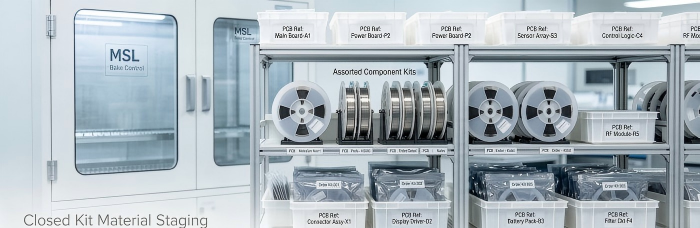
Beyond bake protocols, the more effective upstream control is kit-based material staging. Each production order is kitted as a discrete unit — components pre-counted, labeled by reference designator, and issued to the line as a closed set. This eliminates the cross-contamination risk inherent in pulling shared reels across concurrent builds. When part numbers exceed 200, a single mislabeled reel substituted across two kits produces defects that 3D AOI may not catch until the board is already reflowed.
First-Article Inspection as a Process Gate, Not a Formality
The phrase "first article inspection" appears in nearly every EMS capability statement. The engineering question is what happens when the first article fails, and whether the process has a defined response or an informal one.
In HMLV PLC builds, first-article failures most commonly present as systematic component offsets — a 0.2 mm fiducial registration error that shifts an entire placement zone, or a fine-pitch IC seated 1–2% outside IPC-A-610 Class 2 criteria. These errors are not random. They are deterministic and will repeat across every subsequent unit unless the placement program is corrected before the run continues.
After reflow and before any additional units enter the line, every board undergoes a full 3D AOI scan against the approved Gerber and BOM, followed by a manual cross-check of all IPC-defined critical joints covering fine-pitch, BGA, and QFN devices. Offset data is logged by reference designator; any delta exceeding 50% of pad dimension triggers a placement program correction before the run resumes. Written sign-off is required before production release.
The data logging step is often omitted in practice. Without it, a marginal first article gets approved informally, the offset persists, and the defect mode is only discovered during functional test — at which point 50 boards carry the same systematic failure.
Engineering Change Order Management Under Active Production
PLC and industrial control platforms are iterative products. It is not unusual for a customer to submit a BOM revision or reference designator change while a production order is already in process — a resistor value change on a power rail, a component substitution driven by supply chain constraints, or a layout correction that affects one functional block.
Without a formal ECO control mechanism, the risk is version mixing: some boards built to revision A, some to revision B, with no reliable way to segregate them post-production.
A Smart MES system handles this through hard version locking at the work order level. When a new ECO is received, the system creates a parallel work order with a distinct revision identifier. The original order continues under revision A controls until its defined quantity is complete or explicitly closed. The new revision B work order cannot share placement programs, BOM references, or test parameters with the prior version. Laser-marked serial numbers on each board encode the revision state, providing downstream traceability to the unit level.
This is not bureaucratic overhead. For a PLC deployed in an IEC 62061-regulated safety application, the ability to confirm exactly which component revision is present on a specific serial number is an audit requirement, not a nice-to-have.
What Separates a Process-Ready HMLV Line from a Generalist Shop
The controls described above — stencil-free changeover, kit-based MSD staging, first-article data logging, and MES-enforced ECO version locking — are not individually exotic. Most EMS providers will claim some version of each. The operational question is whether they function as integrated, documented procedures that apply to every order regardless of lot size, or whether they depend on the judgment of whoever happens to be running the line that day.
For PLC and industrial control programs, the distinction matters more than it does in volume production. A 200-unit consumer electronics run can absorb one bad batch and recover. A 75-unit run of safety relay controllers for a manufacturing cell cannot. When the defect mode is a systematic placement offset that propagated from an unconfirmed first article, or a version-mixed ECO that shipped boards to two different revision states, the failure is not a process anomaly — it is a process design failure.
HMLV requires a production infrastructure that treats low-volume, high-complexity runs as the primary use case, not the exception. Changeover economics, material controls, and traceability architecture need to be calibrated for 50-piece lots from the ground up, not retrofitted from a volume-production baseline.

Ready to Review Your PLC Assembly Program?
At PCBCart, we have built our HMLV production infrastructure specifically around this class of work. Our facilities in Hangzhou and Thailand run mixed-revision PLC and industrial control programs as a core competency — not as overflow capacity between volume runs. Jet printing, kit-based material staging, first-article data logging, and MES-enforced ECO version control are standard operating procedure on every order, regardless of lot size.
If you are evaluating contract assembly for a PLC, industrial controller, or test equipment platform with 100+ part numbers and lots under 500 units, our engineering team can review your Gerber and BOM files and identify process risks before production begins.
Helpful Resources
• Effective Ways of Moisture Sensitive Device Storage and Handling
• Common SMT Defects and How to Avoid Them
• Elements Ensuring Your First-Time Success in New Product Introduction (NPI)
• 6 Effective Ways to Cut PCB Assembly Cost Without Sacrificing Quality
• Low-Volume PCB Assembly (HMLV)


