



A PCBA quote is the sum of four line items — bare-board fabrication, component cost, assembly labor/machine time, and one-time engineering costs — and price changes between orders almost always trace back to component cost or engineering-cost amortization, not arbitrary markup.
The Four Cost Buckets, and How Volatile Each One Is
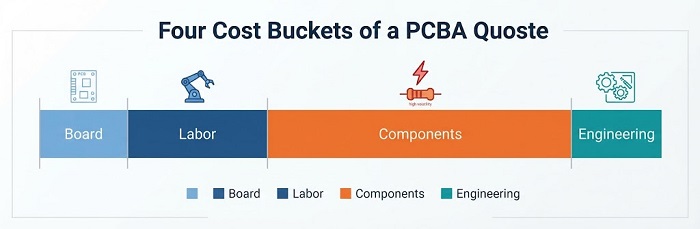
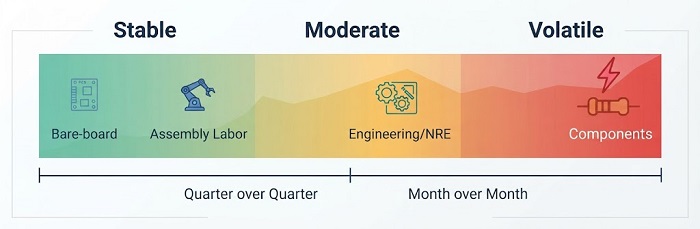
Board fabrication is the most stable line item, typically varying less than 5% quarter over quarter for the same layer count, thickness, and surface finish. Assembly labor/machine time is the second-most stable, since it's driven by placement count and machine-hour rates that suppliers set predictably. Component cost is by far the most volatile: passive and semiconductor spot pricing can swing 10-30% month to month depending on distributor stock levels, and any BOM where 5-10% or more of line items sit on allocation will visibly move the total quote. One-time engineering costs (stencil, programming fixture, first-article inspection) are fixed per unique design, meaning their per-unit impact depends entirely on how many boards that fixed cost gets spread across.
Why the Same Design Can Quote Differently Twice
Three scenarios explain almost every "why did this get more expensive" question:
1. Component allocation shifted. A part that was in stock at the last quote is now on a 12-20 week lead time, forcing a price premium or a substitute.
2. Quantity changed. Ordering 20 units this time instead of 500 last time means the same fixed stencil/setup cost is now divided across a much smaller batch.
3. Currency or freight cost moved. For cross-border orders, exchange rate swings of even 3-5% and freight surcharges (fuel, peak season) shift the landed total even when the supplier's base price hasn't changed.
Cost Bucket Breakdown Table
| Cost Bucket | Typical Volatility | What Drives Change |
|---|---|---|
| Bare-board fabrication | Low (<5%/quarter) | Layer count, material, finish |
| Assembly labor/machine time | Low-Medium | Placement count, panel yield |
| Component cost | High (10-30%/month) | Allocation, distributor stock, spot market |
| Engineering/NRE (stencil, setup) | Fixed per design | Amortized over order quantity |
A Real-World Scenario
A buyer orders 50 units of a board with a BOM including a common MCU. Three months later they reorder the same 50 units. In the interim, the MCU moves from "in stock" to "14-week lead time" at the primary distributor. The requote comes back 18% higher — not because the supplier changed anything, but because the component line now reflects a distributor allocation surcharge and a substitute passive component with a slightly higher unit cost. This is the single most common driver of "unexplained" quote increases in HMLV ordering.
What a Transparent Supplier Should Give You
A reputable assembler issues a fully itemized quote — not a single lump-sum number — within 24-48 hours of a complete file submission. That itemization should let you see, line by line, which of the four buckets moved. If a supplier can't or won't break down the quote this way, you have no way to evaluate whether a price increase is legitimate or padded.
How Quote Volatility Compares Across Order Types
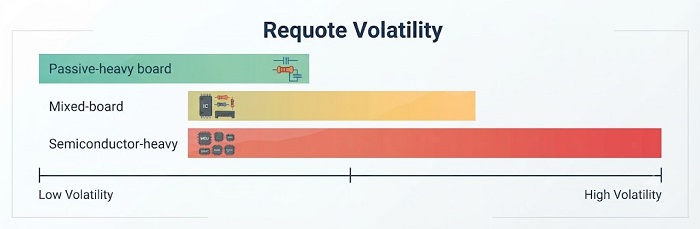
Not every order carries the same requote risk, and knowing where your order falls on this spectrum sets realistic expectations before you even see a number.
| Order Type | Requote Volatility | Primary Driver |
|---|---|---|
| Passive-heavy board (resistors, capacitors, connectors) | Low | Board fabrication cost, which is stable quarter over quarter |
| Board with 1-2 common semiconductors | Medium | Occasional allocation events on a small number of parts |
| Board with multiple analog/power ICs or MCUs | High | Component allocation is the dominant swing factor |
| Cross-border order in a volatile currency pair | Medium-High | Component cost plus currency/freight movement compound together |
A board built almost entirely from passives and simple connectors will typically quote within a few percent of its previous price indefinitely, since the fabrication and labor lines dominate and both are inherently stable. A board with several semiconductors, by contrast, should be expected to move — sometimes significantly — between quotes separated by more than a couple of months, simply because that's how the underlying component market behaves. Knowing which category your design falls into before you request a requote helps you interpret whatever number comes back: a 20% jump on a semiconductor-heavy board is unremarkable, while the same jump on a passive-only board would be worth questioning line by line.
Common Mistakes Buyers Make When Evaluating a Quote
• Comparing two quotes by their bottom-line number alone. A $42 quote and a $38 quote look easy to compare until you realize one includes X-ray inspection and the other doesn't — the cheaper number can easily be the more expensive option once scope is equalized.
• Assuming a price increase means the supplier is padding margin. In practice, component cost volatility explains the overwhelming majority of requote increases; assuming bad faith first, before checking the itemization, damages a relationship that's usually working exactly as intended.
• Not asking for the four-bucket breakdown up front. Buyers who accept a single lump-sum quote have no way to audit a future price change, and end up re-litigating trust every reorder instead of just checking a line item.
• Treating a quote as static. Component markets move weekly for allocated parts; a quote you sat on for six weeks before ordering may no longer reflect current component pricing, and re-confirming before payment avoids a surprise invoice adjustment.
Negotiation Tips That Actually Move the Number
If you're ordering repeat volume, ask directly whether the supplier offers a standing price agreement — a pre-negotiated rate for a fixed period (commonly 3-6 months) that insulates you from month-to-month component volatility in exchange for a committed order cadence. This shifts allocation risk onto the supplier for the agreement period, which most suppliers will only offer to buyers with a demonstrated reorder pattern, so it's worth raising after your second or third order rather than your first. For one-off orders, the more useful lever is timing: locking your quote and paying promptly once you're satisfied avoids the price drifting against you if a BOM component moves onto allocation between quote and order.
It also helps to separate what's negotiable from what isn't before you start the conversation. Component cost, sourced through the supplier's own distributor relationships, is generally not negotiable on a per-order basis — you're paying close to what the supplier itself pays, plus a margin that's usually consistent across their customer base. What is more often negotiable is the engineering/NRE line, especially once you're a repeat customer, and in some cases the labor rate on larger recurring orders where a supplier can justify a modest discount in exchange for predictable, scheduled capacity utilization on their line. Asking a supplier to simply "do better on price" without identifying which bucket you're targeting rarely produces movement; asking specifically about NRE waivers or a standing agreement almost always gets a substantive answer, even if that answer is no.
Checklist Before You Accept a Requote
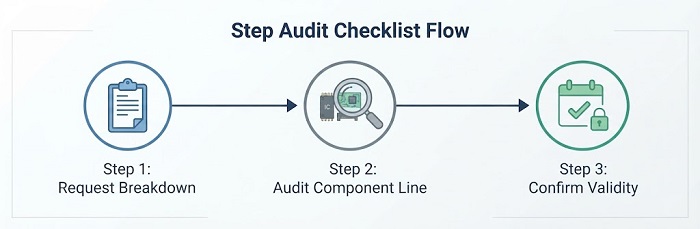
• Ask for the quote broken into the four cost buckets, not a single total.
• Compare the component-cost line specifically against the prior quote.
• Ask whether any BOM substitutions occurred and why.
• Confirm whether the quote is valid for 30-90 days if your files haven't changed.
• If ordering the same design repeatedly, ask about a standing price agreement to reduce re-quote volatility.
• Re-confirm pricing before final payment if more than a few weeks have passed since the quote was issued.
FAQs
1. Does a bigger order always mean a lower unit price?
Generally yes for the engineering/setup portion of the quote, since fixed costs spread across more units, but the raw component-cost line per unit stays essentially flat regardless of quantity — so the "discount" you see at higher volume is really a setup-cost dilution effect, not a materials discount.
2. Why did my requote come back higher with no design changes?
Check the component-cost line first, since it's the most common driver of quote drift; a part moving from in-stock to allocated status can add a meaningful premium even when every file you submitted is byte-for-byte identical to last time.
3. Can I lock a quote for future reorders?
Most suppliers will honor a quote for 30-90 days as long as the BOM and files are unchanged, but ask this explicitly and get the expiration date in writing rather than assuming an open-ended validity.
4. Is a lower quote always a red flag?
Not necessarily — but before treating it as a bargain, ask specifically what's excluded, since testing scope, stencil cost, and shipping terms vary enough between suppliers that a lower headline number can still mean a higher landed cost.
5. How often should I re-quote a recurring design?
Every 60-90 days if the BOM contains semiconductors, since allocation status for those parts changes on a similar cadence; boards built almost entirely from passives can safely go longer between re-quotes.


