



With the evolution of modern electronics towards higher frequencies and data rates, signal integrity is one of the issues that have become a key concern in the design and assembly of PCBs. Reliable transmission at several GHz is required for applications like 5G communication, AI servers, automotive radar and high-speed networking. In such environments, very small conductor imperfections can have a significant impact on the overall electrical performance.
PCB surface roughness is one important factor that is often overlooked. Rough copper surfaces increase bonding strength during fabrication, but can also cause signal loss and cause poor high speed performance while in use.
What is PCB Surface Roughness?
Copper trace and reference plane surface roughness is the microscopic roughening that occurs on the surface of copper components. Never a copper foil surface is 100% smooth. Rather, they feature minute peaks and valleys and irregular structures created during the process of manufacturing copper foil, chemical treatment, etching, and lamination.
During the manufacture of PCB, a certain roughness is purposely added to enhance the bonding strength between the copper and the dielectric material. Rough surfaces offer increased mechanical adhesion properties, ensuring the multilayer PCBs' structural reliability in the drilling, soldering and thermal cycling processes.
But, in high-frequency applications, roughness will have a negative impact on electrical performance.
For lower frequencies, electrical current can travel across the majority of the cross section of the conductor. At high frequencies the current is forced to flow close to the conductor surface due to the skin effect. The quality of surface of copper is thus very crucial. As electrical current flows over a rough surface, there is a greater electrical path length and resistance, which causes conductor losses and lowers signal efficiency.
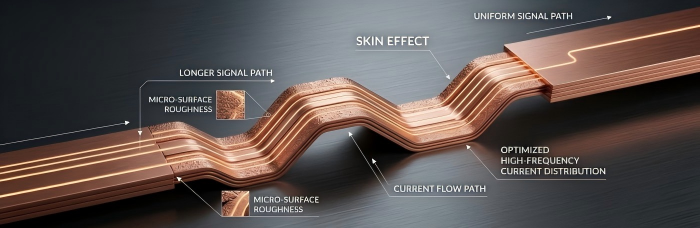
Importance of Surface Roughness in High Speed PCBs
Roughness of the copper is a greater factor as the signal frequencies rise. The surface condition of conductors is directly affecting the signal integrity in high-speed digital and RF systems.
Increased Insertion Loss
Among the most apparent is increased insertion loss due to the roughness of the surface. Smooth copper surfaces allow the high frequency current to take the conductive path through the material with low resistance.High frequency current takes the path of the low resistance when the copper surfaces are smooth.
This extra resistance provides greater attenuation as signals propagate through the PCB. In systems running at frequencies above several GHz, conductor roughness may be a significant component of the overall transmission loss.
If the loss is too high:
Reduced eye diagram opening
Lower signal-to-noise ratio
Higher devices' bit error rates (BER)
Reduced communication reliability
This is becoming increasingly important with data rates greater than 25G bps and frequencies higher than 10 GHz.
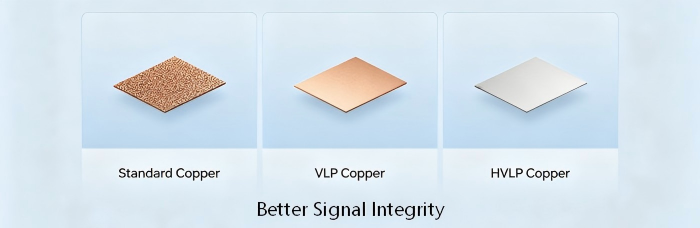
Many of the newer PCB designs are now employing very-low-profile (VLP) or hyper-very-low-profile (HVLP) copper foils to minimize conductor loss. The smoother grades of copper are used to maintain high frequency signal quality.
Impedance Variation and Reflection
The high-speed performance of a PCB is dependent on controlled impedance. The surface roughness of transmission lines may alter the surface electromagnetic properties and can result in variations in local impedance.
If the impedance is not consistent, there can be signal reflections. These reflections can result in signal inaccuracies, timing instability, waveform distortion, and ringing.
Differential pair routing is especially susceptible to roughness induced impedance mismatch. If the conductor surfaces of the two traces are not even, it will cause skew and decrease differential signal performance.
Increased Noise and Jitter
The higher the speed of the system, the more susceptible it is to noise and timing errors due to higher conductor loss and reflections.
Surface roughness may be involved in:
Higher deterministic jitter
Increased crosstalk sensitivity
Eye pattern degradation
Reduced timing margin
Lower overall reliability of the channel
For modern high speed systems, a mere increase in conductor roughness can generate measurable electrical effects.
How Assembly Processes Influence Surface Roughness
The surface quality of conductors is also closely related to the assembly and manufacturing of PCB.The surface quality of conductor is also critical in the assembly and manufacturing process of PCB.
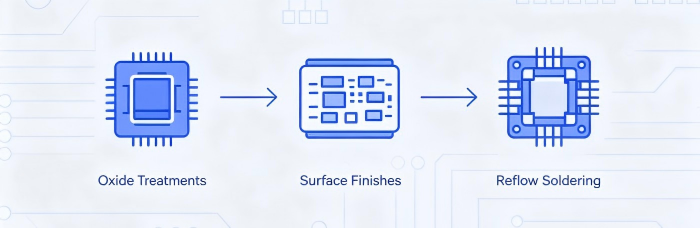
Oxide Treatments
To ensure bonding between copper layers and prepreg materials, traditional copper oxide and brown copper treatments are often applied. These treatments are purposeful to roughen the surface of the copper to help it adhere better.
While it is desirable for mechanical reliability, the conductor loss at high frequencies can increase with excessive roughening. These are the technologies that are designed for modern times to replace the oxides without compromising too much in the electrical effect, to maintain bonding strength.
Surface Finishes
PCB surface finishes not only influence solderability, but also are important for electrical properties. Typical finishes are ENIG (Electroless Nickel/Immersion Gold), immersion silver, OSP and HASL.
High speed applications may require smoother finishes like immersion silver or OSP which help to minimize signal disruption. HASL surfaces can generate irregular topography which can adversely influence high frequency transmission.
Reflow Soldering
The reflow assembly may cause a minor change in the surface condition and oxidation of copper. For consistent electrical performance of different production batches, stable manufacturing processes are important.
Copper Foil Selection Matters
The performance of a PCB is highly dependent on the type of copper foil used. Typically, standard electrodeposited copper has surface roughness and a higher conductor loss, but advanced low-profile copper foils have smooth surfaces and lower attenuation.
In modern applications, the use of VLP or HVLP copper helps to enhance signal integrity for many high-speed PCB applications. The materials are freely employed in servers, RF systems, aerospace electronics and high-tech communications equipment.
With each rising operating frequency, smoother surfaces and less signal degradation are increasingly becoming a necessity for copper surfaces.
Minimizing Signal Issues Due to Roughness
A number of practical techniques can be used to reduce the effect of surface roughness on signal integrity for the PCB assembly process.
To boost the performance, designers can do the following:
Choosing low-profile copper foils
Selecting more subdued surface finishes
Designing PCB stackup structures optimally
Minimizing over-roughening of chemicals
Improving fabrication consistency
Taking advantage of accurate signal integrity simulation models.
As a result of advanced EM simulation software, there are models available to incorporate conductor roughness that enable engineers to more accurately estimate insertion loss before production begins.
Surface roughness in PCB has turned out to be an important parameter in the high-speed signal integrity in assembly and fabrication. Rough copper surfaces provide greater bonding reliability, but also raise conductor loss, instability of impedance, and degradation of signals at high frequencies.
With ever increasing speed and bandwidth of electronic devices, PCB designers are required to ensure that the mechanical reliability and electrical performance meet. The choice of material, surface finish optimization and the selection of assembly processes are all essential for minimising problems caused by roughness.
PCBCart provides professional PCB fabrication and assembly services with a focus on delivering a high-speed PCB assembly solution, helping customers ensure the signal integrity performance for their advanced electronic applications.
Helpful Resources
• High-Speed Layout Tips
• Elements Affecting Characteristic Impedance of PCB and Solutions
• Advanced PCB Assembly


