



In modern electronics, Printed Circuit Board Assemblies (PCBA) serve as the core of nearly all devices, from consumer electronics to automotive and industrial systems. Vias—small copper‑plated structures connecting different layers of a PCB—are critical for electrical connectivity and signal transmission. However, under repeated thermal cycling, vias often become a weak point, leading to intermittent faults, open circuits, or complete functional failure. Understanding why vias fail during thermal cycling is essential for improving reliability, extending service life, and reducing failure rates in demanding environments.
What Is Thermal Cycling and Why Does It Stress Vias?
Thermal cycling refers to the repeated process of heating and cooling a PCB during operation or testing. Temperature fluctuations cause the materials in a PCB to expand and contract cyclically, generating thermomechanical stress. Unlike short‑term thermal shock, long‑term thermal cycling leads to cumulative fatigue damage, especially at material interfaces and structural discontinuities. Vias are particularly vulnerable because they consist of copper plating and dielectric substrate materials with significantly mismatched Coefficients of Thermal Expansion (CTE).
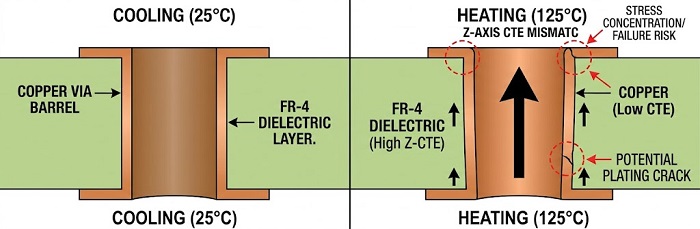
For common PCB materials like FR‑4, the in‑plane CTE is approximately 13–17 ppm/°C, while the through‑thickness (Z‑axis) CTE can reach 60–70 ppm/°C. In contrast, copper has a CTE of about 16–17 ppm/°C. This large mismatch along the Z‑axis creates significant tensile and shear stress on via barrels during temperature changes. Over hundreds or thousands of cycles, stress concentrates at weak points, eventually leading to crack initiation and propagation.
Primary Failure Mechanisms of Vias Under Thermal Cycling
1. Barrel Cracking Caused by CTE Mismatch
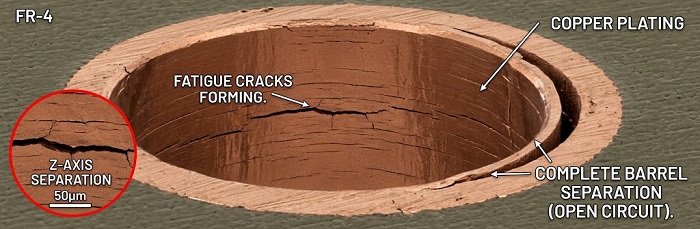
The most common failure mode is barrel cracking, which occurs in the copper plating of the via hole. The Z‑axis expansion of the dielectric substrate is much greater than that of copper. During heating, the substrate pushes the via barrel outward; during cooling, it pulls inward. This repeated stretching and compression causes fatigue in the copper layer. Cracks typically start at the inner wall of the via, propagate along grain boundaries, and eventually break the conductive path.
High aspect ratio vias (depth‑to‑diameter ratio > 8:1) are especially prone to this failure. Narrow, deep vias make uniform plating difficult, resulting in thinner copper in the middle of the barrel. Thinner areas experience higher stress concentration and crack more easily under thermal cycling.
2. Failures in Blind, Buried, and Stacked Vias
In HDI (High‑Density Interconnect) PCBs, blind vias, buried vias, and stacked microvias face unique failure risks. Blind vias often have thinner plating near the surface neck, which becomes a fracture point as the expanding substrate presses against it. Stacked vias tend to fail at the interface between layers, leading to high‑resistance connections or open circuits.
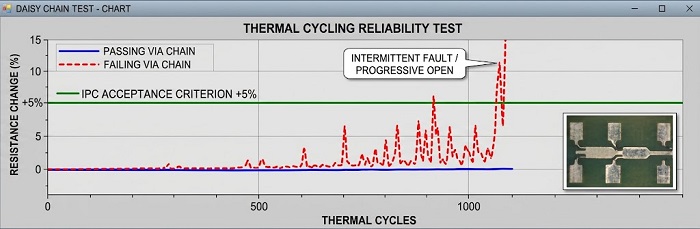
IPC standards highlight reliability concerns for these structures. IPC‑TM‑650 Method 2.6.27 requires thermal cycling and reflow testing to verify that resistance changes do not exceed 5%, ensuring adequate thermal fatigue resistance.
3. Poor Plating Quality and Structural Defects
Via reliability depends heavily on plating quality. Common defects include uneven copper thickness, voids, inclusions, and insufficient plating thickness. The so‑called “dog‑bone effect” describes thinner copper in the middle of the via barrel compared to the top and bottom openings. Such non‑uniformity creates natural stress risers that accelerate crack growth under thermal cycling.
Voids or gaps in the copper plating further reduce mechanical strength and electrical conductivity. Even small voids can expand under cyclic stress, leading to rapid failure. The industry generally recommends a minimum copper plating thickness of 25 μm (1 mil) for stable via performance under thermal stress.
4. Inadequate Material Selection and Substrate Performance
Substrate materials directly affect via reliability under thermal cycling. Low‑Tg (glass transition temperature) materials soften at relatively low temperatures, increasing the risk of deformation, delamination, and via cracking. High moisture absorption can also cause internal vaporization during reflow or high‑temperature operation, damaging via structures from the inside.
Using low‑CTE laminates reduces the expansion difference between the substrate and copper, lowering thermomechanical stress. High‑performance materials with balanced CTE and high thermal stability significantly improve via survival rates during thermal cycling.
5. Internal Layer Separation and Interface Delamination
Another failure mode is inner‑layer separation (ILS), which includes copper foil separation, delamination between flash copper and electroplated copper, or separation at the copper‑substrate interface. Unlike barrel cracking driven by Z‑axis CTE mismatch, ILS is caused by in‑plane expansion of the resin pressing against the via barrel. Thick, high‑quality copper plating can resist this deformation and delay or prevent separation. Thin or weak plating leads to plastic deformation and high tensile stress, triggering separation failures.
How Thermal Cycling Accelerates Via Failure
Thermal cycling accelerates failure through three interconnected mechanisms:
Cumulative Fatigue: Reversible thermal expansion and contraction cause cyclic loading, weakening copper and interfaces over time.
Stress Concentration: Defects, geometry changes, and material mismatches create local stress points where cracks initiate and grow.
Material Degradation: High temperatures accelerate creep, oxidation, and interface degradation, while low temperatures increase brittleness, making materials more susceptible to fracture.
Together, these factors turn minor manufacturing or design flaws into catastrophic failures over the product lifecycle.
Design and Manufacturing Solutions to Improve Via Reliability
To reduce via failures during thermal cycling, engineers and manufacturers can implement the following strategies:
Optimize Via Geometry: Reduce the aspect ratio by increasing via diameter for deeper structures. Avoid overly high aspect ratios that compromise plating uniformity.
Improve Plating Processes: Use pulse plating and agitated, low‑viscosity electrolytes to ensure uniform copper thickness. Follow IPC standards for minimum plating thickness.
Select High‑Performance Materials: Choose high‑Tg, low‑CTE, and low‑moisture substrates to minimize thermal stress and material instability.
Use Robust Via Structures: Prefer microvias with lower aspect ratios in HDI designs. Apply controlled via‑filling (conductive or non‑conductive) to enhance mechanical strength and prevent solder wicking.
Strict Reliability Testing: Conduct accelerated thermal cycling following IPC‑9701 and IPC‑TM‑650 standards to detect weaknesses early. Monitor resistance changes in real time during testing.
Conclusion
Vias fail during thermal cycling primarily due to CTE mismatch between copper and substrate, suboptimal design, insufficient plating quality, and inadequate material selection. These factors lead to barrel cracking, inner‑layer separation, interface delamination, and structural fatigue. As electronics operate in increasingly harsh environments—especially automotive, industrial, and outdoor applications—via reliability under thermal cycling becomes a decisive factor in system performance and longevity.
By addressing root causes through material optimization, robust design, precision manufacturing, and strict reliability testing, it is possible to greatly reduce via failures and ensure stable PCBA performance over thousands of thermal cycles.
For professional PCB manufacturing services that prioritize via reliability, thermal stability, and compliance with international quality standards, PCBCart offers full‑featured PCB fabrication and assembly solutions. PCBCart combines advanced plating technology, strict process control, and comprehensive reliability testing to help you build durable, long‑lasting PCBs that perform reliably even under extreme thermal cycling conditions. Whether for consumer, automotive, or industrial applications, PCBCart supports your projects with reliable, high‑quality interconnect solutions from design to delivery.
Helpful Resources
• PCB Design Tips to Better Take Advantage of PCBCart's Capabilities And Save Cost
• How to Ensure the Quality of PCBs
• PCB Manufacturing Process — A Step-by-Step Guide
• Requirements on PCB Design Files to Ensure a Smooth PCB Assembly


