



The placement process is a major determinant of production yield and product reliability in Surface Mount Technology (SMT) manufacturing. Despite the use of high-tech pick and place equipment and process control systems, there are inevitable small variations in placement that can contribute to soldering problems, assembly variation and field failures.
Placement is more than just placing parts on a PCB. It has a direct impact on solder joint formation, thermal characteristics, inspection ability and mechanical stress distribution over the board. These effects are even more pronounced with high density designs, and placement is an integral component of Design for Manufacturability (DFM).
Component Placement and SMT Yield
The SMT yield is the percentage of production boards that are not defective. This is influenced by component placement since it affects the accuracy of component alignment with solder paste and PCB pad during reflow.
If placed incorrectly, even if it's just a little off, there can be a few issues:
Solder bridging between adjacent pads
Small passive components tombstoning
Solder joints that are open or weak
Open or weak solder joints
The skewing or misalignment of components
Insufficient solder wetting
This is particularly true for fine pitch components, where small placement offset can have a major impact on defect rates as observed in industry.
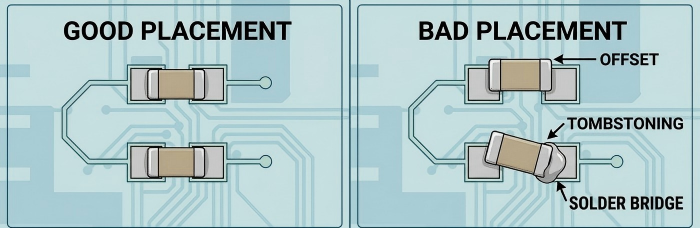
A close attention must also be paid to spacing of components for yield. Layouts that are too cramped make it harder to solder, increase the chances of bridging and make automated optical inspection more challenging. Also, bad spacing can cause thermal shadowing during reflow, causing uneven heating and unstable solder joints.
Placement Accuracy and Thermal Effects
The placement of components and the distribution of copper around components can have a significant impact on the thermal behavior during reflow. Uneven solder wetting forces may result if a component heats up on one side more quickly than the other.
One of the most frequent reasons for tombstoning is because of this imbalance, especially in very small passive components, like 0201 or 01005 packages. Thermal asymmetry gets more complicated as component size becomes smaller and the number of parts per board grows.
This can be mitigated by helping to ensure that the placement strategies are:
Balancing copper areas around pads
Preventing unbalanced heat flows
Ensuring uniformity of pad design rules
It is possible to separate components having different thermal mass.
These measures will help to establish uniform heating and more stable solder joint formation.
Placement and Assembly Process Stability
The stability of the SMT assembly process is also influenced by the component orientation and arrangement. Regularly oriented machines are more efficient and inspection is less complex.
If components are not oriented and/or poorly grouped:
Pick and place machines have higher number of rotation steps
The programming of AOI becomes more complex
Inspection time increases
More likely to commit human errors
The accuracy of placement also is highly dependent on process variables, such as the condition of feeders, nozzle performance, and machine calibration. Even slight mechanical deviations at placement can result in a shift in components or in an angular misalignment.
Research on SMT process behavior reveals that placement variation is indeed a significant cause of assembly defect, particularly in high-speed production.

Placement and Long-Term Reliability
In addition to manufacturing yield, component placement has a significant impact on the performance of a product throughout its life cycle.
Thermal Reliability
If the heat generating components are not placed correctly, they may cause localised hot spots. This speeds up over time:
Solder fatigue
Semiconductor aging
Capacitor degradation
PCB warping
Thermal sources separation and optimizing the airflow paths decreases the operating temperature and extends the product life. Thermal distribution studies reveal that the durability of a solder joint under long-term stress is directly related to thermal distribution.
Mechanical Reliability
Also, the distribution of mechanical stress throughout the PCB depends on the components' placement. Components located near:
Board edges
Mounting holes
Connectors
Depanelization areas
Are more susceptible to vibration and flexing damage.
The large ceramic capacitors and BGA packages are very sensitive and their placement can cause the solder to crack or fail intermittently with time.
Electrical Performance
However, placement also has an impact on signal integrity. If high-speed components are not positioned correctly or if they are not coupled to capacitors, it may be possible to increase:
EMI noise
Crosstalk
Signal reflection
Ground bounce
In electronic circuits, frequencies have been raised in modern technology, so optimized placement is crucial for the stable performance of the circuits.
Best Practices for Optimized Placement
PCB designers generally adhere to a number of important rules for better yield and reliability of SMT:
Keep proper separation of components
Ensure the components are consistently oriented.
The thermal distribution should be balanced across the PCB.
Do not place sensitive parts near the edges of the board
Isolate heat generating equipment from sensitive equipment.
Ensure that decoupling capacitors are as near as possible to the power pins of the IC.
Create layouts to accommodate access to AOI and rework
These practices lessen assembly defects, increase inspection efficiency and increase long term product reliability.
Component placement is one of the basic elements, directly affecting SMT yield and long-term product reliability. Correct placement leads to good solder joint formation, reduces tombstoning and bridging, better thermal balance during reflow, and stability in electrical performance in high speed circuits. Conversely, if products are not placed correctly, manufacturing variation can arise, rework rates can rise and mechanical or thermal failures can occur during product use. With the continuously decreasing size of PCB and increasing complexity of its structures, the optimization of component layout has become an indispensable means to ensure stable and high-quality production of SMT.

As the demand for high density PCB design grows, and manufacturing tolerances become more and more strict, it is important to select the reliable manufacturing partner to ensure the consistent SMT performance. PCBCart is a professional PCB assembly and fabrication company and we have manufacturability, process control and quality assurance as our strong points. Whether you're conducting DFM review, precision SMT assembly or inspection, PCBCart can help you reduce risk of placement problems as early as the production process, enabling you to achieve higher yields and reliability.
Whether you are designing a new product or making improvements to an existing design, a manufacturing review can help minimize your production risks and costs. Feel free to quote PCBCart for any project to help you determine if your PCB design is ready for production, that it will have high SMT reliability and stable long-term performance.
Helpful Resources
• Elements Influencing SMT Soldering Quality and Improvement Measures
• Process Control Measures to Stop Defects in SMT Assembly
• PCB Design Tips to Better Take Advantage of PCBCart's Assembly Capabilities And Save Cost
• PCB Thermal Design Considerations


