



In consignment, you supply the components and pay only for fabrication and assembly labor; in turnkey, the supplier sources every component and bills parts plus assembly. Turnkey is cheaper for most buyers, but "cheaper" isn't really the question that should decide this — the question is which model actually fits your specific situation, since the wrong model can cost you more in hidden overhead than it saves on component pricing.
The Core Tradeoff in One Sentence
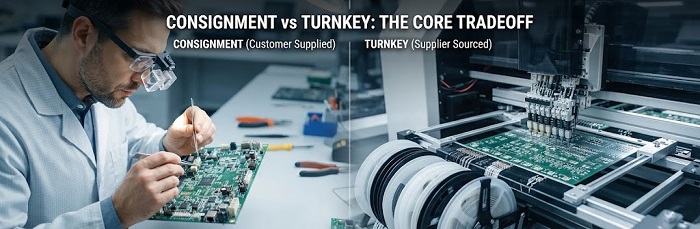
Turnkey trades a small component-pricing premium you'd otherwise avoid for the supplier's purchasing scale, procurement labor, and shortage-risk absorption; consignment trades those conveniences for tighter control over sourcing, at the cost of taking on the logistics and risk yourself.
Neither trade is objectively better — they're priced differently depending on what you already have and what you actually need control over. A buyer with no special sourcing requirements is essentially paying for something they don't need if they choose consignment; a buyer with a genuinely proprietary component is paying a hidden tax in procurement friction if they force that part through turnkey channels that can't actually source it anyway. The mistake most buyers make isn't picking the "wrong" model in some absolute sense — it's applying one model uniformly to a BOM that actually has different requirements running through different components.
Three Buyer Situations, Three Right Answers
"I'm sourcing a standard design with no unusual components." This is turnkey, close to automatically. Suppliers with volume purchasing relationships across many customers typically access component pricing below what an individual buyer gets through standard distributor channels, and turnkey eliminates your own procurement labor, shipping-to-supplier logistics, and the reconciliation overhead of tracking exact quantities against BOM usage. For HMLV projects specifically, professional buyers consolidating orders across many customers can often navigate component shortages more effectively than an individual firm sourcing alone — which is exactly the scale advantage an individual buyer can't replicate no matter how carefully they shop.
"I already own the components, or they're proprietary and can't go through a normal purchasing channel." This is where consignment earns its keep. If you have excess inventory from a prior run, a component under an exclusive supply agreement, or a part your own legal team requires sourcing control over for compliance reasons, turnkey's purchasing-scale advantage doesn't apply to that specific line — you already have the part, or you're the only one who can get it.
"Most of my BOM is standard, but a few components are proprietary or already in stock." This is the case buyers most often force into an all-or-nothing decision when they don't need to. A hybrid approach — consigning the specific parts that genuinely warrant it, turnkey for the rest — is worth asking about explicitly rather than assuming your only options are 100% one model or the other.
A Scenario Worth Walking Through
A buyer with excess inventory from a discontinued product line considers consigning those specific parts for a new, similar design. A side-by-side quote reveals that for the components they already own, consignment genuinely saves money — there's no reason to pay a supplier to re-procure something already sitting in a warehouse. But for the remaining portion of the BOM that isn't already in inventory, turnkey sourcing through the supplier comes in meaningfully cheaper than the buyer sourcing those parts independently, since the supplier's volume pricing applies to everything they procure regardless of what else is being consigned alongside it. The buyer ends up using a hybrid approach: consigning the owned inventory specifically, turnkey for everything else — capturing the savings on both halves of the BOM rather than forcing a single model onto components with genuinely different cost structures.
What Consignment Actually Costs You in Overhead

The purchasing-price comparison is the visible cost difference, but it's not the whole picture. Under consignment, you own the shortage risk on every part you're supplying, the shipping-damage risk in transit to the assembler, and the reconciliation work of tracking exact quantities against BOM usage — including normal attrition, which typically runs a small percentage per production run and needs to be pre-supplied or you risk a production halt over a handful of missing parts. None of this shows up on a component-price comparison, but all of it is real labor and real risk that turnkey simply absorbs into the supplier's existing process.
This overhead scales in a way that's easy to underestimate on paper. A single consigned component on a small prototype run is genuinely low-friction — one part, one shipment, one reconciliation check. A full BOM consigned across a recurring production schedule means dozens of parts, each with its own lead time, packaging requirements, and attrition margin, all tracked by your own team on every single order. The labor cost of that ongoing coordination rarely gets priced into the initial "consignment is cheaper because I already own the parts" calculation, which is exactly why it's worth actually costing out your own internal time before assuming consignment's savings are as large as the component-price line alone suggests.
Consignment vs. Turnkey Comparison
| Factor | Consignment | Turnkey |
|---|---|---|
| Component cost | Buyer's own sourcing cost | Typically cheaper via supplier volume pricing |
| Shortage risk | Buyer's responsibility | Supplier's responsibility |
| Shipping/logistics overhead | Buyer ships parts to assembler | None — supplier procures directly |
| Scrap/attrition allowance | Buyer must pre-supply extra units | Handled internally by supplier |
| Best use case | Excess inventory, proprietary parts, sourcing-control requirements | Nearly all standard HMLV orders |
Common Mistakes When Choosing a Model
• Defaulting to consignment out of an instinct for "control," without pricing the overhead. Control has a real cost in labor and risk that's easy to underweight against a purely visible per-component price comparison.
• Treating the decision as all-or-nothing. Most buyers with a genuinely mixed BOM don't need to force every component through the same model — ask specifically whether hybrid sourcing is supported and clearly itemized.
• Not pricing scrap/attrition allowance into a consignment decision. Under-supplying by even a small margin can halt production over a handful of missing parts, turning a cost-saving choice into a schedule risk.
• Assuming consignment is always cheaper because you "already own the parts." Ownership only offsets the component-cost line — it doesn't offset the logistics and shortage-risk overhead that comes with consigning.
FAQs
1. If I consign parts I already own, do I still need to worry about lead time?
Only for anything you don't already have in hand — parts you're supplying are outside the supplier's procurement timeline entirely, for better or worse.
2. Does consignment affect the warranty or defect-responsibility framework?
Often yes — ask specifically how liability is split when a defect could trace back to a part you supplied versus the assembly process itself.
3. Can I switch models between a prototype run and production?
Commonly yes, and it's worth planning for — some buyers consign a small prototype batch to validate components already in hand, then shift to turnkey once the design is confirmed and volume increases.
4. Does a hybrid BOM cost more to quote than a pure turnkey or pure consignment order?
Sometimes, since it adds reconciliation complexity — ask whether hybrid quoting carries any additional itemization fee before assuming it's cost-neutral.
5. If I'm consigning a proprietary component under an NDA, how does the supplier protect that information?
Ask directly about their confidentiality handling for consigned parts specifically, since this is a separate question from general design-file confidentiality.
Helpful Resources
• Full Turnkey vs. Partial Turnkey PCB Assembly: Which Is Right for You?
• What Is Turnkey PCB Assembly?
Ready to compare both models for your own BOM? Request a PCB Assembly quote and ask for a side-by-side consignment and turnkey breakdown.


