



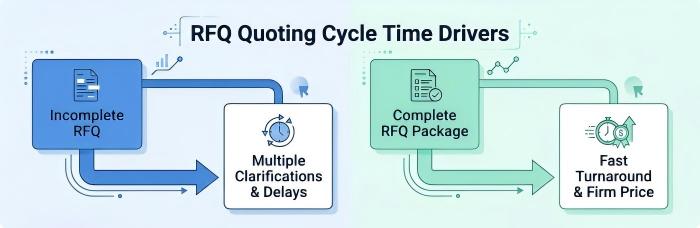
Quote turnaround time is one of the most common friction points in high-mix, low-volume (HMLV) PCBA sourcing. An RFQ that looks complete to the buyer often triggers three or four rounds of clarification before a contract manufacturer can issue a firm price. The gap is rarely about vendor responsiveness — it's about which inputs a quoting engineer actually needs to price assembly labor, program placement equipment, and scope test coverage.
This checklist outlines what a PCBA assembly partner needs at RFQ submission, why each item matters for HMLV pricing specifically, and how to structure your package so the first quote you receive is the one you can act on.
Why HMLV Quoting Is Different From High-Volume RFQs
In high-volume manufacturing, a quoting team can amortize setup time and engineering review across tens of thousands of units, so gaps in the RFQ have a smaller per-unit cost impact. In HMLV work — frequent design revisions, small lot sizes, mixed product families running through the same line — setup time, changeover, and first-article engineering review are a larger share of the per-unit cost. That means incomplete documentation doesn't just delay the quote; it forces the quoting engineer to price around unknowns with contingency margin, which usually shows up as a higher-than-necessary number or a "budgetary estimate" caveat instead of a firm quote.
A complete RFQ lets the quoting engineer price the actual process — not a worst-case assumption of it.
Core Documentation: The Non-Negotiable Package
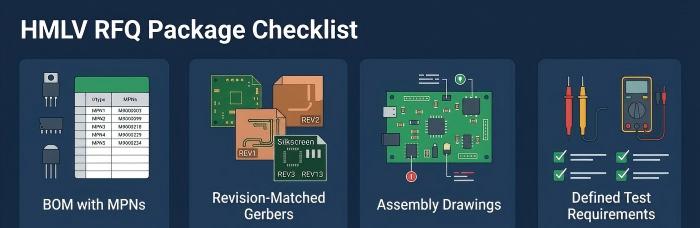
Bill of Materials (BOM)
The BOM is the single highest-impact document in the RFQ. For an HMLV quote to be accurate rather than provisional, the BOM should include:
Manufacturer part number (MPN) and manufacturer name for every line item — not just a distributor SKU
Reference designators matching the schematic and assembly drawing
Quantity per assembly, with do-not-populate (DNP) items clearly flagged
Package/footprint type, especially for BGA, QFN, and other area-array components that affect placement and inspection process selection
Approved Manufacturer List (AML) alternates, where dual-sourcing is acceptable, since component availability windows shift fast enough that a single-source BOM can stall a quote pending an obsolescence check
A BOM without MPNs forces the quoting team to either request a revision or price sourcing risk into the estimate — both of which add cycle time.
Gerber Files and Fabrication Data
Even though PCBA quoting is an assembly-focused exercise, Gerber data (or ODB++/IPC-2581) still matters for assembly-side planning:
Current revision, matched to the BOM and assembly drawing revision — mismatched revisions are one of the most common causes of requoting
Board outline and panelization data, if panelized, since panel utilization affects placement throughput estimates
Layer count and stackup summary, relevant to reflow profile and fixture design decisions
Assembly Drawing
The assembly drawing resolves ambiguity that the BOM and Gerbers can't. At minimum it should specify:
Component orientation and polarity markings
Special mounting instructions (press-fit connectors, heat sinks, conformal coating boundaries)
Any selective soldering requirements for through-hole components in mixed-technology boards
Torque or adhesive requirements for mechanical hardware
Test Requirements
Test scope has a direct, often underestimated, effect on both price and lead time. The RFQ should state:
Test method: ICT, flying probe, functional test, boundary scan, or a combination
Test coverage expectations, particularly for high-density or high-speed boards where full node coverage may not be achievable with flying probe alone
Customer-supplied test fixtures or programs, versus a request for the EMS partner to develop them — fixture development is a separate line item and, on custom designs, one of the larger sources of lead-time variance
Acceptance criteria (AQL, functional pass/fail thresholds) if the customer has defined ones
Packaging and Logistics Requirements
Often provided last, but relevant to cost:
ESD packaging requirements for sensitive components
Tray, tube, or tape-and-reel requirements for finished assemblies
Kitting or sub-assembly grouping instructions for box-build or higher-level integration
Shipping incoterms and destination, which affect logistics quoting on international HMLV orders
Common Gaps That Trigger Clarification Rounds
Based on recurring patterns in RFQ intake, the following omissions are the most frequent causes of quote delay:
BOM and Gerber/assembly drawing revision mismatch. The quoting engineer can't confirm placement counts or component fit without knowing which revision governs.
Missing or ambiguous DNP flags. Populated-vs-DNP ambiguity affects both material cost and placement time.
No test method specified. Quoting teams default to a placeholder assumption, which is almost always revised once the customer clarifies — restarting part of the cycle.
Distributor part numbers instead of MPNs. This forces a manual cross-reference step before sourcing risk can even be assessed.
Undefined special process requirements, such as conformal coating, underfill, or selective soldering on mixed-technology boards — these change both equipment allocation and cycle time and are easy to omit if not explicitly prompted for.
How Content Type Affects Quote Cycle Time
Not every RFQ moves through the same quoting path. Three general categories shape how long a firm quote takes:
Standard repeat-build or drop-in RFQs with complete, revision-matched documentation and no new component qualification typically move fastest, since the quoting team is pricing a known process against known inputs.
New product introduction (NPI) or first-article RFQs — new board designs, first-time component packages, or unfamiliar test requirements — require engineering review before a firm number can be issued. This review covers DFM feasibility, fixture or programming needs, and component risk assessment, and it is the primary reason NPI quotes take longer than repeat-build quotes.
RFQs involving custom fixture or test program development add a distinct engineering scoping step, since fixture design has its own lead time independent of the assembly quote itself.
Flagging which category an RFQ falls into at submission — even informally — helps set realistic expectations for turnaround rather than treating every quote as if it were a repeat order.
Self-Check Before Submission
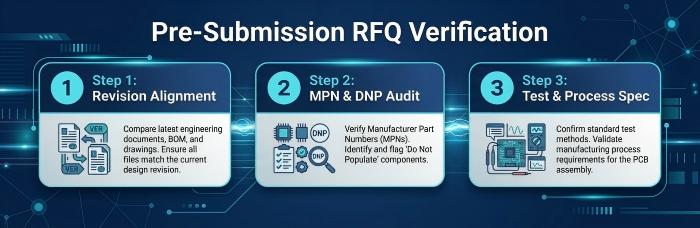
Before sending an RFQ, a quick internal review can eliminate the most common back-and-forth:
Do the BOM, Gerber files, and assembly drawing all reference the same revision?
Does every BOM line item have a manufacturer name and MPN, not just a distributor SKU?
Are DNP items explicitly marked, not just absent from population notes?
Is the test method specified, even if only at a high level?
Are special process requirements (conformal coating, selective soldering, press-fit, underfill) called out on the assembly drawing rather than assumed?
Is the target quantity — and any anticipated reorder cadence — stated, since HMLV pricing structures differ meaningfully between one-time builds and recurring low-volume runs?
Follow-Up Checkpoints After Quote Receipt
Once a quote comes back, a short verification pass avoids surprises at PO stage:
Confirm the quote's stated revision matches your current design revision — designs change quickly in HMLV environments, and a quote against a superseded revision needs to be reissued
Verify that test scope and fixture/programming costs (if applicable) are itemized rather than bundled, so scope changes later don't require a full requote
Check that lead time assumptions in the quote reflect your actual component availability, particularly for any parts flagged as long-lead or subject to allocation
Confirm packaging and kitting instructions were captured as submitted, not defaulted
Submit a Complete RFQ
A complete, revision-matched RFQ package — BOM with verified MPNs, current Gerber and assembly drawing revisions, defined test scope, and stated packaging requirements — is the fastest path to a firm, actionable quote rather than a budgetary placeholder. Use the checkpoints above to review your package before submission, or download the RFQ information checklist for a structured reference you can apply to future quote requests.
Use the checkpoints above to review your package before submission. If your BOM, drawings, and test requirements are ready now, submit your RFQ to PCBCart directly — as an HMLV-focused PCBA assembly partner, our quoting engineers will review your documentation against the equipment and process capabilities on our line and follow up with any clarifying questions before issuing a firm quote, so you get a number you can act on rather than a placeholder estimate.
Helpful Resources
• Why MOQ Minimums Are Killing Your HMLV Program — and How to Fix It Before RFQ
• Turnkey vs. Consignment PCBA: A Procurement Director's Decision Framework for 2026
• 10 Questions to Ask Any EMS Partner Before Signing
• How to Evaluate A PCB Manufacturer or A PCB Assembler
• Instruction on Getting Free PCB Assembly Quotes
• DFM Audit Checklist for Industrial PCBA: 38 Design Rules That Cut Rework Rate by Over 40%


