



Selective soldering solders only chosen through-hole joints with a small nozzle of molten solder, after the surface-mount side has already been reflowed. It suits mixed boards that are dense or heat-sensitive, but it is a programmed process. Cost and lead time therefore depend more on how many joints there are, and how awkwardly they are placed, than on how many boards you order. Decisions about pin access, nearby parts, and joint count, made before files are sent, determine how smoothly it goes. We work with both wave and selective soldering, and which one suits your board depends on its layout and quantity.
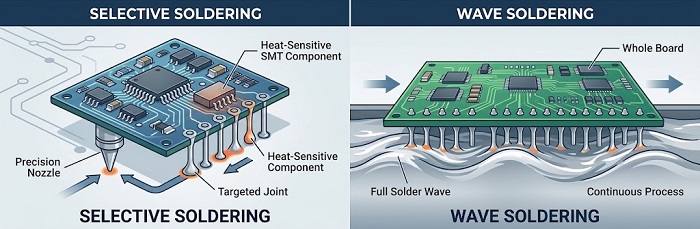
How Selective Soldering Works, in Plain Terms
Selective soldering is the through-hole step for boards that cannot simply be run across a full wave. Flux is applied only where it is needed, the board is preheated, and the joints are then soldered with a small nozzle of molten solder. Our comparison of wave and selective soldering describes two ways of doing this: drag soldering, where a small nozzle wave moves across the joints in sequence, and dip soldering, where a custom nozzle plate solders many joints at once.
The appeal is control. Heat goes only to the intended areas, which lowers the risk to temperature-sensitive parts and makes the process workable on dense boards where through-hole and surface-mount parts sit close together. The price of that control is setup. The process needs programming for each design, and it takes longer than running a whole board over a wave. For a buyer, that trade-off explains most of what follows.
What It Means for Your Design
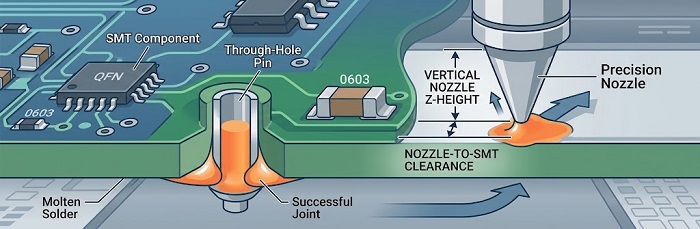
A nozzle needs physical room to work. Surface-mount parts sitting close to a through-hole pin, on the side being soldered, can be in the way, and how close is too close depends on the equipment and the fixture. So ask us for the distance that applies to your board rather than relying on a general rule of thumb.
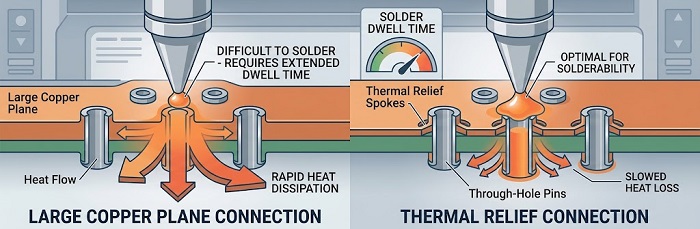
Thermal connections matter too. A pin tied into a large copper area pulls heat away from the joint, and such pins are often harder to solder well than an isolated pin with the same lead. It is far better to hear that during a design review than to find out on a first build. Placement also affects process time. Because the nozzle works joint by joint or plate by plate, a scattering of single pins across the board is typically slower to solder than the same parts grouped together. It is worth checking whether the through-hole parts can be consolidated.
It also helps to be deliberate about what stays through-hole in the first place. Leaded, bulky, or high-thermal devices are the parts that most often justify it. A through-hole part that is there only because it was on the previous revision adds a soldering step for no mechanical reason.
Cost and Lead Time in a High-Mix, Low-Volume Program
Selective soldering does not scale the way wave soldering does. Wave soldering is efficient for large runs of simpler boards, while selective soldering is better suited to precision on complex ones and is less effective for bulk orders. In a high-mix, low-volume program that is often exactly the right fit, but the programming and setup are a per-design effort. The first build of a design therefore carries more of it than a repeat order might, so it helps to tell us in your quote request how often you expect to reorder.
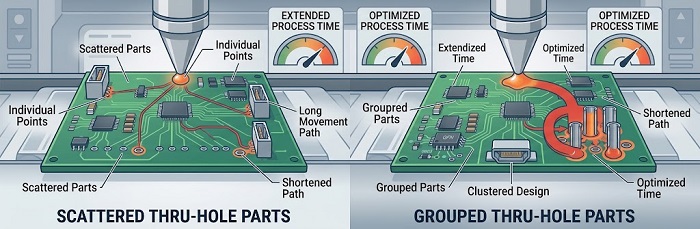
A simple comparison shows why. Imagine two versions of the same board. In the first, the through-hole parts are a single connector and a transformer, each with a group of pins close together. In the second, the same function is spread over a dozen individual through-hole parts scattered across the board. The two have the same number of boards in the order, but the second asks for a longer program, more nozzle movement, and more places where a nearby surface-mount part might need protecting. Neither is wrong, but the first is likely to be much cheaper to build in small batches, which is why the through-hole layout deserves attention while the design is still open.
Joint count and placement drive the process time more than board count does. If a quote for a mixed board looks high, the through-hole step is a good place to look, and the useful questions are how many joints are being soldered and by which method.
What to Put in Your RFQ
Mark every through-hole part and the side it is mounted on, state how many through-hole joints there are, and flag any heat-sensitive part near them. Ask us which method will be used for the through-hole step. A design review is the natural place to settle spacing and thermal questions, and our free Valor DFM/DFA check is part of our assembly service for that purpose.
Some mistakes come up repeatedly. Treating selective soldering as wave soldering with a smaller wave leads buyers to expect volume pricing from a process whose cost is driven by programming and joint count. Adding through-hole parts late in the design is costly because each one changes the program and may crowd parts nearby. Ignoring how a pin is connected to copper hides a soldering difficulty until the first build. Assuming a reorder carries no setup at all can distort cost planning on a program with frequent small orders.
FAQs
1. Is selective soldering the same as wave soldering with a smaller wave? Not quite. It solders chosen joints with a programmed nozzle instead of the whole underside in one pass.
2. Why is it slower than wave soldering? It works through joints in sequence under a program, rather than soldering them all as the board passes over a wave.
3. Can it be used when parts are mounted on both sides? Often, but parts close to the pins need clearance. Ask us to review the layout.
4. Do all mixed boards need selective soldering? No. Wave soldering suits simpler, higher-volume boards, while selective soldering suits complex mixed-technology ones. Ask us which applies to your board.
5. Will it add cost to a small order? It adds programming and setup, which weigh more on small runs. Include your through-hole joint count in your quote request.
On a mixed board, the through-hole step is often where cost and risk concentrate, so it is the part of a quote worth reading most closely.
Get an Instant Quote for PCB Assembly
Helpful Resources
• THT Assembly: 50+ Years Strong—Why Modern Electronics Still Needs It


