



A stencil is required for any SMT reflow assembly and is typically a one-time, per-design cost quoted automatically as part of your assembly order. Panelization is usually handled by the supplier as well, but whether it's a separate line item or bundled into assembly cost varies, so it's worth confirming explicitly.
There Are Really Two Stencil Decisions Here, Not One
Buyers usually think of the stencil choice as a single question — framed or frameless — but that's actually only half of it. The other half is manufacturing method: how the openings in the stencil get made in the first place. Most suppliers offer two main approaches. Laser-cut stencils cut openings directly into stainless steel, producing clean, evenly-tapered apertures that release solder paste well; the tradeoff is a somewhat slower manufacturing process. Chemical-etch stencils use acid to etch the openings instead, which is faster and cheaper, but tends to leave the opening narrower in the middle than at either face rather than cleanly tapered, and that narrower middle can restrict how well paste releases — a real liability on fine-pitch components, though perfectly fine for simpler designs where ultimate precision isn't critical.
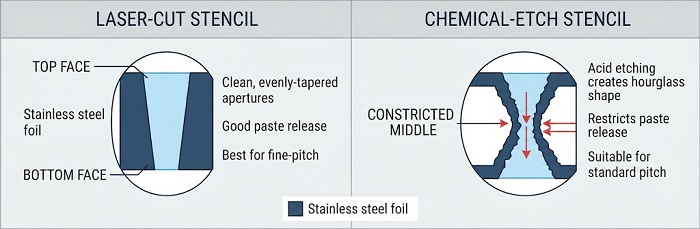
These two decisions — mounting and manufacturing method — are genuinely independent of each other, and mixing them up is how buyers sometimes end up with the wrong combination. A laser-cut stencil can be framed or frameless, and so can a chemical-etched one. A high-volume recurring design with ordinary pitch components might reasonably land on framed plus chemical-etch, prioritizing durability since the extra precision of laser-cutting isn't really needed. A one-off prototype with fine-pitch components might land on frameless plus laser-cut instead, since accuracy still matters even though durability across many reorders doesn't. One buyer with a 0.4mm-pitch QFN learned this the hard way after defaulting to chemical-etch to save a little money, then tracing a run of weak, uneven solder joints on that specific component back to poor paste release — exactly the kind of issue the narrower aperture tends to cause on fine pitches. Switching to laser-cut on the reorder fixed it at a modest cost increase. The part worth remembering is that the manufacturing method should match your tightest-pitch component, not whatever's cheapest for the board as a whole, since one problem component can drive defects regardless of how comfortable the tolerances are everywhere else.
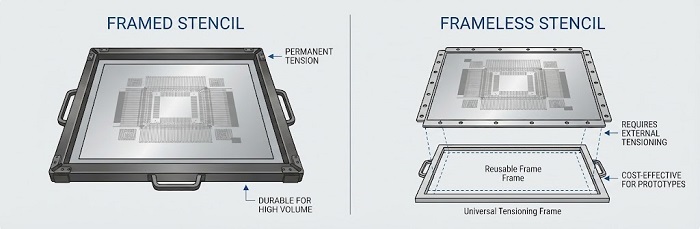
Framed stencils mount on a rigid frame that keeps tension consistent across repeated print cycles, which is why they're the better choice for high-volume or recurring production — the frame prevents the stretching-related errors that build up over many cycles, at the cost of being heavier and pricier to ship and store. Frameless stencils skip the permanent frame and mount to a temporary one only when in use, making them lighter, cheaper, and easier to store — a sensible default for prototypes or genuinely one-off runs, even if they're less durable across many repeated print cycles. For a design you know you'll reorder, a framed stencil typically pays for itself after a handful of reorders through better print consistency and fewer paste-related defects.
Here's the same information as a quick reference:
| Decision | Option | Best Fit |
|---|---|---|
| Manufacturing method | Laser-cut | Fine-pitch components, precision-critical designs |
| Manufacturing method | Chemical-etch | Standard-pitch designs, cost-sensitive orders |
| Mounting | Framed | High-volume or recurring production |
| Mounting | Frameless | Prototypes or genuinely one-off runs |
Panelization Affects Cost More Than People Expect
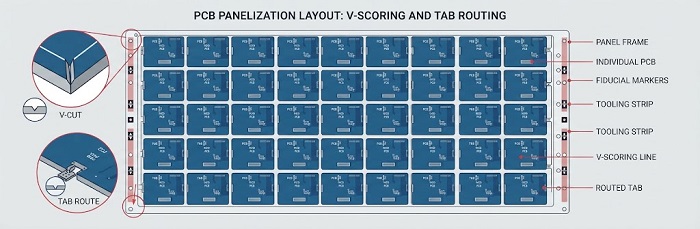
Panelization — grouping multiple boards into a single array with V-scoring or tab-routing for efficient SMT line processing — directly affects fabrication cost through how efficiently the panel is used. A well-optimized layout can meaningfully cut fabrication waste and cost per unit, especially at low-to-mid volumes where waste matters proportionally more relative to the size of the order. Most suppliers will handle this automatically if you submit single-unit Gerbers, but it's worth confirming rather than assuming, particularly if your design has an unusual aspect ratio that might not tile efficiently by default. One submission mistake worth watching for: giving the quoting system your single-unit board dimensions when it's actually expecting full-panel dimensions (or vice versa). It's a common mix-up that delays quoting, and it's cheap to just ask which one the system wants rather than guess and find out later.
A few other things are worth keeping in mind when you're working through these decisions. Manufacturing method and mounting aren't the same choice — it's easy to assume they are, but a fine-pitch design might need laser-cut precision regardless of whether it ends up framed or frameless. Defaulting to chemical-etch on a fine-pitch design purely to save money is a common false economy, given how much that narrower aperture can affect paste release exactly where precision matters most. On reorders, ask explicitly whether the supplier still has your stencil on file — buyers often pay for a brand-new one every time simply because nobody asked whether the old one could be reused, which for a design that's already validated and unlikely to change is money spent for no real benefit.
FAQs
1. Does a fine-pitch design always require laser-cut stencils specifically? Not always, but it's worth asking about directly — the finer the pitch, the more a chemical-etch stencil's narrower aperture becomes a real liability rather than a minor tradeoff.
2. Can I request a specific stencil manufacturing method, or does the supplier choose by default? Ask explicitly — suppliers often default based on typical use cases, but you can usually specify laser-cut or chemical-etch if your design has a particular reason to need one over the other.
3. If I switch suppliers, can I bring my existing stencil with me? Generally no — stencils are typically produced to match a specific supplier's tooling and process, so a new supplier relationship usually means a new stencil regardless of how recently the old one was made.
4. Does stencil thickness need to change for different component types on the same board? Often yes for mixed designs — this is what step stencils are for, allowing different paste volumes in different regions of the same board rather than a single uniform thickness.
5. How long does a supplier typically keep a stencil on file for reorders? This varies — ask directly rather than assuming indefinite storage, especially if your reorder cadence is longer than a few months.
Helpful Resources
• Why Do We Need Stencils for PCB Assembly?
• Stencil Design Requirements for PCBA
Ready to specify the right stencil for your own design? Request a PCB Assembly quote and confirm both the mounting type and manufacturing method.


