



What Is NPI, and Why Does It Matter for Procurement Risk?
New Product Introduction (NPI) is the structured process that takes an electronics product from a validated prototype to repeatable, scalable production. In electronics manufacturing services (EMS), NPI is typically organized into four gated stages — EVT, DVT, PVT, and MP — each with its own engineering deliverables and exit criteria before the next stage begins.
Most procurement teams focus their risk attention on the prototype build — understandably, since it's the first time a design becomes physical. But the highest-risk moment in NPI isn't the prototype. It's the first production lot.
Here's why. During prototype builds, skilled technicians hand-fix issues board by board: a misaligned component nudged into place, a marginal solder joint touched up. Every board gets individual attention, so defects are caught one at a time — and often never documented as process issues at all.
Then those same "working" parameters carry into the first production run, at volume, without the manual corrections that made prototype boards pass. What looked like a validated process was actually a validated result, propped up by invisible manual intervention. At scale, the same latent issues surface across many boards at once — a systemic failure mode, not an isolated defect.
This is the core scale-up risk every hardware program faces, and it's where an EMS partner's NPI discipline either earns its value or exposes its gaps.
The Four-Stage NPI Model: EVT, DVT, PVT, and MP
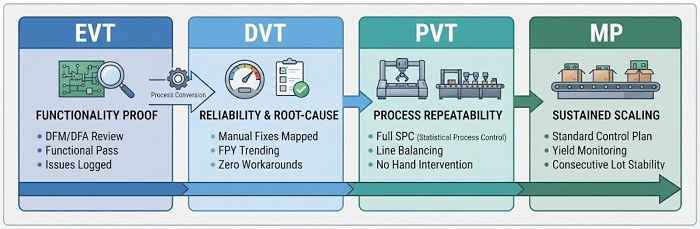
A structured NPI process moves through four gated stages. In plain terms: EVT proves the design works, DVT proves it's reliable under real-world conditions, PVT proves the manufacturing process is repeatable at volume, and MP is sustained production. Each stage should carry a defined engineering involvement level, a required deliverable set, and a quantitative exit criterion — not just a calendar date.
| Stage | Purpose | EMS Engineering Involvement | Exit Criteria |
|---|---|---|---|
| EVT (Engineering Validation Test) | Prove the design functions | DFM/DFA review, initial risk flagging | Functional pass on first-article units; issues logged |
| DVT (Design Validation Test) | Validate design under real conditions | Engineer maps every manual fix to a root cause | FPY trending toward target; zero unresolved workarounds |
| PVT (Production Validation Test) | Prove the process at near-volume | Full SPC, line balancing, operator sign-off | FPY at or above target, no hand intervention |
| MP (Mass Production) | Sustained volume output | Standard process control, yield monitoring | Yield stability sustained across consecutive lots |
The critical discipline: no stage should pass on effort — only on data. A board that "works" after three touch-ups hasn't passed DVT; it has revealed three process gaps still needing root-cause resolution.
Three metrics make this auditable rather than anecdotal: First-Pass Yield (FPY) — boards passing every test stage without rework; yield per SKU — flagging a poorly optimized design before it drags down a whole product line; and rework rate — showing whether instability is improving or just being absorbed by labor cost. Ask any EMS partner to report these at each gate, not just at program end.
Turning Manual Fixes Into Frozen Process Parameters
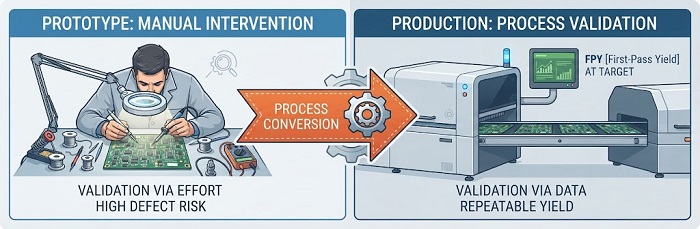
This is the real engineering work of NPI, where PCBA programs succeed or quietly fail. The conversion path:
Log every manual intervention during EVT and early DVT — not just "fixed," but what was fixed, where, and by what technique.
Root-cause each recurring intervention. Is it a footprint tolerance issue, a stencil aperture problem, a reflow profile gap, or a component-specific placement sensitivity?
Convert the fix into a process parameter — an adjusted stencil design, a revised reflow profile, a placement program update — rather than a standing instruction to "watch for this."
Re-validate without the manual step. If the board still passes, the parameter is frozen. If it doesn't, the root cause wasn't fully identified.
By the end of DVT, a mature program should show near-zero undocumented manual correction. If hand touch-up is still routine going into PVT, the design is technician-validated, not process-validated — and won't scale.
Material Risk: What Is Early Supplier Involvement, and Why Does NPI Timing Matter?
Early Supplier Involvement (ESI) means an EMS partner's procurement engineers get engaged during design — not after freeze — so component lifecycle status is understood before it becomes a forecasting problem.
Long-lead-time components create a genuine strategic tension, with no cost-free answer:
Commit early (pre-DVT sign-off): You lock in allocation and lead time before the design is fully validated. Risk: a late change strands inventory or forces costly rework of committed material.
Wait until after PVT: You avoid ordering against an unstable design, but face the component's full lead time stacked on top of your production schedule — which for certain semiconductor or connector categories can meaningfully extend the overall program.
The disciplined middle path: place binding forecasts only on components confirmed unchanged since EVT, holding conditional (cancelable or partial) orders on components still under design scrutiny. This is what ESI enables in practice — knowing early whether a part is active, approaching Last-Time-Buy, or nearing end-of-life. It also requires a pre-qualified alternate-part list, validated during DVT, so a supply disruption doesn't force an untested substitution mid-production.
Evaluate this tradeoff on total cost of ownership (TCO), not unit price. A lower quoted price loses appeal once you count frozen capital in premature minimum-order commitments, or scrapped inventory when an ECO lands after material is already bought.
ECO Lockdown: What Should Happen Before a Design Freeze?
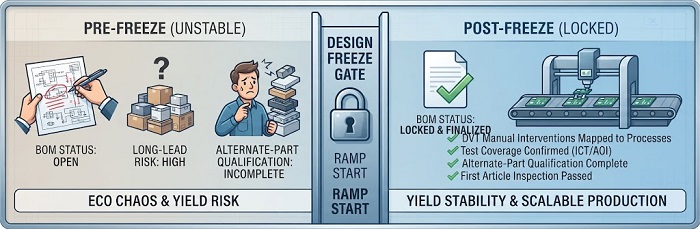
A design freeze is the checkpoint where a product's BOM, test coverage, and process parameters are locked before ramp — closing off the uncontrolled engineering changes that otherwise disrupt yield during scale-up. Engineering Change Orders (ECOs) are a normal part of any program, but ones introduced mid-ramp, without a freeze gate, are among the most common causes of ramp-stage chaos.
A design freeze gate should require five items closed before ramp begins:
BOM finalized with no open substitution decisions
All DVT-identified manual interventions converted to documented process parameters
Test coverage confirmed — ICT/AOI/functional test programs updated to the frozen design
Alternate-part qualification complete for any component with supply risk
First Article Inspection passed — a controlled run confirming every material, component, and process step matches the approved design, with sign-off from design and manufacturing engineering leads
Any ECO after this point should route through formal change control with impact assessment on cost, timeline, and test coverage — not an email thread.
A Representative NPI Timeline (Illustrative Scenario, Not a Specific Client Case)
To make this concrete, consider a composite scenario reflecting a typical mid-complexity industrial control board program — not a specific client engagement, but a pattern consistent with common HMLV timelines. EVT often runs roughly 2–4 weeks; DVT commonly takes 4–6 weeks, with duration driven largely by how many manual-intervention root causes need resolving; PVT typically runs 3–5 weeks; and design freeze is usually set 1–2 weeks ahead of ramp. Under this pattern, total time from EVT to MP often falls somewhere in the 12–18 week range — though actual duration depends heavily on component complexity, the number of manual interventions surfaced during DVT, and supply chain readiness for long-lead parts.
What compresses that timeline in practice is engineering continuity: the same engineer staying with the program from DFM review at EVT through root-cause analysis at DVT, rather than handing the project between rotating resources. A dedicated NPI engineer model — one person accountable across all four stages — consistently outperforms a shared-resource model, where engineers rotate through each stage and re-learn the program's history at every handoff. For programs with real scale-up risk, ask prospective EMS partners directly which model they use.
An IATF 16949-certified process framework underpins all of this, providing the documentation discipline and traceability that make root-cause conversion — rather than repeated firefighting — possible at each gate.
Frequently Asked Questions
What is NPI (New Product Introduction) in electronics manufacturing? NPI is the structured, gated process — EVT, DVT, PVT, MP — that converts a validated design into a manufacturable, testable, and reliably repeatable production process, rather than one that depends on ad hoc technician skill.
How long does NPI typically take, from prototype to mass production? It varies by complexity and supply chain readiness, but many mid-complexity PCBA programs complete EVT through MP in roughly 3–5 months. Programs with more long-lead components or unresolved manual interventions at DVT typically take longer.
What's the practical difference between EVT, DVT, and PVT? EVT confirms the design functions. DVT confirms it's reliable and repeatable without manual correction. PVT confirms the full manufacturing process — tooling, line balancing, test coverage — holds up at near-production volume.
Why do defects show up in the first production batch when the prototype passed fine? Because prototype units are usually corrected by hand, board by board, without those corrections being converted into documented process parameters. At volume, the same underlying issues surface simultaneously across many units instead of being quietly fixed one at a time.
What should I ask a prospective EMS partner about their NPI process? Ask whether stage gates pass on data (FPY, yield per SKU, rework rate) rather than on effort; whether they practice Early Supplier Involvement on long-lead components; and whether one engineer stays with the program across all four stages or hands it between rotating resources.
Planning your own prototype-to-production transition? Request a free DFM Review to catch manufacturability risks before they become scale-up problems, or download our EMS Supplier Evaluation Scorecard to benchmark potential partners against the NPI discipline outlined above.
Helpful Resources
• High Volume Assembly
• Turnkey PCB Assembly
• AXI Test (X-Ray Inspection)
• Box Build Assembly
• Top HMLV EMS Providers: What to Consider When Choosing
• HMLV Electronics Manufacturing: The Future of Low-Volume PCB Assembly


