



With the current growth of the electronics industry, the manufacturers are now pressured more to minimize their environmental impact in order to comply with stringent global laws. RoHS compliance is one of the key standards to be adhered to in production of electronic devices which are environmentally responsible. The selection of PCB assembly based on the RoHS-compliance not only assists companies to comply with the regulatory requirements but also enhances the safety of products, sustainability, and competitiveness in the global market.
What Is RoHS Compliance?
RoHS is the abbreviation of the Restriction of Hazardous Substances, a directive that was initially introduced by the European Union in 2003 and effected in 2006. This regulation is used to contain the use of hazardous materials in electrical and electronic devices to safeguard the human life and environment.
In the latest modifications (RoHS 3), ten substances are prohibited:
Lead (Pb)
Mercury (Hg)
Cadmium (Cd)
Hexavalent Chromium (Cr6+)
Polybrominated Biphenyls (PBB)
Polybrominated Diphenyl Ethers (PBDE)
Bis (2-ethylhexyl) phthalate (DEHP)
Butyl benzyl phthalate (BBP)
Dibutyl phthalate (DBP)
Diisobutyl phthalate (DIBP)
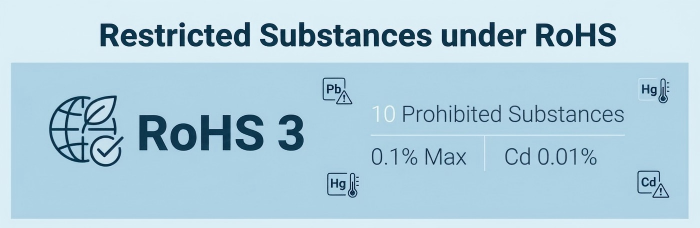
The highest permissible concentration of these substances in any homogeneous material is usually 0.1% (1000 ppm), with an exception of cadmium which is restricted to 0.01% (100 ppm).
RoHS started as an initiative by the European, but the kind of environmental laws have been adopted in most parts of the world. Consequently, the compliance of RoHS has emerged as an international electronics manufacturing standard.
The Importance of RoHS Compliance in PCB Assembly
Environmental Protection
One of the most rapidly increasing types of waste all over the world is electronic waste. The typical circuit board has toxic substances like lead or mercury that can pollute the soil and ground water when improperly disposed.
PCB assembly based on RoHS will seriously decrease the occurrence of these harmful substances. Manufacturers can also ease the environmental impact of electronic waste in the long run by substituting them with more environmentally friendly ones.
Better Worker Health and Safety
There are some materials that are traditionally used in electronics production, which are dangerous to both workers and the end users. For example, neurological damages and developmental problems have been attributed to lead exposure.
Removing or minimizing these hazardous materials, RoHS-regulated PCB assembly can provide a more secure environment in the workplace of technicians and engineers, recycling and recyclist, and to consumers.
Global Market Access
Annually, numerous markets across the globe demand RoHS compliance of electronic products. Companies not complying with these requirements can be limited in its products, fined by the regulating authorities or recall.
The manufacturers who use RoHS-conforming PCB assembly will find it easier to access the international markets and can escape the expensive compliance problems. In the cases of any business that markets internationally, in many instances, the compliance to the standards of RoHS is a prerequisite to entering the market.
Green Electronics Manufacturing
The concept of sustainability is emerging as one of the priorities in the technology sector. The environment is becoming a key factor causing governments, investors, and consumers to appraise companies in terms of environmental responsibility.
RoHS compliant production helps achieve sustainability objectives by:
Limiting poisons in electronics
Increasing recyclability of parts
Reducing e-waste pollution of the environment
RoHS compliance makes the production of electronics consistent with the contemporary standards of environmental sustainability as the trend of such activities is spread worldwide.
Stronger Brand Reputation
Companies that show commitment to the environment are more appealing to the customers, investors, and business partners. RoHS-compliant PCB assembly is an indicator that the company is taking a proactive approach to safe materials, responsible manufacturing and compliance with regulations.
This commitment can build brand equity and improve confidence among the customers who are more concerned about environmental friendly supply chains.
Key Requirements for RoHS-Compliant PCB Assembly
RoHS compliance is attained by paying close consideration to materials, processes, and documentations during the PCB production cycle.
Lead-Free Solder
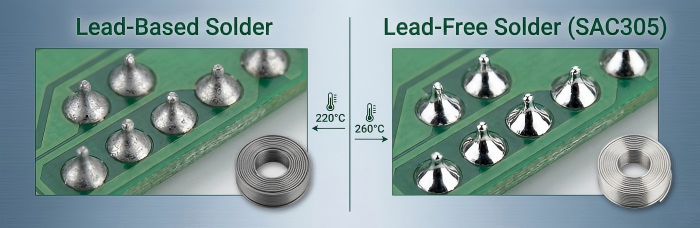
The solder that was commonly used in the past was a mixture of tin and lead (SnPb). This is now being replaced by manufacturing following RoHS standards that use lead-free solder alloys, most often of the tin-silver-copper (SAC) compositions, including SAC305.
Lead-free solder is good and requires more reflow temperatures during assembly since it possesses high mechanical properties as well as good reliability.
RoHS-Compliant Materials
PCB manufacturers should be able to make sure that all the manufactured materials should not go against the restrictions of RoHS. Common examples include:
FR-4 laminates and substrates that are RoHS compliant.
Lead-free solder pastes
Legend Inks Environmentally safe solder mask and legend inks.
The choice of materials is very essential in achieving compliance standards of the final assembly.
Compliant Surface Finishes
Surface finishes of PCBs should also be free of restricted substances. Popular finishes which are compliant with RoHS are:
ENIG (Electroless Nickel Immersion Gold)
OSP (Organic Solderability Preservative)
Immersion Silver
Lead-free HASL
These finishes are durable in solderability and, at the same time, comply with regulations of the environment.
Component and Supply Chain Verification
The electronic components installed on the board are to be of RoHS standards. Manufacturers and designers usually demand suppliers to provide documentation in order to determine compliance.
As screening techniques, testing techniques like X-ray fluorescence (XRF) analysis are common to detect materials and ensure that prohibited materials are not at levels that exceed the allowed levels.
Design Considerations for RoHS-Compliant PCBs
The standards of RoHS also influence PCB design and manufacturing specifications.
The increase in Processing Temperatures
Fuses made with lead-free solder are more difficult to fuse than standard solder as they have a higher melting point and typically demand reflow temperatures of the order 240-260℃. The designers need to choose PCB materials that are able to resist such conditions.
Component and Material Compatibility
Components, coatings and substrates should be RoHS compliant. The designers should make sure that the parts used are lead-free and lead-free assembly processes.
By considering these factors at early design phase, manufacturers could then be certain with the reliability of performance and still be fully compliant with the RoHS.
Challenges of RoHS-Compliant Manufacturing
Although the benefits of RoHS compliance are numerous, there are some challenges that it brings to manufacturing:
Lead-free solder involves increased temperatures of processes
Other conforming materials can be more expensive
There is extra work involved in the supply chain verification and documentation
With the improved technology in manufacturing and materials, these issues have been controllable however. The use of PCB assembly that has complied with RoHS is now common in almost all the electronic industries.
RoHS-Compliant PCB Assembly Applications
Circuit boards which comply with RoHS are now common in most industries such as:
Medical electronics
Automotive systems
Industrial automation
Consumer electronics
Telecommunications equipment
Compliance in such industries makes products meet the requirements of regulations and the current sustainability expectations.

Compliance to RoHS has emerged as a major requirement in the current electronics production. RoHS-compliant PCB assembly can save the environment, enhance the safety of the workers and open up the global market by restricting hazardous substances.
In need of a high-quality PCB assembly and PCB manufacturing partner? PCBCart has the solution, providing high-end PCB assembly and PCB fabrication services, including the facility of manufacturing products with precision, high quality control, and in line with international environmental requirements.
Request for High-quality PCB Assembly & Fabrication Quote Now
Helpful Resources
• Lead-Free Reflow Soldering Process Optimization
• High-Tg PCB Fabrication
• PCB Surface Finishes Guide
• Medical PCB Solutions
• Automotive PCB Design Guidelines


