



In the fast‑paced world of electronics manufacturing, many companies still make sourcing and production decisions based purely on upfront unit price. This short‑sighted approach often leads to unexpected costs, squeezed margins, supply chain disruptions, and lower long‑term profitability. Total Cost of Ownership (TCO) provides a holistic financial framework that captures all direct and indirect costs across the entire product lifecycle—from initial design and component sourcing to manufacturing, logistics, quality control, and end‑of‑life disposal. By adopting TCO analysis, original equipment manufacturers (OEMs) and electronics manufacturing services (EMS) providers can uncover hidden costs, optimize supply chain efficiency, reduce risks, and make more strategic, sustainable decisions.
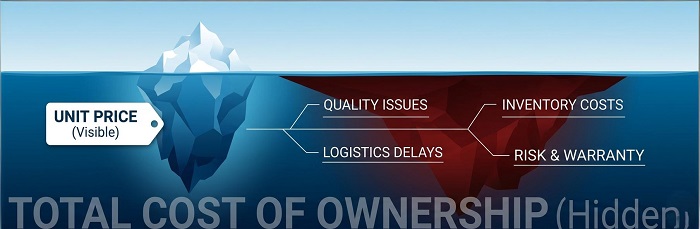
What Is Total Cost of Ownership (TCO) in Electronics Manufacturing?
Total Cost of Ownership is a comprehensive financial estimate that accounts for every expense associated with a product, asset, or production solution throughout its entire lifecycle. Unlike simple purchase‑price comparisons, TCO goes far beyond the factory ex‑works cost to include operational, logistical, quality‑related, risk‑based, and end‑of‑life expenses. For electronics manufacturing—including printed circuit board assembly (PCBA), box builds, and full product assembly—TCO serves as a critical decision‑support tool that reveals the true economic impact of sourcing, outsourcing, production methods, and supplier selection.
A simplified TCO formula widely used in the sector is:TCO = Acquisition Costs + Operating Costs + Supply Chain Costs + Quality & Warranty Costs + End‑of‑Life Costs + Risk‑Related Costs
This full‑scope view helps businesses avoid the common pitfall of choosing low‑upfront‑cost suppliers that later generate far higher total expenses due to delays, defects, freight premiums, rework, or inventory carrying costs.
Core Components of TCO in Electronics Manufacturing
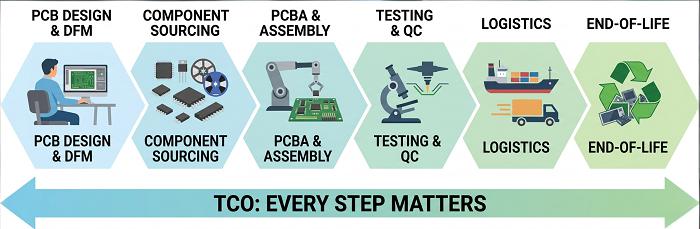
TCO in electronics manufacturing is made up of several interconnected cost categories. Each plays a vital role in determining the true cost of bringing a product to market and sustaining it over time.
1. Acquisition Costs
These are the most visible upfront expenses, yet they represent only a portion of total lifecycle costs.
Component and raw material purchasing
PCB fabrication and assembly unit costs
Tooling, stencils, fixtures, and molds
Initial setup and engineering charges
Freight for inbound components and materials
2. Operating Costs
Ongoing expenses incurred during production, testing, and lifecycle support.
Engineering support and design verification
Electrical, functional, and reliability testing
Compliance certifications (e.g., ISO, RoHS, CE, FCC)
Labor for production, inspection, and testing
Energy consumption for manufacturing equipment
3. Supply Chain & Logistics Costs
Costs driven by global or regional supply chain dynamics.
International and domestic freight (ocean, air, ground)
Customs duties, tariffs, and import fees
Harbor handling, brokerage, and customs clearance
Inventory warehousing and carrying costs
Safety stock and work‑in‑progress (WIP) storage
Lead‑time variability and rush shipment premiums
4. Quality, Rework, and Warranty Costs
Expenses caused by defects, failures, and non‑conformance.
Inspection, testing, and quality control
Rework, repair, and scrap material
Field failures, product returns, and warranty claims
Unplanned downtime due to quality issues
Brand reputation damage and customer churn
5. Risk‑Based Costs
Often overlooked but financially impactful over time.
Emergency freight for delayed shipments
Intellectual property (IP) leakage or theft risks
Supplier instability and production interruptions
Political, regulatory, or natural disaster risks in sourcing regions
Currency exchange fluctuations and inflation impacts
6. End‑of‑Life Costs
Expenses associated with product retirement and responsible disposal.
Electronic waste (e‑waste) recycling and disposal
Component obsolescence management
Reverse logistics for returned or outdated units
Salvage and material recovery processes
Why TCO Matters More Than Unit Price in Electronics Manufacturing
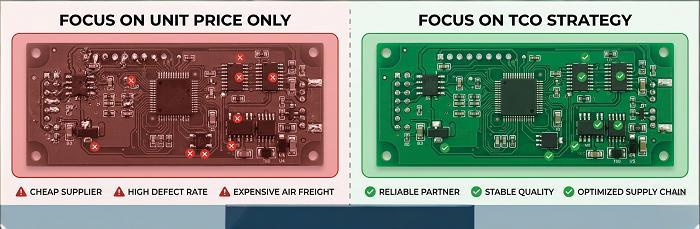
Focusing solely on unit price can be highly misleading. Many offshore suppliers offer low initial costs but impose significant hidden expenses that raise TCO substantially. For example:
A supplier with a 10% lower unit cost may create 30–40% higher total costs due to poor quality, long lead times, high defect rates, and expensive air freight to compensate for delays.
Domestic or near‑shore manufacturing often has a moderately higher unit price but much lower TCO thanks to shorter logistics chains, better communication, faster response times, lower inventory requirements, and reduced risk exposure.
TCO‑driven decision‑making delivers multiple strategic benefits:
Improved supply chain resilience and predictability
Lower total lifecycle costs and higher profit margins
Reduced rework, scrap, and warranty liabilities
Stronger supplier partnerships and accountability
Better alignment with long-term business and sustainability goals
More accurate budgeting and forecasting
Common Hidden Costs That Skew Traditional Costing
Even experienced procurement and manufacturing teams frequently miss these hidden cost drivers:
Excess inventory carrying costs for safety stock and in‑transit goods
Frequent engineering change orders (ECOs) due to poor design for manufacturability (DFM)
Cost of delays from long lead times and customs bottlenecks
Unplanned downtime from equipment failures or supply interruptions
IP protection expenses to mitigate risks in high‑risk regions
Cost of poor communication from time‑zone gaps and cultural misalignment
These expenses can add 20–30% or more to the total cost of a product compared to upfront price estimates.
How to Implement TCO Analysis in Electronics Manufacturing
A structured TCO assessment helps organizations compare suppliers, production methods, and supply chain strategies objectively.
Step 1: Define Scope and Lifecycle Timeline
Set clear boundaries: Which product, assembly, or project is being analyzed? What is the expected lifecycle (typically 3–10 years for electronics)?
Step 2: Map All Cost Categories
List every cost type across acquisition, operations, supply chain, quality, risk, and end‑of‑life stages. Use checklists to avoid missing hidden expenses.
Step 3: Gather Accurate Data
Collect quotes, logistics invoices, quality reports, historical defect rates, inventory carrying costs, and supplier performance metrics.
Step 4: Quantify Both Direct and Indirect Costs
Assign financial values to intangible factors like lead‑time risk, IP vulnerability, and downtime impact.
Step 5: Compare Scenarios and Annualize Costs
Evaluate domestic vs. offshore, single‑source vs. multi‑source, and high‑volume vs. flexible production. Annualizing TCO supports fair comparison across assets with different lifespans.
Step 6: Use Proven TCO Methodologies
Should‑Cost Modeling: Estimates fair pricing based on material, labor, and process breakdowns
Activity‑Based Costing (ABC): Allocates indirect costs based on actual resource usage
Value Stream Mapping (VSM): Identifies waste and inefficiency across production and logistics
Lifecycle Cost Analysis (LCCA): Evaluates full costs from design to disposal
TCO and Strategic Sourcing: Nearshoring vs. Offshoring
TCO analysis strongly supports the shift toward nearshoring and regionalized supply chains in electronics manufacturing. While offshore production may lower unit costs, nearshoring typically reduces:
Freight costs and transit times
Lead‑time uncertainty and emergency shipments
Inventory carrying costs
Communication delays and errors
IP and regulatory risks
Carbon footprint and sustainability costs
Many companies that switch from offshore to nearshore or domestic manufacturing achieve lower TCO, faster time‑to‑market, and higher customer satisfaction—even with a moderately higher unit price.
TCO in the Digital Manufacturing Era
Digital transformation enhances TCO optimization through data transparency, automation, and integrated systems.
Digital Thread: Connects PLM, ERP, and MES systems to track costs across the entire product lifecycle
Predictive Analytics: Forecasts cost drivers like maintenance needs, supply delays, and quality risks
Automated Testing & Inspection: Reduces defects, rework, and warranty costs
DFM Collaboration: Early design input minimizes production waste and costly changes
These tools turn TCO from a retrospective accounting exercise into a proactive strategic lever for sustainable growth.
Conclusion: TCO Is the Foundation of Sustainable Electronics Manufacturing
Total Cost of Ownership is far more than a financial metric—it is a strategic mindset that transforms how electronics manufacturers approach sourcing, production, and partnerships. By looking beyond upfront unit price to evaluate full lifecycle costs, companies can reduce risk, improve profitability, strengthen supply chains, and build long‑term competitive advantage. In an industry defined by tight margins, rapid innovation, and global complexity, TCO analysis is no longer optional; it is essential for sustainable success.
For businesses seeking to optimize TCO across PCB fabrication, assembly, and full product manufacturing, PCBCart offers end‑to‑end solutions designed to minimize lifecycle costs while ensuring high quality, reliable lead times, and transparent pricing. By integrating design for manufacturability (DFM) support, robust quality management, efficient supply chain control, and customer‑centric flexibility, PCBCart helps OEMs reduce hidden expenses, lower total cost of ownership, and accelerate time‑to‑market. Whether for prototyping, low‑volume production, or high‑volume assembly, PCBCart’s TCO‑focused approach delivers lasting value beyond the unit price.
Helpful Resources
• 6 Effective Ways to Cut PCB Assembly Cost Without Sacrificing Quality
• How Much Does PCB Assembly Cost: A Complete Guide From Basics to Optimization Approaches
• How to Evaluate A PCB Manufacturer or A PCB Assembler
• Components Sourcing Services


