



Pick full turnkey when you want one party accountable for the whole bill of materials and your team has no spare purchasing capacity. Pick consigned when you already own the components, or must buy from specific sources for contractual reasons. Partial turnkey sits in between and is usually the right answer once a project has a few parts you can source better than the CM can, and a long tail of parts you can't be bothered to chase.
We covered the full versus partial split in our full vs partial turnkey PCB assembly guide. Here we add the consigned model and judge all three by project stage, your procurement capacity, and who carries the component risk.
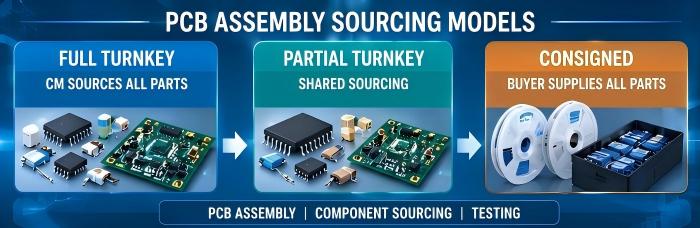
What does each model hand to the CM?
The real difference is who owns the BOM after the Gerbers and the parts list leave your desk.
In full turnkey, the CM buys every component, manages shortages and substitutions (with your approval), builds, tests and ships. You review the BOM and approve alternates. You do not hold inventory.
In partial turnkey, you supply a defined subset of parts and the CM buys the rest. The subset is typically the expensive, long-lead or allocation-controlled ICs, plus anything your customer specifies by approved vendor. Passives, connectors and other commodity parts go to the CM.
In consigned assembly, you supply every component. The CM provides the line, the process engineering and the test, and nothing else. You are your own purchasing department, and you are responsible for kit completeness when it lands at the dock. Our consigned assembly service works on this basis.
One thing people miss is that the bare board is a separate question. Because we manufacture PCBs ourselves, fabrication can sit with us in any of the three models, and it usually does. What changes between models is the component side only.
Which model fits which project stage?
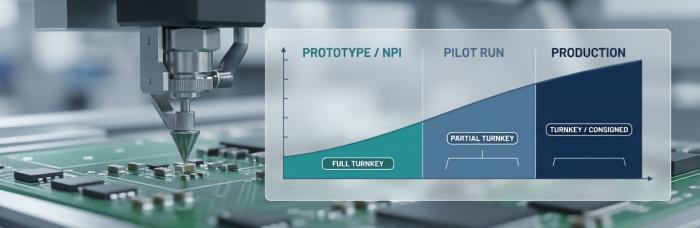
Early prototypes lean toward full turnkey, because the BOM is still moving and nobody wants to be the person re-ordering a footprint-changed connector at 4 pm on a Thursday. When a revision changes three parts, a CM that owns the purchasing can react the same day. If you own the kit, every spin means new purchase orders, new receiving and new counting on your side.
The exception is a prototype built from a handful of parts you already have on the shelf from an evaluation board or a previous build. Consigned works there because the BOM is short and you know exactly what is in the bag. We would not recommend it once the BOM passes the point where one person can reconcile it by hand.
Pilot and early production runs are where partial turnkey earns its place. By then you have normally learned which two or three parts cause all the supply pain. You buy those through your own channel, or lock them with a distributor agreement, and hand the CM the commodity remainder. You keep control of the parts that can stop the line and drop the paperwork on the parts that never do.
Steady production runs tend to settle into one of two patterns. Either the CM runs a stable full turnkey BOM with agreed approved vendors, or the buyer has a framework agreement with a manufacturer or distributor and keeps consigning those parts. Both work. The pattern that fails is a hybrid nobody wrote down, where each side assumes the other is covering a part.
High-mix, low-volume work adds a wrinkle. When you release many small orders across several board types, shared components can be bought once and spread across jobs, which is awkward to do in a consigned model because each kit must be complete for its own job. That is one reason HMLV programs drift toward turnkey over time even when they began as consigned.
How much procurement capacity do you have in-house?
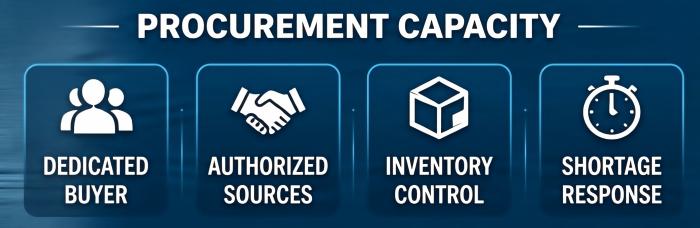
Ask this before you ask anything about price. A consigned or heavily partial model only saves money if someone on your side can actually run the purchasing.
Honest signs you can handle consigned or a large consigned share:
A named buyer who handles electronic components, not a generalist who also orders office supplies
Accounts with authorized distributors or direct manufacturer agreements, so you are not shopping the open market under deadline
A receiving process that counts and labels reels, tracks lot and date codes and stores moisture-sensitive parts correctly
A way to reorder a shortage within the build window, not after the CM tells you the kit is short
If you cannot tick most of those, full turnkey will probably cost you less in practice, even if the line-item component prices look higher. The saving you thought you had on parts gets eaten by expedited freight, idle build slots and the engineer who spent a week on the phone with a broker.
There is also a capacity question on the paperwork side. A consigned kit comes with a packing list, and someone has to reconcile it against the BOM before the build is released. We would rather catch a missing reel at kit review than halfway through the SMT run. A completeness check before release is normal practice, and the cost of skipping it is borne by whoever owns the schedule.
For partial turnkey, the test is narrower: can you reliably deliver the specific parts you take on? If your supplied list is five ICs and you have orders placed for all five, fine. If it is forty parts and half are "in the mail," you have built a consigned job without admitting it.
Who carries the component risk?
Risk is where the three models differ most, and where buyers tend to underestimate what they are signing up for.
Availability and lead time. In turnkey, the CM's purchasing team works the shortage. We do not promise a particular lead time, because that depends on what the market does with your specific parts. What you get is a single party working the problem with visibility across the BOM. In consigned, a shortage is entirely yours, and the line waits for you. See our components sourcing page for how we approach the buy side.
Authenticity. Whoever buys from the open market carries counterfeit exposure. In consigned, that is you. In turnkey, it is the CM, and you should still ask where parts are bought and keep your approved vendor list explicit. For safety-sensitive or long-life products, name the channels you accept in writing.
Overage and attrition. SMT lines lose a few parts to pickup errors, feeder changes and setup. How many spares a kit needs depends on package type and the placement process, so confirm with our engineering team before you finalize a consigned kit quantity. A kit with zero overage on 0402 passives is a kit that will come up short.
Obsolescence and excess stock. In turnkey, minimum buy quantities and leftover reels follow the commercial terms you agree on, so settle that before the first order, not after. In consigned, leftovers are yours by default, and so is the storage.
Liability for supplied parts. If a consigned part is defective or mislabeled, the build and rework cost starts with the question of who bought it. Spell out in the order what happens to boards built with a bad consigned lot. This conversation is much easier before the build than after.
Decision matrix
| Factor | Full turnkey | Partial turnkey | Consigned |
|---|---|---|---|
| Who buys components | CM | Split, by agreed list | Buyer |
| Best project stage | Prototype, NPI, HMLV with changing BOMs | Pilot and early production | Stable production with existing supply, or tiny builds from stock |
| Buyer procurement load | Low | Medium, limited to supplied parts | High |
| Shortage handling | CM works it, you approve alternates | Split: you own your parts, CM owns the rest | Buyer only |
| Counterfeit exposure | Sits with CM purchasing, set approved channels in writing | Split by supplied list | Buyer |
| Overage and attrition | Handled in CM purchase | Handled for CM-bought parts, buyer plans for own | Buyer must plan; confirm with our engineering team |
| Leftover stock | Per commercial terms | Buyer's parts return to buyer | Buyer |
| Typical failure mode | BOM changes late without notice | Unwritten split of who buys what | Incomplete kit stalls the line |
Use it as a screening tool, not a verdict. If two columns tie for you, pick the one where the failure mode in the last row is least likely to hit your team.
Putting it into practice
A workable sequence for most buyers: start the first builds in full turnkey, mark in the BOM which parts have caused supply trouble, then decide at pilot stage whether to pull those into a supplied list. Moving from full to partial is a small step. Moving from consigned back to turnkey after a kit shortage is a larger one, because the BOM then needs full sourcing under time pressure.
Whatever you choose, write the split down in the order: which parts are supplied by whom, what overage is included, where the kit ships, and who owns leftover stock. Most disputes we see between buyers and assemblers trace back to an assumption that was never on paper.
FAQ
Can I switch models between build batches?
Yes, and many buyers do. Tell the engineering team at order time which parts move, so the BOM and the kit review reflect the new split instead of the old one.
If I consign parts, can the CM still buy the missing ones?
That is a partial turnkey arrangement. Agree in writing which parts are on your list and which are on ours, and who approves a substitute if a supplied part runs short.
Does consigned assembly lower my cost?
Only if your purchasing is better than the CM's for those parts and you can absorb the receiving, storage and shortage handling. Count those hours before comparing line-item prices.
Who decides on alternates in turnkey?
You do. The CM proposes a substitute with the reason, and nothing changes in the build until you approve it. Keep the approval trail with the BOM revision.
What should I include with a consigned kit?
A packing list that matches the BOM, reels and trays labeled with the manufacturer part number, and moisture-sensitive parts sealed and marked. Ask our engineering team about overage per package type before you ship.
Helpful Resources
• What's the Difference Between Consignment and Turnkey Assembly, and Which Is Cheaper?
• Are the Components Genuine, and How Is Authenticity Verified?
• Mitigating Moisture Sensitivity Level (MSL) Risks in High-Density SMT Assembly
• Component Shortage Contingency for Long-Lifecycle Industrial & Medical Devices


