



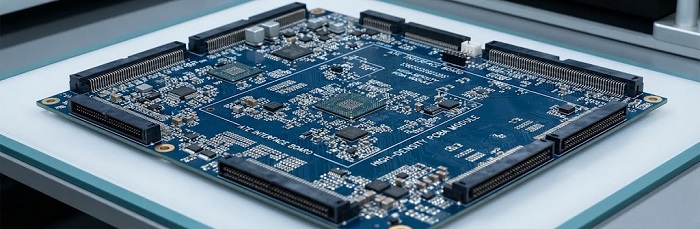
Semiconductor test equipment — ATE handlers, probe card interface boards, wafer-level test fixtures, burn-in boards — carries a different documentation burden than most industrial PCBA. A board failure doesn't just cost a repair; it can invalidate a test cell's calibration record or force a re-screen of parts that already shipped downstream. For OEMs in this space, semiconductor OEM quality documentation isn't paperwork attached to the product — it's part of the product's qualification file.
This guide covers the test equipment manufacturing records an ATE OEM should require, what traceability granularity is realistic, and how to structure the handoff so records are usable, not just archived.
What Manufacturing Records Should an ATE OEM Actually Require?
Most quality agreements default to generic "keep records for X years" language. That's not specific enough for test equipment boards. Three categories matter more than a retention period alone.
Lot and batch traceability. Every component lot should be traceable back to its date code, manufacturer lot number, and receiving inspection record — particularly for precision passives and reference components where a lot substitution can shift calibration behavior, connectors and sockets where a supplier change affects contact resistance on high-cycle-count fixtures, and any component under an approved vendor list (AVL) restriction, where the OEM should be able to confirm the as-built board matches the qualified AVL revision.
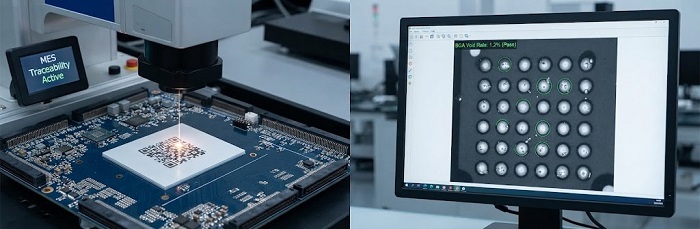
Test and inspection data. This is the category OEMs most often under-specify: Automated Optical Inspection (AOI) pass/fail records, Solder Paste Inspection (SPI) volume and offset data, X-ray inspection records for BGA/QFN joints including void-rate imaging, and in-circuit or functional test logs tied to the board serial number. Which of these need raw data versus a summary, and at what granularity, depends on the board — covered in the checklist below.
Change and deviation records. Any engineering change — a component substitution, a process parameter adjustment, a rework — needs a documented record tied to the affected date range or lot, not just a general changelog. This matters more for test equipment boards than most product types: if a fleet of test cells shows correlated drift, a dated, lot-linked change history is what lets an OEM narrow the cause to a specific build window instead of treating it as a fleet-wide unknown.
What ATE Board Traceability Requirements Can a PCBA Partner Actually Provide?
OEMs should ask precise questions here rather than accepting "we have full traceability" at face value. Granularity generally falls into two practical tiers.
Serial-number (SN) level traceability ties each board's own inspection results, test data, and component genealogy to a unique identifier, typically laser-marked and captured at each process step. This depends on an MES capable of assigning and tracking a unique ID per board, as covered in our MES Traceability Architecture for IEC-Regulated Industrial Electronics overview, so placement, inspection, and test data roll up to that specific unit rather than the panel or lot. This is the level needed when a single unit's failure requires root-cause isolation, or when the OEM wants to correlate field returns to a specific build date or equipment run.
Batch/lot-level traceability maintains the same component lots, process settings, and inspection sampling plan across a production batch rather than per unit. This fits lower-criticality boards — power distribution boards, non-signal-path interface boards — and cost-sensitive programs where SN-level tracking isn't justified by the failure-mode risk.
The public IPC-1782 standard ("Standard for Manufacturing and Supply Chain Traceability of Electronic Products") is a useful reference point here: it lays out four tiers of traceability, from basic documented practice up to comprehensive component-level tracking, with the tier set by agreement between customer and supplier based on the application's risk profile — a reasonable way to decide, board by board, which tier justifies its cost.
Scope note: PCBCart holds IATF 16949 certification, which governs our quality management system and change-control discipline. We do not hold ISO 13485 or any semiconductor-industry-specific certification, and we scope traceability commitments to what our MES and inspection systems can actually support — not to a standard we haven't been certified against.
How Should Documentation Formats and Retention Be Agreed With the OEM's Quality System?
A traceability system is only useful if the OEM's quality team can actually consume the output. This is usually the weakest link in practice — not because the data isn't collected, but because format and retention were never explicitly agreed before production started.
Points worth settling at the quality agreement stage, before the first build:
File format. Raw AOI/SPI/X-ray images and pass/fail logs can be exported in various formats; agree up front whether the OEM needs raw files, summary reports, or both. Our DFM Audit Checklist for Industrial PCBA covers how this maps back into the design review stage.
Retention period. A specific number, written into the quality agreement or PO terms — not assumed.
Escalation trigger. Define what triggers proactive notification versus what stays in the internal record for retrieval on request (see checklist below for concrete thresholds).
Access method. Whether records are pushed at ship time (a traveler packet per lot or serial number) or held for retrieval on request, since "on request" without a defined response time tends to break down when it matters most.

Documentation Requirements Checklist Template
For each category below, the quality agreement should fix the granularity, format, retention period, and notification trigger — decided against the criteria noted, not left open.
Component lot traceability — Default to SN-level for boards carrying an AVL-restricted or calibration-sensitive component; batch-level is acceptable only where no single component is failure-critical. AVL-restricted parts additionally need as-built revision confirmation.
AOI inspection data — Require raw defect images for boards where post-ship failure analysis is plausible; summary reports alone are workable where a fail simply triggers a repeat build.
SPI inspection data — Raw volume/offset data matters for fine-pitch and BGA-populated boards, since paste-volume drift is a leading precursor to voiding; skip it for through-hole-dominant boards.
X-ray inspection records — Require void-rate imaging on any BGA/QFN joint feeding a thermally cycled application; state which void-rate reference standard governs accept/reject, as covered in our BGA Void Rate Acceptance Reference.
In-circuit/functional test logs — Tie logs to board SN whenever the board sits in the signal path; full parametric data is worth the storage cost only where fleet-wide drift analysis is a realistic need.
Engineering change records — Require the record to reference the specific lot or date range affected — a changelog without a bounded scope can't answer "which units does this touch."
Deviation/rework records — Proactive notification should be default for anything touching an AVL-restricted component; retrieval-on-request is acceptable for rework within documented IPC-A-610 limits.
The common failure mode isn't omitting a category — it's leaving the threshold (which boards, which risk level) undefined until a dispute forces the question.
FAQ
What retention period should we specify for inspection records?
There's no universal figure — it should be set based on the fielded lifetime of the test system and written explicitly into the quality agreement rather than assumed.
Can traceability granularity be mixed within a single board assembly program?
Yes — SN-level tracking on high-value or signal-path boards and batch-level tracking on lower-criticality boards, defined per board type in the quality agreement.
What happens if an OEM needs a documentation format we haven't used before?
Raise it at the quotation or DFM review stage, so format and file structure are set before production starts.
Helpful Resources
Component Shortage Contingency for Long-Lifecycle Industrial & Medical Devices
IPC-A-610 Class 3 Visual Inspection Guide for Industrial & Medical Assemblies
ESD Control Protocols in PCBA Assembly for Sensitive Medical Sensor Boards


