



In the manufacturing and deployment of high‑reliability electronic systems, early‑life failures—often called infant mortality failures—represent one of the most costly and reputation‑damaging risks. These failures occur shortly after a product enters service, typically caused by hidden manufacturing defects, marginal components, or material weaknesses that remain undetected under normal operating conditions. Burn‑in testing has emerged as a foundational reliability screening process designed specifically to identify, accelerate, and eliminate these defects before products reach end users, especially in mission‑critical applications where downtime or malfunction can lead to severe consequences.
Understanding Infant Mortality and the Bathtub Curve
Electronic devices and assemblies follow a well‑documented failure pattern known as the bathtub curve, which plots failure rate against service life. This curve is divided into three distinct regions:
1. Infant Mortality Region: High but decreasing failure rate immediately after deployment, driven by latent manufacturing flaws, imperfect packaging, and low-quality marginal components.
2. Useful Life Region: Low, relatively constant failure rate caused by random, unpredictable operational events rather than systematic production defects.
3. Wear‑Out Region: Rising failure rate as components degrade over long-term operation due to natural material aging and fatigue.
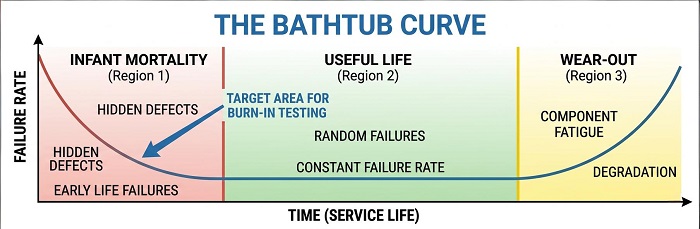
Burn‑in testing directly targets the first and most problematic failure stage. By subjecting finished electronic assemblies and components to controlled accelerated stress conditions, manufacturers force weak or defective units to fail during in-house testing rather than field operation. This effective screening process eliminates infant mortality failures, ensuring only qualified, stable products enter the market and transition smoothly into the reliable useful-life phase. For aerospace, medical, automotive, industrial, and telecommunications electronics where stable long-term operation is essential, burn-in testing serves as a core quality assurance procedure.
How Burn‑In Testing Works
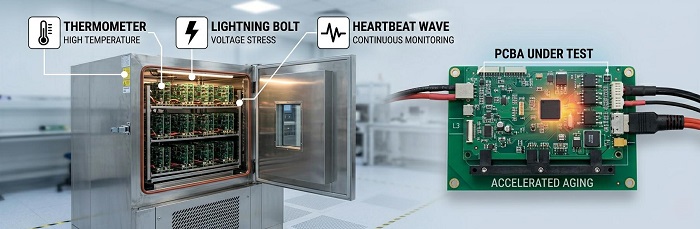
Burn‑in testing operates on the fundamental principle of accelerated aging, compressing months or years of standard field operation into a short, controlled testing cycle. Manufacturers apply calibrated elevated stressors to activate latent defects that remain dormant under regular working conditions. Common industrial stress parameters include elevated operational temperatures, moderate overvoltage, and continuous static or dynamic electrical loads.
During standard workflows, tested units are mounted on professional burn-in boards and placed inside temperature-stabilized environmental test chambers. Devices run continuously under predefined stress conditions for standardized durations, ranging from 8 to 48 hours for consumer electronics, and extending up to 168 hours for high-reliability industrial products. Throughout the entire testing cycle, engineers monitor core electrical performance, functional stability, and thermal status of devices under test.
Industry burn-in tests fall into two primary categories to adapt to diverse product requirements:
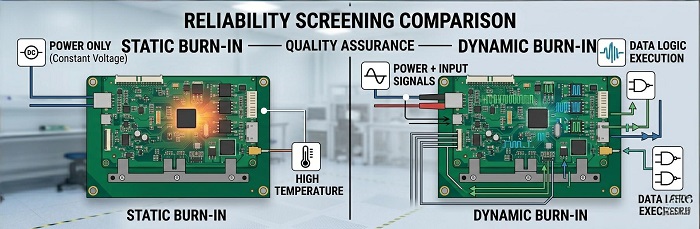
Static Burn-in: A cost-effective, widely applicable testing method that exposes powered-on devices to constant high temperature and rated voltage without active operational tasks. This method efficiently screens basic material defects and packaging flaws for most standard PCB assemblies.
Dynamic Burn-in: A rigorous testing mode that runs devices with real-time operational programs and input stimuli under stressed thermal and electrical conditions. It exercises more internal circuit structures to expose subtle design and assembly vulnerabilities, ideal for high-performance critical electronics.
Key Benefits of Burn‑In Testing for Critical Electronics
As a standardized reliability screening procedure, burn-in testing delivers tangible technical and commercial advantages for electronic product manufacturing:
1. Improved Long-Term Product Reliability
By eliminating infant mortality failures in advance, burn-in testing significantly reduces early field malfunction risks. Screened electronic assemblies maintain stable performance throughout their service life, meeting basic reliability requirements for commercial, industrial, and automotive electronic applications.
2. Optimized Lifecycle Cost Control
Though burn-in testing adds moderate upfront production costs, it avoids substantial follow-up losses including product returns, warranty compensation, on-site maintenance, and batch product recalls. For mass-produced electronic products, this screening process effectively controls overall operational and after-sales costs.
3. Stable Brand Credibility and User Trust
Products free of early-life operational failures deliver consistent user experiences. Strict burn-in quality screening helps manufacturers reduce customer complaints, stabilize market reputation, and build long-term user loyalty.
4. Data-Driven Manufacturing Optimization
Failure data recorded during burn-in testing accurately exposes recurring flaws in PCB assembly, component welding, and component selection. Engineering teams can leverage these data insights to optimize assembly processes, adjust component sourcing standards, and continuously improve overall production quality.
Challenges and Modern Optimizations of Burn-In Testing
Despite its irreplaceable quality value, burn-in testing has inherent limitations. The testing procedure is time-consuming and requires professional testing equipment and standardized operating workflows. Excessively high stress settings may cause unnecessary wear on qualified products and reduce their inherent service life. In addition, long testing cycles may slightly slow down production turnaround for urgent orders.
Modern manufacturing teams optimize burn-in workflows through multiple practical methods. Manufacturers adopt precise stress parameter calibration based on product application scenarios to balance defect screening efficiency and product protection. Combined auxiliary testing methods including automated optical inspection (AOI) and functional testing assist burn-in screening, shortening redundant testing cycles while ensuring full defect coverage. Automated testing equipment also reduces manual operation errors and improves testing consistency and production throughput.
Industry Application of Burn-In Testing
Burn-in testing is a universal quality standard for high-value and mission-critical electronic products. In automotive electronics, it ensures the stability of vehicle control and auxiliary electronic systems under complex road and temperature conditions. In industrial automation, it guarantees 24/7 stable operation of factory control circuit boards. In consumer high-end electronic devices and telecommunication equipment, burn-in screening effectively reduces after-sales failure rates and improves product market competitiveness.
PCBCart: Reliable PCB Manufacturing & Standardized Burn-In Testing Service
Quality reliability screening is the core guarantee of qualified PCB products. As a professional one-stop PCB manufacturing and assembly service provider, PCBCart delivers standardized, customer-oriented burn-in testing services matching real industrial demands, strictly following mainstream industry quality specifications.
PCBCart’s verified burn-in testing capabilities include:
- Professional static and dynamic burn-in testing applicable to diverse PCB assembly products, supporting customized testing durations and standard stress parameters based on customer project requirements.
- Standard quality compliance aligned with mainstream industry norms, matching the quality requirements of commercial, industrial, and automotive-grade electronic products.
- Comprehensive auxiliary quality inspection procedures, including AOI inspection, functional testing, and visual dimensional verification, cooperating with burn-in testing to achieve full-range product quality screening.
- Complete test data recording and standardized test reports, enabling customers to track product quality status and meet project quality audit demands.
Focused on reliable PCB fabrication and assembly, PCBCart integrates rigorous burn-in reliability screening into every batch of qualified products. We eliminate infant mortality failures through standardized testing workflows, helping global customers obtain stable, high-quality PCB assemblies and reduce product after-sales risks, delivering trustworthy one-stop electronic manufacturing solutions.
Helpful Resources
• How to Implement Quality Inspection of PCBs
• Printed Circuit Board Assembly Inspection Methods
• Inspections and Tests Applied in SMT Assembly Process
• How to Ensure the Quality of PCBs


